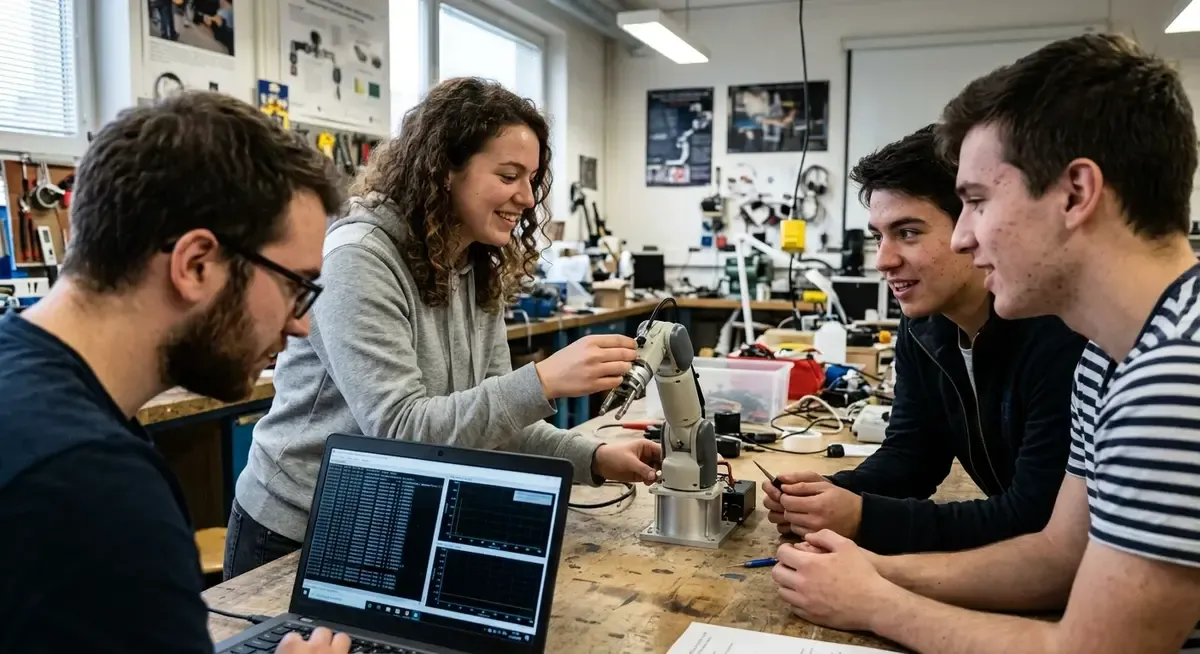
Editorial illustration for Newest AI Quest Maps the Human Brain, Builds on Fruit Fly Brain Map
AI Quest Maps Human Brain, Builds on Fruit Fly Study
Google Research and the Stanford Accelerator for Learning released "Polar Peaks" on Tuesday, the third installment in their AI Quests series built for students ages 11 to 14. The program has logged more than 400,000 completed quests across 10 languages since launch, and this new chapter sends students into the field of connectomics, the science of mapping neural networks in the brain. Where the first two quests put students to work on flood forecasting and diabetic retinopathy screening, modeled on actual Google Research projects, Polar Peaks asks them to scan and map neurons to figure out why a game character is losing their memory.
The quest draws on more than ten years of Google's connectomics research, including the recent full mapping of the fruit fly brain, the largest neuron-count brain map produced so far. Students handle tasks like data cleaning and model testing under the direction of in-game mentors, picking up a sense of why AI systems still need human judgment at every step. Google is also rolling out training modules for teachers alongside the quest. After finishing, students hear directly from two researchers who worked on the underlying science.
With the guidance of in-game mentors, students scan and map the neurons in the brain to better understand the game character’s memory loss. They complete tasks like data cleaning and model testing, learning firsthand that AI requires careful human oversight and critical thinking.
Why this matters
Google is betting that the fastest way to build an AI-literate workforce is to start kids on connectomics before they can drive. That's a long game, and it's worth watching for what it signals rather than what it ships. "Polar Peaks" leans on real research, the fruit fly brain map with its full neuron count, to give the exercise credibility it wouldn't have as a generic coding game. Four hundred thousand completions across 10 languages is a real number, not a vanity metric, and it tells us Google Research and the Stanford Accelerator for Learning have found a format that scales.
For researchers and founders, the interesting part isn't the classroom activity, it's the pipeline. Companies that control how the next generation learns to frame "AI problems" are shaping the assumptions those future engineers bring into labs and startups. Worth tracking whether the human brain mapping quest produces any actual research talent, or whether this stays a literacy exercise dressed up as science outreach.
Related Reading
 Research & Benchmarks
Microsoft AI Chief: "If It Isn't Safe We Shouldn't Build It
 Research & Benchmarks
Google's FACTS benchmark shows 70% factuality ceiling across four tests
 Research & Benchmarks
Nvidia's DLSS 4.5 beta adds 6x Multi Frame Generation for RTX 50 GPUs
 From Archives
iLands AI agents pitch WIRED for fact-checking, editor Vojdani says they spam
 From Archives
Stanford, UC Berkeley TokenGate Speeds Long-Context Prefill Up to 11.3x
Common Questions Answered
What is Polar Peaks and how does it fit into the AI Quests series?
Polar Peaks is the third installment in Google Research and Stanford Accelerator for Learning's AI Quests series, designed for students ages 11 to 14. Unlike the first two quests focused on flood forecasting and diabetic retinopathy screening, Polar Peaks introduces students to connectomics, the science of mapping neural networks in the brain.
How do students learn about connectomics through the Polar Peaks game?
Students work with in-game mentors to scan and map neurons in the brain while helping a game character understand memory loss. They complete practical tasks like data cleaning and model testing, learning that AI requires careful human oversight and critical thinking skills.
What real research foundation does Polar Peaks use to build credibility?
Polar Peaks is based on the fruit fly brain map with its full neuron count, which provides authentic scientific grounding for the educational exercise. This connection to real connectomics research gives the game credibility beyond a generic coding game.
How successful has the AI Quests series been since its launch?
The AI Quests series has logged more than 400,000 completed quests across 10 languages since launch, demonstrating significant global engagement. This substantial completion rate represents a meaningful metric of the program's reach and impact rather than just a vanity statistic.
Why is Google starting students on connectomics at such a young age?
Google believes that beginning AI literacy education early with connectomics is a strategic long-term investment in building an AI-literate workforce. By introducing complex neural mapping concepts to children before they can drive, Google is signaling a commitment to foundational AI education that will shape future generations of technology professionals.
Further Reading
- Google and HHMI Janelia Publish the Complete Fruit Fly Brain Connectome - Neurotech
- Microscopy and AI Decipher Fruit Fly Neural Architecture - Neuroscience News
- Scientists mapped a fruit fly’s brain. The internet made it play Doom - IBM Think
- Google Mapped a Fruit Fly’s Brain. Now It’s Playing Doom and Super Mario 64 - Gizmodo
- Scientists Complete Full Map of the Fruit Fly Central Nervous System - HHMI
