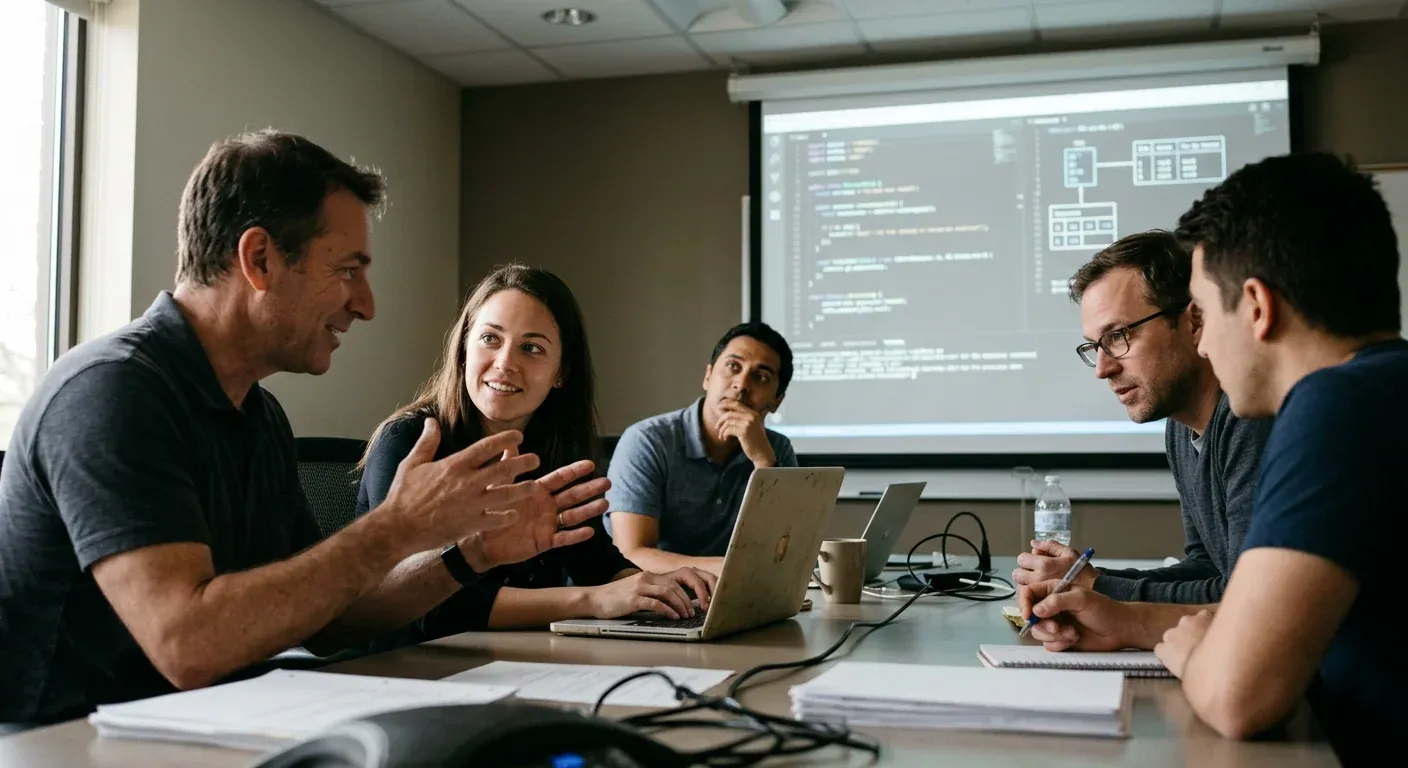
Editorial illustration for Open vs. Closed AI: Founders' Dilemma at TechCrunch Disrupt 2026
Open vs. Closed AI: The Startup Strategy Shift
Open vs. Closed AI: Founders' Dilemma at TechCrunch Disrupt 2026
Startups building on AI used to make one big bet: pick an architecture, usually open or closed, and live with it. That calculus has changed. Open-weight models have closed much of the gap with frontier APIs, those APIs keep getting better anyway, and a growing number of companies are routing tasks across several models instead of marrying one. The result isn't a cleaner decision, it's a more complicated one, with founders now weighing cost, performance, and how much flexibility they want to keep as the tools underneath them keep shifting.
At TechCrunch Disrupt 2026, that tension runs through four separate conversations, each looking at a different layer of the stack, from applications that juggle multiple models down to the infrastructure and chips that make any of it run. One of those sessions, "The Real Tokenmaxxing: How the Best AI Companies Navigate a Multi-Model World," puts the multi-model question directly to people building and investing in it: Mo Jomaa of CapitalG, Together AI's Vipul Ved Prakash, and Pathway's Zuzanna Stamirowska. Passes for Disrupt are discounted now, including a reduced rate for attendees affected by layoffs.
Frontier APIs keep advancing. Models can be customized for specific workloads, and some companies are building products that use multiple models rather than committing to one. That gives founders more ways to build — and more decisions about where to spend, what to own, and how much flexibility to preserve as the technology changes.
Why this matters
The open-versus-closed framing was never going to hold, and the Disrupt lineup confirms it. When Nvidia sends two people, one focused on developer tooling and one on VC partnerships, to the same stage, that's a signal about where the money and the infrastructure incentives actually sit. For founders, the real work now is architectural hedging: picking a default model while building the plumbing to swap in another when pricing, latency, or licensing terms shift. That's harder than a one-time build decision, and it means engineering time gets spent on abstraction layers instead of features.
For researchers and developers reading this, the takeaway isn't "open models are catching up" or "APIs are getting better." It's that multi-model architecture is becoming the default assumption, which changes what skills matter. Knowing how to orchestrate across providers may end up more valuable than deep expertise in any single model's quirks. We'd watch whether Nvidia's pitch at Disrupt is about enabling that flexibility or quietly steering founders back toward its own stack under the banner of choice.
Related Reading
 Open Source
 D&B rebuilds 642 million‑business database after AI agents hit limits
 Open Source
 Box CEO Aaron Levie Says AI Will Drive "Biggest Cybersecurity Upgrade
 Open Source
 Study: 6.7% of Deepfake Requests on Hugging Face Targeted Children
 From Archives
 Open Model apex-flash-1 Solves 40 of 60 Security Research Bug Tasks
 From Archives
 NASA, IBM Release Lunar Science Model Built on 17 Years of Orbiter Data
Common Questions Answered
How has the gap between open-weight models and frontier APIs changed for AI startups?
Open-weight models have closed much of the gap with frontier APIs, making the choice between them less clear-cut than it used to be. Additionally, frontier APIs continue to improve, and many companies are now routing tasks across multiple models rather than committing to a single architecture, which further complicates the decision-making process for founders.
What is architectural hedging and why is it important for founders building on AI?
Architectural hedging involves picking a default model while building the infrastructure to swap in another model when pricing, latency, or licensing terms shift. This approach allows founders to maintain flexibility as the AI technology landscape evolves and market conditions change, rather than being locked into a single solution.
What are the key factors founders must now weigh when choosing between open and closed AI models?
Founders must balance cost, performance, and how much flexibility they want to preserve as the technology changes. The decision is no longer a simple binary choice but a more complicated calculation that involves considering multiple models and the ability to switch between them based on business needs.
How are companies using multiple models instead of committing to one architecture?
A growing number of companies are routing tasks across several models rather than marrying one, allowing them to optimize different workloads with different solutions. This multi-model approach gives founders more ways to build products while maintaining the flexibility to adapt as frontier APIs advance and new options become available.
Further Reading
- Papers with Code - Latest NLP Research - Papers with Code
- Hugging Face Daily Papers - Hugging Face
- ArXiv CS.CL (Computation and Language) - ArXiv
