
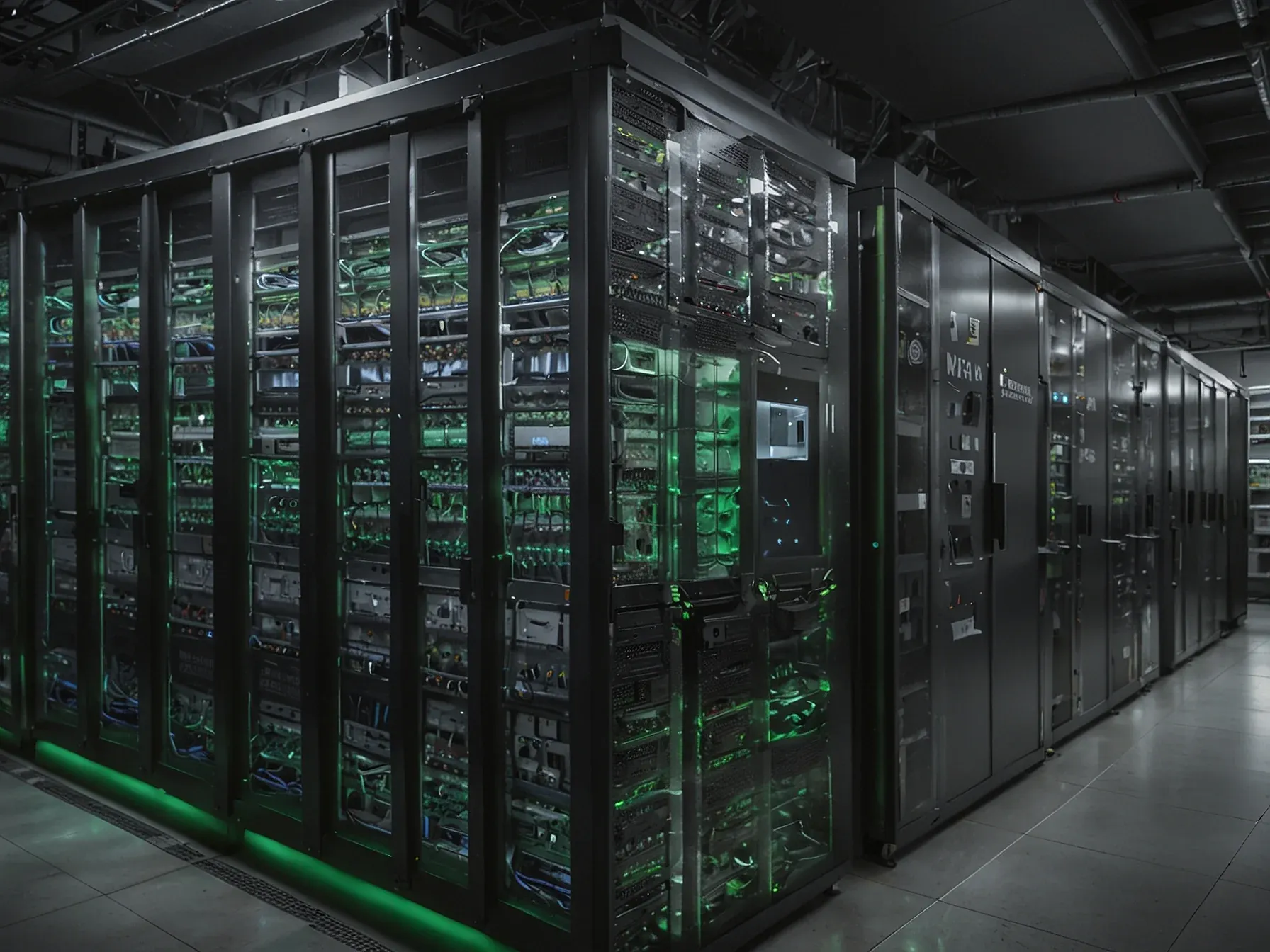
Editorial illustration for NVIDIA tops AA‑AgentPerf benchmark, credits Vera Rubin platform
NVIDIA tops AA‑AgentPerf benchmark, credits Vera Rubin...
Leaderboards are usually marketing noise. This one is different. NVIDIA just topped the first major benchmark for AI agent performance, and the margin isn't close.
The GB300 NVL72 system posted up to 20 times the agentic coding performance of its competition. That's the kind of number that rewrites a product category. NVIDIA's next move is already named: the Vera Rubin platform.
AA-AgentPerf establishes the standard for evaluating agentic inference, and the results highlight how tightly integrated hardware and software can unlock step-function gains in concurrency and efficiency. NVIDIA GB300 NVL72 demonstrates up to 20x higher agentic coding performance.
The benchmark win is a tactical victory. Vera Rubin is the strategic play. It promises 50 petaflops of a new compute type, NVFP4, plus a specialized CPU designed to handle the messy, tool-calling chaos of real AI agents.
This isn't about running a model faster. It's about rebuilding the system around a new assumption: that AI inference is no longer a single question and answer, but a chain of reasoning, lookups, and actions. Latency compounds.
Bottlenecks multiply. NVIDIA is betting its architecture can tame that complexity where general-purpose systems falter.
The benchmark proves they can win a sprint. The platform aims to own the marathon.
Related Reading
 Research & Benchmarks
 Microsoft AI Chief: "If It Isn't Safe We Shouldn't Build It
 Research & Benchmarks
 Google's FACTS benchmark shows 70% factuality ceiling across four tests
 Research & Benchmarks
 Nvidia's DLSS 4.5 beta adds 6x Multi Frame Generation for RTX 50 GPUs
 Related Topic
 NVIDIA NeMo powers telco reasoning model for autonomous network workflows
Industry Applications
 Related Topic
 China offers cheaper electricity to AI firms abandoning NVIDIA chips
Business & Startups
 From Archives
 Perplexity routes deep‑research subtasks across 20+ models using Gemini agent
 From Archives
 Visual model exploits similarity of 打, 拍, 拉; text model starts from embeddings
 From Archives
 MiniMax M3 runs on NVIDIA hardware with 8‑way tensor parallelism and FLASHINFER
AI Tools & Apps
 From Archives
 Run DiffusionGemma on NVIDIA GPUs for high‑throughput text generation
LLMs & Generative AI
Common Questions Answered
What performance advantage did NVIDIA's GB300 NVL72 system achieve in the AA-AgentPerf benchmark?
NVIDIA's GB300 NVL72 system posted up to 20 times the agentic coding performance of its competition in the benchmark. This significant margin demonstrates a substantial leap in AI agent performance capabilities compared to competing systems.
What is the Vera Rubin platform and what computing resources does it provide?
The Vera Rubin platform is NVIDIA's next-generation system that promises 50 petaflops of a new compute type called NVFP4, along with a specialized CPU designed to handle the tool-calling requirements of real AI agents. It represents a strategic shift in how systems are architected for AI inference workloads.
How does the Vera Rubin platform's approach to AI inference differ from traditional systems?
Rather than optimizing for running a single model faster, Vera Rubin rebuilds the system around the assumption that AI inference involves a chain of reasoning, lookups, and actions rather than just a single question and answer. This approach addresses how latency compounds and bottlenecks multiply in complex agentic workflows.
Why is the AA-AgentPerf benchmark considered significant compared to other AI leaderboards?
According to the article, most leaderboards are typically marketing noise, but the AA-AgentPerf benchmark is different because it represents the first major benchmark specifically for AI agent performance. NVIDIA's decisive victory with a 20x performance margin suggests this benchmark meaningfully measures a critical new category of AI capabilities.
Further Reading
- NVIDIA Vera Rubin Ramps Into Full Production to Power Agentic AI Factories Worldwide — NVIDIA Newsroom
- How the NVIDIA Vera Rubin Platform is Solving Agentic AI's Scale-Up Problem — NVIDIA Developer Blog
- NVIDIA unveils Vera Rubin AI platform for next-gen agents — Ynetnews
- Vera Rubin – Extreme Co-Design: An Evolution from Grace Blackwell — SemiAnalysis
- Infrastructure for Scalable AI Reasoning | NVIDIA Vera Rubin Platform — NVIDIA
