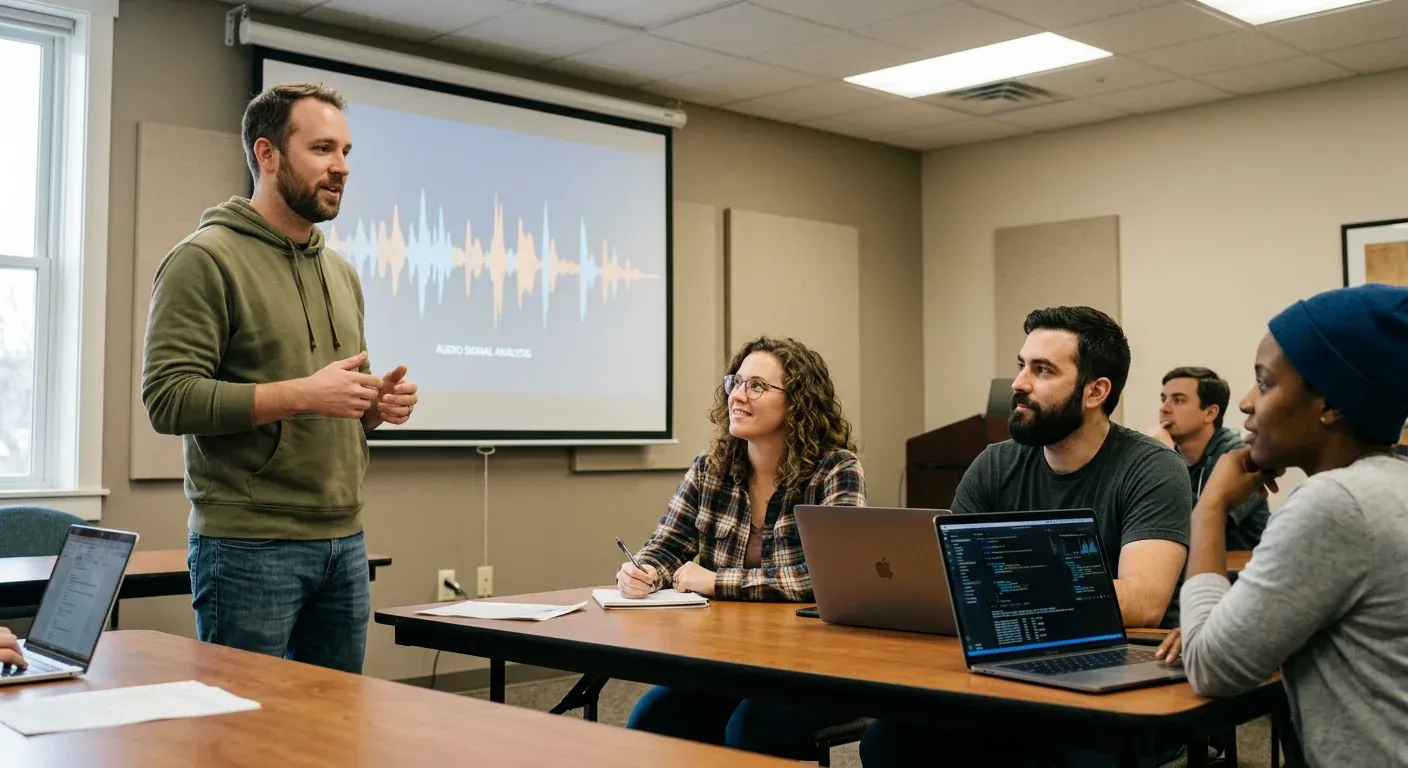
Editorial illustration for Nvidia releases new open transcription model to recognize industry jargon
Nvidia releases new open transcription model to...
Nvidia put out a new transcription model Wednesday, Nemotron 3.5 Transcribe, and it's free to use with open weights. The company paired it with version 2 of Granary, its open-source speech dataset, giving developers both the model and the raw material to retrain it on specialized vocabulary. Nemotron 3.5 handles 40 languages for transcription and can translate 31 of them to and from English. It processes recordings up to an hour long and separates up to eight speakers in a conversation, which matters for anyone building tools around business meetings or medical dictation, two spaces where AI has already found steady work.
Nvidia says the model beats competitors on Hugging Face's Open ASR Leaderboard, though it only works on recorded audio rather than live streams. At 30 billion parameters, Nvidia claims it still runs on a single chip, scaling from the Jetson AGX Thor robotics controller up to Blackwell datacenter hardware. It joins the company's existing lineup of open voice models, including the much smaller Parakeet.
The timing isn't incidental. Mistral released Voxtral 3 earlier this month, ElevenLabs launched a real-time speech product for voice agents, and Salesforce put out its own voice model, Launa-Omni.
Nvidia on Wednesday released Nemotron 3.5 Transcribe, a free, open-weight model that transcribes audio in up to 40 languages. It also released version 2 of Granary, its open-source speech dataset.
Why this matters
For developers building meeting bots, call-center tools, or industry-specific apps, the pitch here is customization: a 30-billion-parameter model plus the Granary dataset and NeMo tooling to teach transcription systems the difference between, say, a cardiologist's shorthand and a lawyer's. That's a real gap in most off-the-shelf speech models, which choke on jargon no matter how good they are at everyday English. Open weights and 40-language coverage make this worth testing against whatever you're currently running, especially if you've been stitching together Whisper variants to handle niche vocabulary.
But the live-stream limitation is a real constraint, not a footnote. If your product needs real-time captioning or transcription during an actual call, Transcribe doesn't solve that today. It's built for post-hoc processing: recordings, meeting notes, batch jobs.
Nvidia's benchmark claims against Hugging Face's Open ASR Leaderboard are worth independent verification before anyone rearchitects a pipeline around them. Watch whether Nvidia or the community ships a streaming version, and whether the jargon-tuning workflow is actually as simple as Nvidia suggests once outside developers start poking at it with real audio.
Related Reading
 Open Source
D&B rebuilds 642 million‑business database after AI agents hit limits
 Open Source
Box CEO Aaron Levie Says AI Will Drive "Biggest Cybersecurity Upgrade
 Open Source
Study: 6.7% of Deepfake Requests on Hugging Face Targeted Children
 Related Topic
NVIDIA and Google Cloud let developers scale AI from prototype to production
Market Trends
 Related Topic
NVIDIA NeMo powers telco reasoning model for autonomous network workflows
Industry Applications
 From Archives
FlashMap Flow Mapping Speeds LLM Decoding by 6.14x, Cuts GPU Hours
 From Archives
AI Agents Shift Experts’ Judgment on Critical Decisions
 From Archives
Install NVIDIA Nemotron v0.2.0 Locally to Fine-Tune It for Local Rules
LLMs & Generative AI
 From Archives
NVIDIA RTX Spark Adds Native ARM64 and UE 5.8 Support for DLSS Projects
LLMs & Generative AI
Further Reading
- Voice AI in vogue: Nvidia releases new open transcription model - TechCrunch
- NVIDIA Nemotron 3.5 Transcribe and Granary v2: Intelligent Multilingual Transcription You Can Prompt and Adapt - Hugging Face
- NVIDIA Nemotron Speech - NVIDIA Perspectives
- Nemotron 3.5 ASR Streaming - Hugging Face
