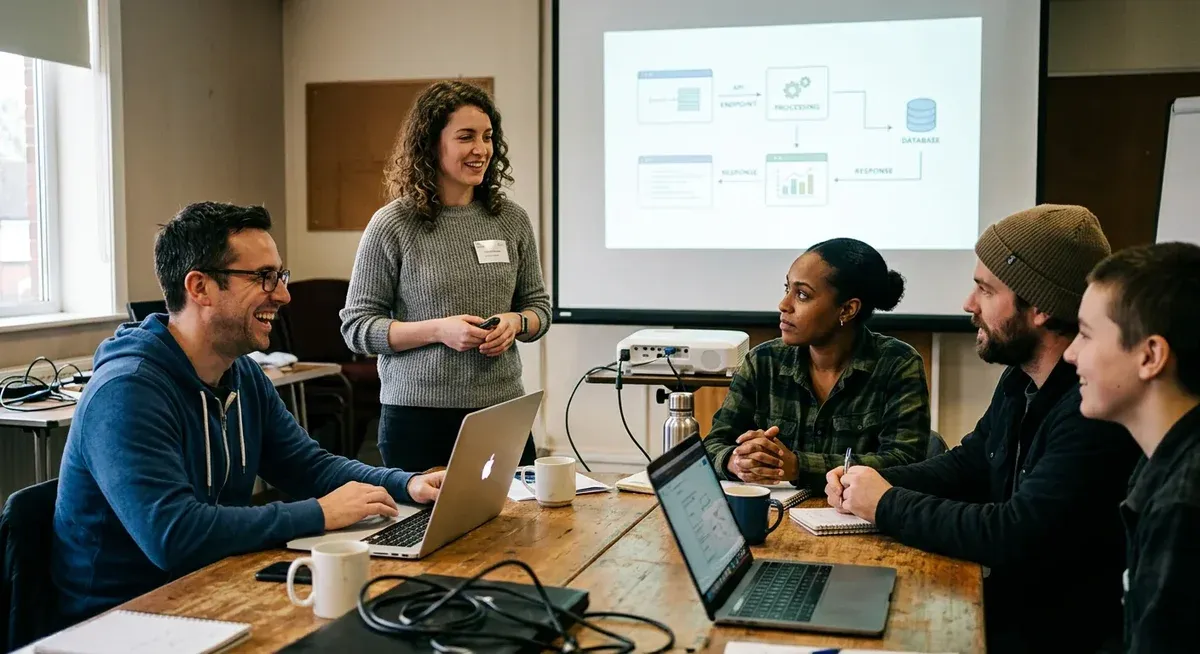
Editorial illustration for NanoClaw Brings Teams of Custom AI Agents to Slack
NanoClaw Brings Custom AI Agent Teams to Slack
NanoCo. wants to fix a problem most enterprise Slack users already know firsthand: bolting an AI agent onto a company workspace usually turns into a mess of custom bots, half-working integrations, and one bland assistant pretending to be several people. The company's flagship product, NanoClaw, an open source and enterprise-friendly agent harness built as a more sandboxed, lower-code alternative to OpenClaw, is now landing directly inside Slack.
The pitch is simple. Type one message, and instead of getting a single generic bot, you get an entire roster of agents, each with its own skill set, workflow, and avatar, ready to work inside channels and shared Canvases.
The integration also breaks agents out of Slack entirely. NanoCo says these same AI colleagues can be reached on Telegram or WhatsApp, so a team member can ping an agent the same way they'd message a human coworker, regardless of which app they're using. NanoCo CEO and co-founder Gavriel Cohen told VentureBeat in an exclusive interview that this marks a shift in how agents show up inside workplace tools, one where identity, not just function, becomes part of the product.
"In the next 12 to 18 months, everyone on a team will be a manager of agents," NanoCo CEO and co-founder Gavriel Cohen told VentureBeat in an exclusive interview.
Why this matters
For teams evaluating AI agents at work, NanoClaw's pitch is really about friction, not intelligence. The bar it's clearing isn't "can an agent reason well" but "can a non-technical employee spin one up without opening a terminal." That's a lower bar than the industry usually advertises, and it's telling that a Slack message and a generated avatar are the selling points, not model benchmarks. The detail worth watching is that these bots keep running on the customer's own infrastructure, connected over Socket rather than living inside Slack's servers.
That's a meaningful design choice for anyone worried about data residency or shadow IT, since it means provisioning is easy but governance still has to be built by the people deploying it. If NanoCo has actually solved the "clunky in practice" problem VentureBeat describes, other agent platforms will feel pressure to match the one-message setup. If it hasn't, expect the usual gap between marketplace listing and Monday-morning reality.
Worth testing before trusting the avatar.
Related Reading
 Open Source
 D&B rebuilds 642 million‑business database after AI agents hit limits
 Open Source
 Box CEO Aaron Levie Says AI Will Drive "Biggest Cybersecurity Upgrade
 Open Source
 Study: 6.7% of Deepfake Requests on Hugging Face Targeted Children
 From Archives
 Slack Introduces Collaborative AI Coding Channels
 From Archives
 AI Teaches Robots New Tasks With 83% Success After 10 Steps
Common Questions Answered
What problem does NanoClaw solve for enterprise Slack users?
NanoClaw addresses the common issue of multiple custom bots and half-working integrations cluttering Slack workspaces. Instead of managing numerous AI agents pretending to be different people, NanoClaw provides a unified agent harness that allows teams to create and manage persistent AI agent teams from a single message within Slack.
How does NanoClaw differ from OpenClaw?
NanoClaw is built as a more sandboxed, lower-code alternative to OpenClaw with an emphasis on enterprise-friendliness and accessibility. It is designed as an open source solution that reduces friction for non-technical employees to create and deploy AI agents without requiring terminal access or complex setup processes.
What is NanoCo CEO Gavriel Cohen's vision for AI agent adoption in teams?
According to Cohen, within the next 12 to 18 months, every team member will become a manager of AI agents. This vision suggests a shift toward widespread democratization of AI agent creation and management across organizations, moving beyond specialized technical roles.
What are the key selling points of NanoClaw according to the article?
NanoClaw's main selling points are ease of use and accessibility rather than advanced reasoning capabilities. The article highlights that a Slack message and generated avatar are the primary features being marketed, with emphasis on enabling non-technical employees to spin up AI agents without opening a terminal, rather than focusing on model benchmarks.
Where does NanoClaw's infrastructure run?
NanoClaw's bots keep running on the customer's own infrastructure, meaning organizations maintain control over their AI agent deployment and data. This approach provides better security and compliance for enterprise customers compared to cloud-dependent solutions.
Further Reading
- NanoClaw comes to Slack, letting you create persistent AI agent teams and colleagues from a single message - VentureBeat
- Slack AI Agents with Agentforce & Agentic AI - Slack
- AI in Slack overview - Slack Developer Docs - Slack Developer Docs
- Slack AI at Dreamforce: Introducing Native AI for Teams - Slack
- Slack AI Agents for Every Department - Slack
