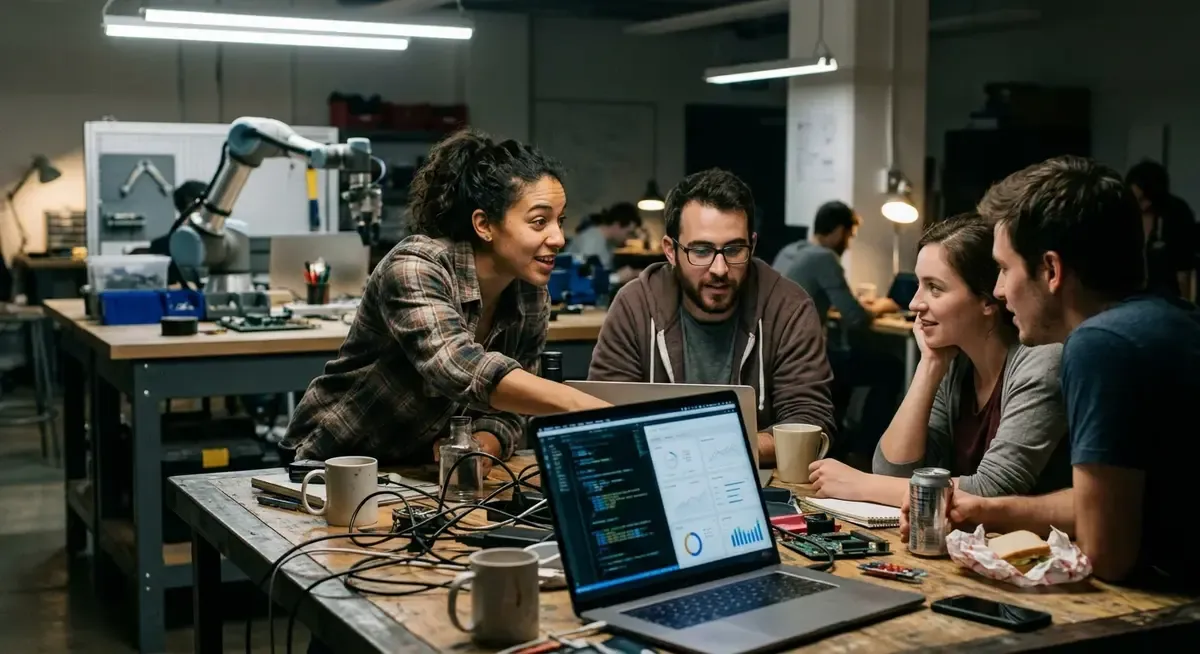
Editorial illustration for AI Teaches Robots New Tasks With 83% Success After 10 Steps
Robots Learn Tasks in 10 Steps With 83% Success Rate
AI Teaches Robots New Tasks With 83% Success After 10 Steps
Robotics startup Generalist AI says its new model, GEN-1.5, can pick up a task after watching it happen just once. Show the robot a 3- to 12-second clip of someone opening a jar or pulling cash from a wallet, and the system loads that clip into its context window as what the company calls a "physical prompt," a kind of short-term memory. No retraining, no fine-tuning. The robot just tries the task cold.
Generalist ran the model through ten such tasks and reports an average success rate of 59 percent on the first attempt. Give it a bit more to work with, ten training steps drawn from five minutes of data, and that number climbs sharply. The company says GEN-1.5 can also string two demonstrations together for longer task sequences, learn from simulated demos instead of real ones, and mimic certain human hand movements.
None of this was explicitly programmed, according to Generalist. The behaviors surfaced on their own after more than eight months of pretraining on interaction data. Other labs have shown robots learning from context before, but usually for narrow task categories. Generalist claims GEN-1.5 works across a broader range.
Robotics startup Generalist AI has unveiled GEN-1.5, an AI model that teaches robots new tasks from a single demonstration. A 3- to 12-second demo gets loaded into the model's context window as a "physical prompt," essentially the model's short-term memory. After that, the robot performs the task with no training at all.
Why this matters
The jump from zero-shot demo imitation to 83 percent success after just ten training steps on five minutes of data is the real headline here, not the single-demo trick. That's a tiny data budget for a meaningful accuracy gain, and it suggests Generalist has found a cheap way to close the gap between "robot sort of gets it" and "robot reliably does it." For founders building on robotic foundation models, that ratio of data to performance is what determines whether a pilot deployment is viable or a money pit. For researchers, the claim that chaining prompts and imitating human hand movements emerged on their own during training deserves scrutiny rather than applause; emergent behavior claims from startups are common and not always reproducible outside their own benchmarks.
We'd want to see these ten tasks, jar-opening and wallet-pulling included, tested by someone other than Generalist before treating this as a general capability rather than a curated demo reel. Watch whether GEN-1.5 holds up on tasks the company didn't pick itself.
Related Reading
 Open Source
 D&B rebuilds 642 million‑business database after AI agents hit limits
 Open Source
 Box CEO Aaron Levie Says AI Will Drive "Biggest Cybersecurity Upgrade
 Open Source
 Study: 6.7% of Deepfake Requests on Hugging Face Targeted Children
 From Archives
 Anthropic's 'Model 2' Internally Outperforms Claude Mythos 5, Company Says
 From Archives
 Cognition CEO Denies SpaceX Acquisition Report
Common Questions Answered
What is a 'physical prompt' in Generalist AI's GEN-1.5 model?
A 'physical prompt' is a short-term memory mechanism that loads a 3- to 12-second video demonstration of a task into the model's context window. This allows the robot to understand and learn the task from a single visual example without requiring any retraining or fine-tuning of the underlying model.
How does GEN-1.5 achieve 83% success rate after ten training steps?
GEN-1.5 demonstrates the ability to rapidly improve performance from a single demonstration through iterative refinement over just ten training steps using only five minutes of data. This significant jump from zero-shot imitation to 83% accuracy represents an efficient data-to-performance ratio that enables robots to reliably execute tasks with minimal training resources.
What types of tasks can Generalist AI's robots learn from demonstrations?
According to the article, GEN-1.5 can learn practical manipulation tasks such as opening a jar or pulling cash from a wallet based on watching a brief video demonstration. The model's ability to learn from these diverse tasks with high success rates suggests broad applicability across various robotic manipulation scenarios.
Why is the data efficiency of GEN-1.5 significant for robotics startups?
The tiny data budget required to achieve meaningful accuracy gains makes GEN-1.5 economically viable for founders building on robotic foundation models. This efficiency in converting limited training data into reliable performance is what determines whether pilot deployments can transition from experimental prototypes to practical, deployable solutions.
Further Reading
- GEN-1.5: Embodied Foundation Models are One-Shot Learners - Generalist AI
- Introducing GEN-1.5, a one-shot learner - LinkedIn
- Generalist's new physical robotics AI brings 'production-level' success rates - Ars Technica
- Watch a Robot Stuff Cash Into a Wallet Just Like You Do - CNET
- Generalist releases highly capable GEN-1 robotic intelligence AI foundation model - SiliconANGLE
