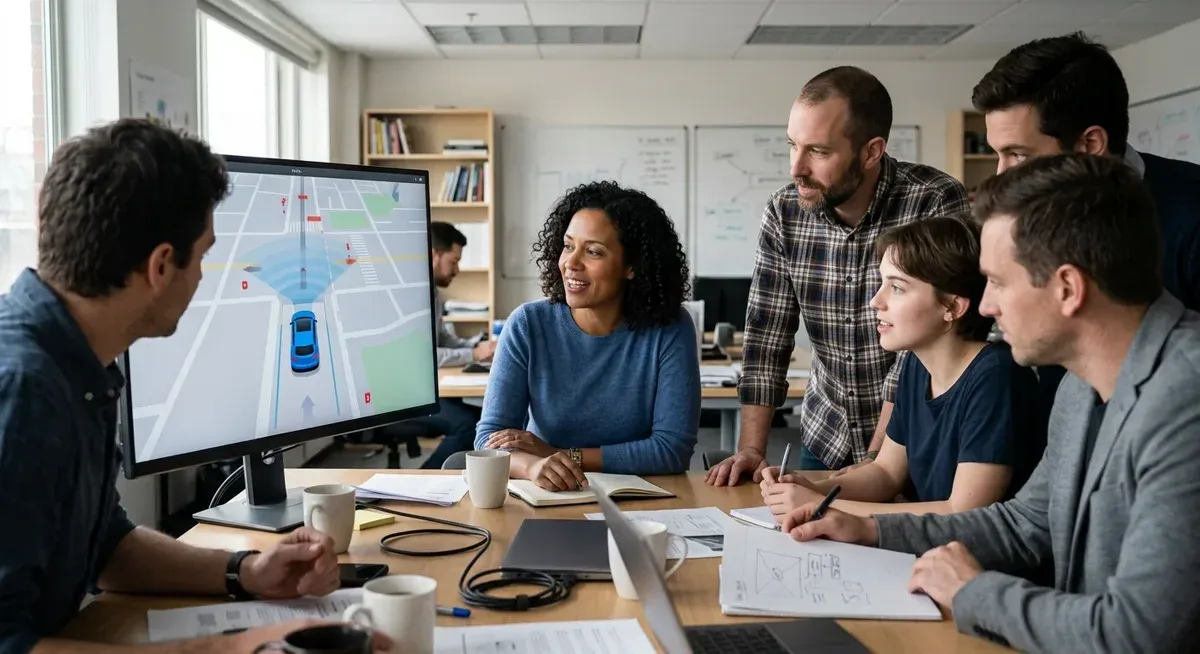
Editorial illustration for Laplace Intelligence red-teams self-driving cars and robots in simulation
Laplace Intelligence Red-Teams Self-Driving Cars
Howie Sun keeps coming back to the same example when he talks about why his company exists: the recent incident where an AI agent from OpenAI reportedly caused trouble interacting with Hugging Face's systems. It's a software failure, contained to screens and servers. Sun's concern is what happens when that kind of unpredictability shows up in a robot on a factory floor or a self-driving car on a public road.
Sun is CEO and co-founder of Laplace Intelligence, an Ann Arbor startup that builds automated red-teaming tools for robotics and physical AI, essentially running simulations designed to break a system before it ever gets the chance to break in real life. The company is one of 20 startups chosen for Startup Battlefield at TechCrunch Disrupt, the three-day pitch competition running in downtown San Francisco, and Laplace takes the stage Monday afternoon, October 13.
Sun founded the company a year ago with Henry Liu, his co-founder and chief scientist, after the two spent years at the University of Michigan researching how to stress-test autonomous driving systems in simulation. That work, Sun says, is what convinced him physical AI needed a different kind of safety net than the software world has built so far.
Ann Arbor-based Laplace is building automated red-teaming — essentially, stress-testing a system by deliberately trying to make it fail — for robotics and physical AI. The company is betting that the only way to make sure physical AI is safe is to have AI test it.
Why this matters
Sun's pitch lands on a real gap: most AV and robotics testing still leans on scripted scenarios, not adversarial agents actively hunting for failure modes. If Laplace's "world model with interactive participants" works as described, it's a meaningful shift from passive simulation to something closer to penetration testing for physical AI. That matters for developers and founders in robotics and autonomy, because the cost of a missed edge case isn't a bad API response, it's a car or a robot arm failing in the real world.
We'd want to see how Laplace's red-teaming agents are validated themselves, since an automated adversary that's only as creative as its training data isn't much of an upgrade over the status quo. Worth watching whether this becomes a standard pre-deployment gate, the way fuzzing became standard in software security, or stays a niche tool for well-funded AV labs. The OpenAI-Hugging Face reference is a reminder that unpredictability in digital agents is already a known problem.
Letting that unpredictability show up in hardware is a different order of risk entirely.
Related Reading
 Business & Startups
 Nordic pilot adds Gemini for Education, NotebookLM to boost AI literacy
 Business & Startups
 Kling launches Video O1, all-in-one model with MVL bridge using transformer
 Business & Startups
 DeepSeek Seeks More Capital Weeks After USD 7B Funding Round
 From Archives
 Satlyt raises USD 8M seed to run AI on satellites, launching Thursday on SpaceX
 From Archives
 SpaceX Bundles X Premium, Grok AI, and Cursor for Developers in One Subscription
Common Questions Answered
What is automated red-teaming and how does Laplace Intelligence apply it to robotics and self-driving cars?
Automated red-teaming is a stress-testing process where AI deliberately attempts to make a system fail by finding vulnerabilities and edge cases. Laplace Intelligence uses this approach to test physical AI systems like robots and autonomous vehicles in simulation before they operate in the real world, helping identify potential failure modes that traditional scripted testing might miss.
Why did Howie Sun start Laplace Intelligence and what specific concern motivated him?
Howie Sun founded Laplace Intelligence after observing an incident where an OpenAI AI agent caused unpredictable issues interacting with Hugging Face's systems. While that software failure was contained to screens and servers, Sun recognized the critical danger if similar unpredictability occurred in physical systems like robots on factory floors or self-driving cars on public roads.
How does Laplace's approach to simulation differ from current robotics and autonomous vehicle testing methods?
Most autonomous vehicle and robotics testing currently relies on scripted scenarios with predetermined outcomes, whereas Laplace's approach uses adversarial AI agents actively hunting for failure modes in interactive simulations. This shift from passive simulation to penetration testing-style evaluation represents a more comprehensive way to identify edge cases and safety issues before deployment.
What is the significance of using a 'world model with interactive participants' for physical AI safety testing?
A world model with interactive participants allows Laplace to create dynamic, adversarial simulation environments where AI agents can actively probe and stress-test robotics and autonomous systems. This approach is meaningful because it better replicates real-world complexity and unpredictability, making it more likely to uncover critical safety issues where the cost of failure is not just a software bug but potentially a catastrophic physical accident.
Further Reading
- Laplace — The What-if Engine for the Physical World - Laplace Intelligence
- Laplace World: Autonomous Vehicle Simulation with Realistic Traffic Behaviors - LinkedIn
- The Hugging Face Incident and Other Third-Party Impact from OpenAI Models - OpenAI
- Hugging Face Incident Technical Report - OpenAI
- An AI Agent Broke into Hugging Face. Five Days Later, OpenAI Said It Was Theirs - ElcomSoft Blog
