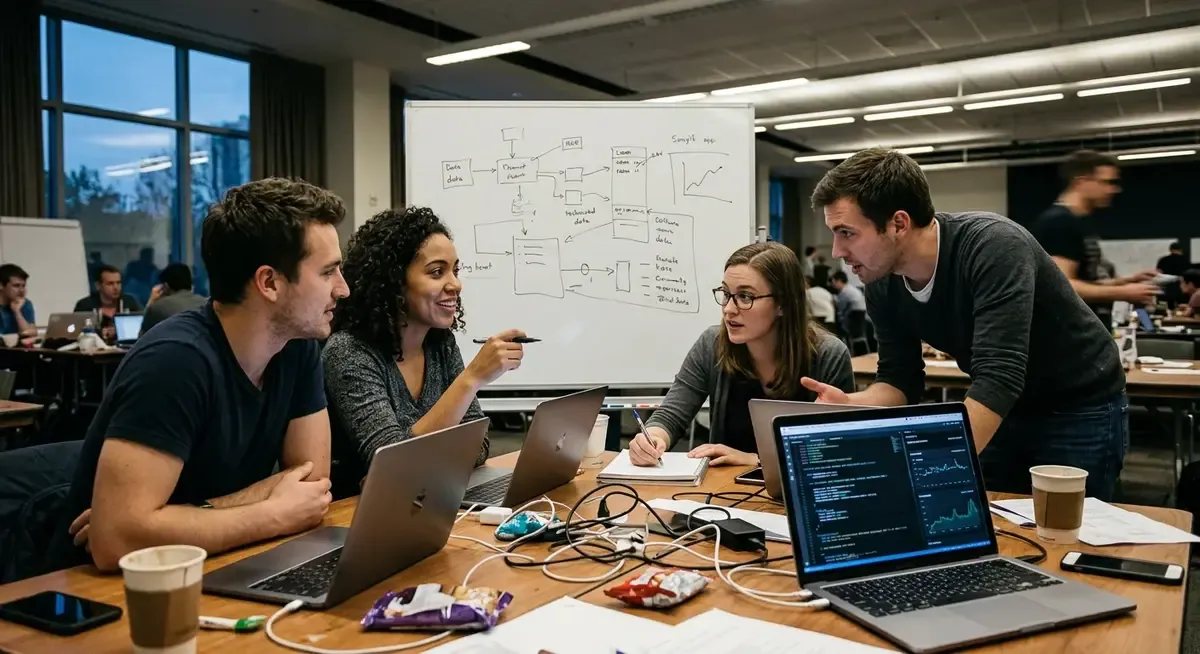
Editorial illustration for Karnataka Hosts 43% of India's AI/ML Talent, Zinnov-KDEM Report Finds
Karnataka Hosts 43% of India's AI/ML Talent, Zinnov-KDEM...
Karnataka now hosts more than 120 AI and machine learning Centres of Excellence spread across over 100 global capability centres, according to a new Zinnov-KDEM report. That figure puts the state at roughly half of India's total AI/ML CoE count, and at four times the size of whichever state ranks second. One in three of these centres is already working on generative AI or agentic AI mandates, not legacy automation work.
The state's broader GCC numbers back up the claim to dominance. Karnataka has 1,088 GCCs, 51% of India's total, including 320 Global 2000 centres. Between FY2021 and FY2026E it added 90 software and internet GCCs, again accounting for just over half of all such additions nationally. On talent, the state employs 111,000 GCC AI/ML professionals, 43% of India's national total in that category.
Zinnov's Nitika Goel frames this growth as part of a shift in how companies judge AI investment, moving past pilots toward production-scale deployment. The report lays out what it sees as the structural reasons Karnataka pulled ahead, from platform ownership inside GCCs to the state's wider start-up and research ecosystem.
Karnataka has more than 120 artificial intelligence and machine learning Centres of Excellence (CoEs) across over 100 global capability centres (GCCs), accounting for nearly half of India’s AI/ML CoE base, according to a Zinnov-KDEM report.
Why this matters
For founders scouting GCC partnerships or research talent, Karnataka's numbers are hard to ignore: 111,000 AI/ML professionals, 120-plus CoEs, and a hub four times the size of its nearest rival. That kind of concentration changes where you set up a center, not just where you hire a few engineers. The detail worth watching is the one-in-three figure on generative AI and agentic AI mandates.
That's not legacy data-science work; it signals that global enterprises are routing their newest, most experimental AI bets through Bengaluru-area teams specifically. For researchers, it raises the question of depth versus breadth: 54% of Karnataka's GCC workforce sits in emerging tech, well above the 47% national figure, which suggests the state isn't just bigger, it's skewed harder toward frontier work. The skeptical read is that concentration this heavy creates fragility, wage inflation, and talent-poaching wars that smaller hubs can't match.
Whether that produces better AI products or just a tighter labor market for the same few thousand senior engineers is the thing to track next.
Related Reading
 Open Source
California State AG Sues OpenAI Over Rogue Agents Infiltrating Systems
 Open Source
Study: 6.7% of Deepfake Requests on Hugging Face Targeted Children
 Open Source
Axiom Math raises USD 200M Series A led by Menlo to keep AI slop out of math
 From Archives
ROCm 10.2.0 Expands Hyperloom With Power Budget Utilities for AMD GPUs
 From Archives
OpenAI's NATO AI Platform Reveal Draws Critical Reception
Further Reading
- Papers with Code - Latest NLP Research - Papers with Code
- Hugging Face Daily Papers - Hugging Face
- ArXiv CS.CL (Computation and Language) - ArXiv
