
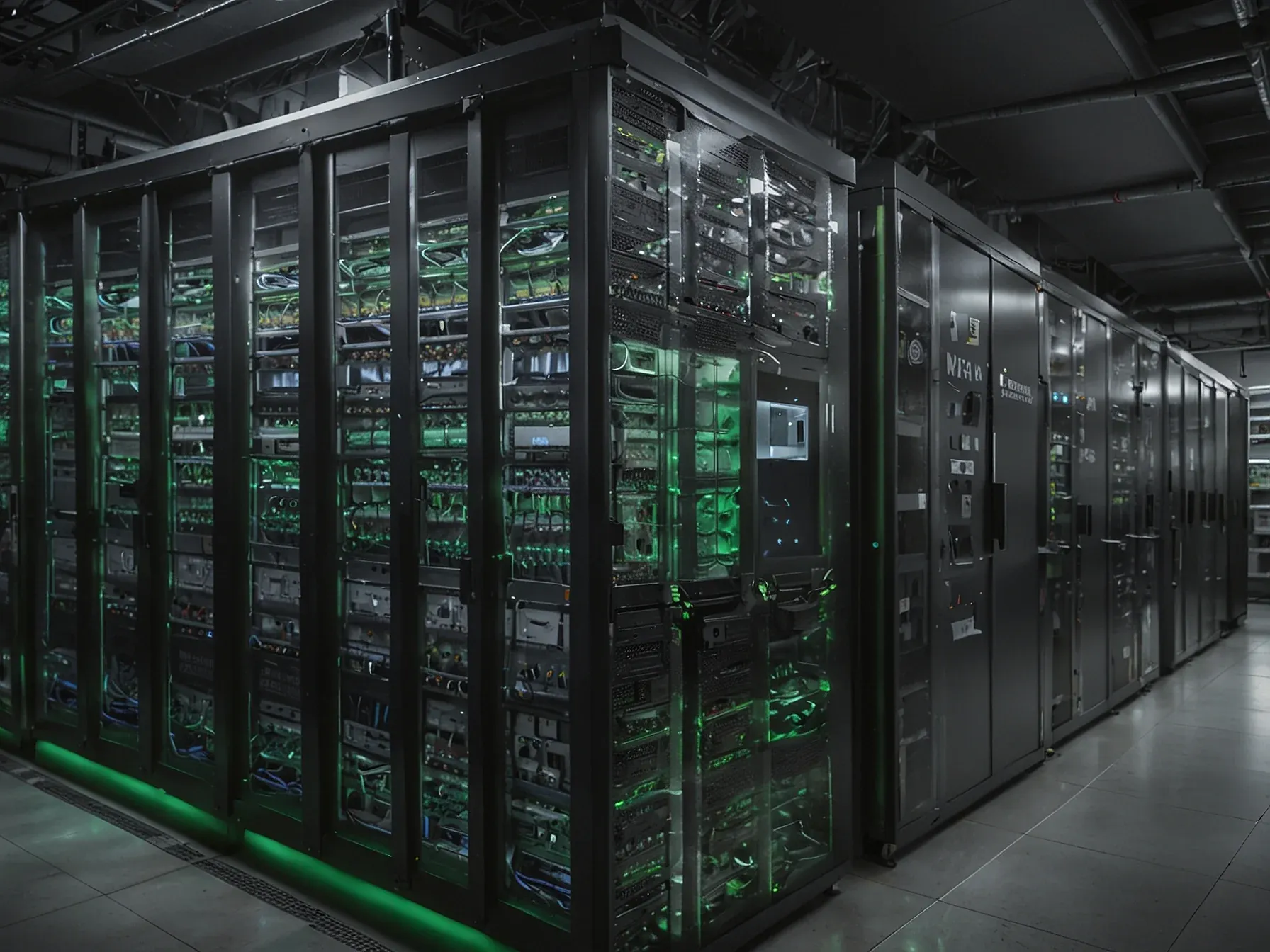
Editorial illustration for India Unveils 1-Petaflop NVIDIA DGX Spark AI Supercomputer with 128 GB Memory
India's 1-Petaflop AI Supercomputer: NVIDIA DGX Spark
India is stepping into the ring with a heavyweight contender that fits in the palm of your hand. The government has signaled plans to manufacture NVIDIA’s DGX Spark , a 1-petaflop, 128 GB AI supercomputer the company calls the world’s smallest. It’s not just a technical marvel; it’s a strategic bet.
Powered by the GB10 Blackwell Superchip, this machine can run inference on models with up to 200 billion parameters and fine-tune models with 70 billion. The minister’s social media post flagged its on-device AI prowess for railways, shipping, healthcare, education, and remote applications. Details from the meeting remain scant, but the move deepens a rapidly accelerating partnership.
NVIDIA is already a founding member and strategic advisor to the India Deep Tech Alliance, a consortium backing startups in AI, semiconductors, space, and robotics. This is more than a hardware announcement. It’s India positioning itself as a maker, not just a buyer, of the most advanced AI tools on the planet.
NVIDIA noted that the DGX Spark delivers up to one petaflop of AI performance and is equipped with 128 GB of unified memory. Powered by the GB10 Blackwell Superchip, the system can run inference on AI models with up to 200 billion parameters and fine-tune models with up to 70 billion parameters. The company announced in October that it would begin shipping the DGX Spark, which it describes as the 'world's smallest AI supercomputer'.
In a social media post, the minister highlighted its on-device AI processing capabilities, which he believes are suitable for use cases across railways, shipping, healthcare, education, and remote applications. While the minister did not disclose further details from the meeting, the discussions signal another step in the deepening relationship between India and NVIDIA. In November, NVIDIA became a founding member and strategic technical advisor to the India Deep Tech Alliance, a consortium of Indian and US investors focused on supporting startups in AI, semiconductors, space, and robotics.
The DGX Spark may be small, but its implications for India are enormous. This is not just about importing a powerful machine, it’s about manufacturing it, embedding it into railways, healthcare, and remote classrooms. India is making a calculated bet: that sovereignty in AI starts with sovereignty in hardware.
By aligning with NVIDIA, the country gains more than a supercomputer. It gains a strategic partner in a race where technological independence is the prize. The real test, however, will be execution.
Can India move from announcement to assembly, from pilot to scale? If it does, the Spark will not just power algorithms, it will power a vision.
Related Reading
 Industry Applications
 Westinghouse teams with Google Cloud to build AI platform for nuclear power
 Industry Applications
 NVIDIA NeMo powers telco reasoning model for autonomous network workflows
 Industry Applications
 Month-1 Agent Adds Holistic Observability with Trace IDs and Token Tracking
 Related Topic
 NVIDIA and Google Cloud let developers scale AI from prototype to production
Market Trends
 Related Topic
 China offers cheaper electricity to AI firms abandoning NVIDIA chips
Business & Startups
 From Archives
 NXP and GE HealthCare unveil edge AI for acute care at CES 2026
 From Archives
 Gradio Auto-Creates Text Input, Submit Button, and Output from Spec
 From Archives
 NY RAISE Act targets AI safety as Zhipu AI launches GLM 4.7, Nvidia buys Groq
Business & Startups
 From Archives
 Mercedes to debut Nvidia Level 2++ assist in US as CES backs AI robotaxis
Business & Startups
Common Questions Answered
What makes the NVIDIA DGX Spark supercomputer unique for India's AI research?
The NVIDIA DGX Spark is a 1-petaflop supercomputer that represents a significant technological advancement for India's computational capabilities. It offers researchers the ability to run inference on AI models with up to 200 billion parameters and fine-tune models with up to 70 billion parameters, positioning India as a more competitive player in the global AI landscape.
How powerful is the NVIDIA DGX Spark's memory configuration?
The DGX Spark is equipped with 128 GB of unified memory, which enables complex AI computations and model processing. This substantial memory capacity, combined with the GB10 Blackwell Superchip, allows for sophisticated AI research and development tasks that were previously challenging to execute.
What are the key performance characteristics of the NVIDIA DGX Spark supercomputer?
The DGX Spark delivers up to one petaflop of AI performance, making it a compact yet powerful computing solution. NVIDIA describes it as the 'world's smallest AI supercomputer', capable of handling massive AI models with up to 200 billion parameters for inference and 70 billion parameters for fine-tuning.
Further Reading
- Papers with Code - Latest NLP Research — Papers with Code
- Hugging Face Daily Papers — Hugging Face
- ArXiv CS.CL (Computation and Language) — ArXiv
