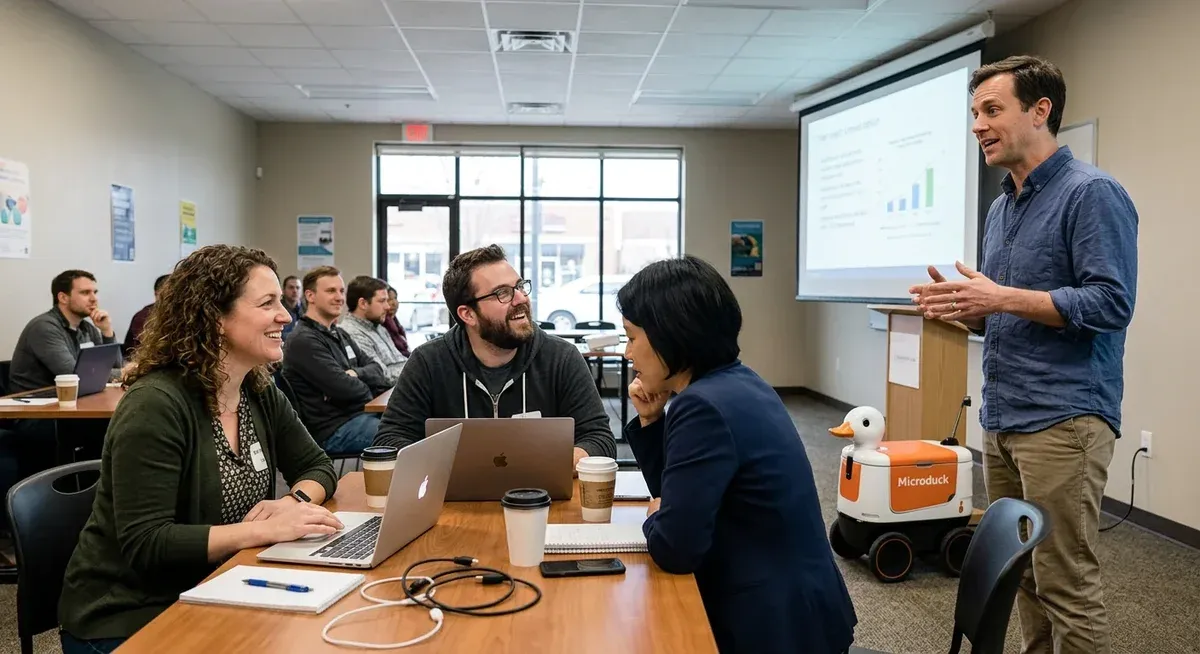
Editorial illustration for Hugging Face's USD 399 Microduck Biped Robot Ships With Seven Pre-Trained Moves
Hugging Face's $399 Microduck Robot Ships Ready
Pollen Robotics, the Bordeaux team behind Hugging Face's Reachy Mini desk robot, opened pre-orders this week for something with a very different job description. Microduck is a 25 cm bipedal robot that costs $399, and instead of asking buyers to take its abilities on faith, the company published the whole training pipeline on GitHub: the simulator environments, the reward functions, the domain-randomization settings, the sim-to-real recipe. Every motion the duck performs, walking, sitting, kicking, roller-skating, hauling itself upright after a fall, started as a neural policy trained in physics simulation before being exported to the physical hardware.
That's a deliberate reversal of what Reachy Mini was built for. Reachy Mini, which has sold more than 10,000 units, was designed to stay put on a desk and interact with whoever's sitting in front of it. Microduck is built to leave the desk, tip over, and figure out how to stand back up.
It packs 15 motors, a stereo sensor suite, and enough onboard compute to run learned behaviors locally, at a price closer to a toy than a research platform. The hardware itself, and the seven pre-trained moves it ships with, are worth a closer look.
Pollen Robotics, the Bordeaux robotics team at Hugging Face, is instead shipping the training loop. This week it opened pre-orders for Microduck, a 25 cm bipedal robot in which every movement — walking, sitting, kicking, roller-skating, standing back up after a fall — is a neural policy trained in a physics simulator and exported to the hardware. It costs $399.
Why this matters
We've watched enough robotics demos to know a slick video proves nothing about what ships in the box. Pollen Robotics is doing something different by handing over the actual training loop, the sim environments, the reward functions, the domain-randomization settings that produced those seven behaviors. For $399, that's a real invitation to poke at reinforcement learning on physical hardware without the usual five-figure entry fee.
Researchers get a cheap platform to test policy transfer from simulator to servo motors, a problem that's eaten budgets at labs with far deeper pockets than a hobbyist's. Founders building robotics startups should note the pricing signal here: Hugging Face is betting that open, tinkerable hardware sells better than another closed black box you can't retrain. The per-unit audio identity is a small but telling detail, it suggests they're thinking about product feel, not just benchmark specs.
Whether Microduck holds up outside a controlled demo, whether the self-recovery policy actually recovers on carpet versus tile, is the thing to watch once units start shipping to people who aren't Pollen's own engineers.
Related Reading
 Open Source
 D&B rebuilds 642 million‑business database after AI agents hit limits
 Open Source
 Box CEO Aaron Levie Says AI Will Drive "Biggest Cybersecurity Upgrade
 Open Source
 Study: 6.7% of Deepfake Requests on Hugging Face Targeted Children
 From Archives
 Deploy an AI Model in Two Commands with NVIDIA's TensorRT Model Connect
 From Archives
 Google AI Claims 2.6% Average WER for Gemini 3.5 Transcribe
Common Questions Answered
What are the seven pre-trained moves that Microduck can perform?
Microduck is capable of walking, sitting, kicking, roller-skating, standing back up after a fall, and two additional neural policy-trained movements. Each motion is a neural policy that was trained in a physics simulator and then exported to the hardware for real-world performance.
Why did Pollen Robotics publish the entire training pipeline on GitHub for Microduck?
Pollen Robotics published the complete training pipeline including simulator environments, reward functions, and domain-randomization settings to provide transparency and allow researchers to understand exactly how the robot's behaviors were developed. This approach demonstrates that the robot's capabilities are genuine and reproducible, rather than relying on marketing videos that may not reflect actual performance.
How much does the Microduck bipedal robot cost and what makes it accessible for reinforcement learning research?
Microduck costs $399, which represents a significant reduction compared to the typical five-figure entry fee for robotics research platforms. By providing an affordable platform with open-source training methodology, researchers can now experiment with reinforcement learning on physical hardware without the usual expensive barrier to entry.
What is the relationship between Pollen Robotics and Hugging Face in the development of Microduck?
Pollen Robotics is the Bordeaux-based robotics team behind Hugging Face's Reachy Mini desk robot, and they have now developed Microduck as a new bipedal robot offering. The company opened pre-orders for Microduck this week as part of their expanding robotics product line.
How does Microduck's training approach differ from traditional robotics demonstrations?
Instead of relying on slick marketing videos that don't prove actual capabilities, Microduck's training loop is fully transparent and reproducible through the published GitHub repository. Every movement is a neural policy trained in a physics simulator using domain randomization and specific reward functions, then exported to the physical hardware, making the development process verifiable and accessible to other researchers.
Further Reading
- Hugging Face is selling a cute $399 open source duck robot, Microduck - TechCrunch
- Hugging Face unveils $400 singing, skating duck-like robot - Bloomberg
- Hugging Face debuts Microduck, a $399 robot - Axios
- Hugging Face launches Microduck, a $399 open-source robot duck - Mashable
- Hugging Face And Pollen Robotics Open Pre-Orders For The $399 Microduck Robot - Engadget
