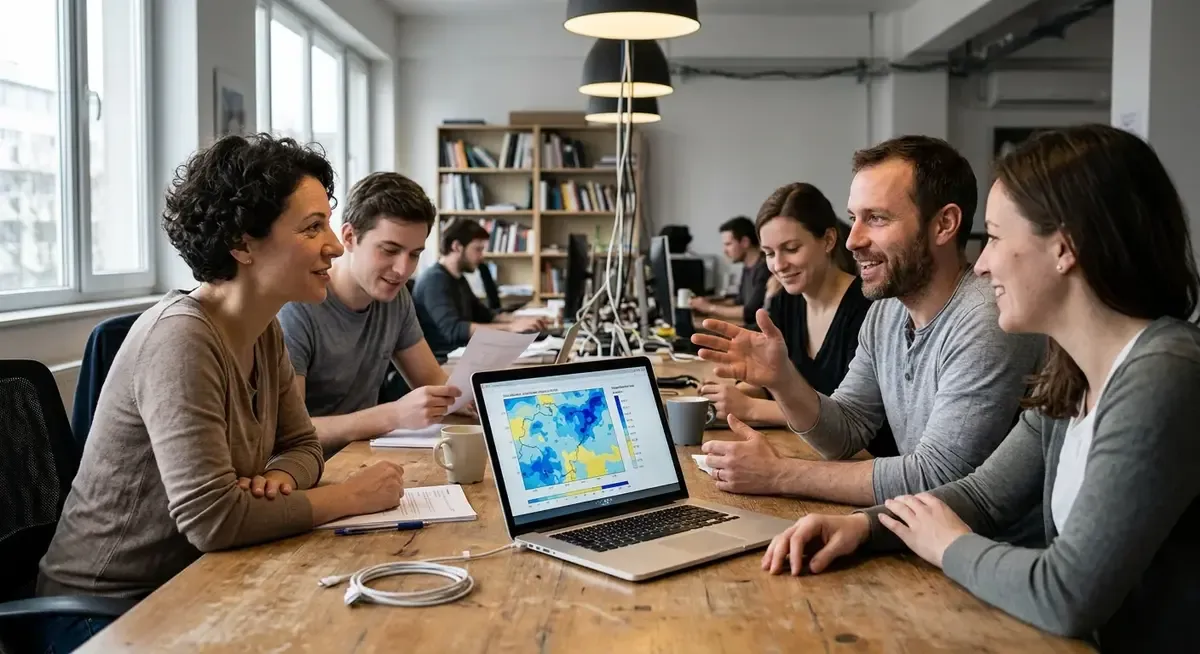
Editorial illustration for Google Updates AI Weather Model for More Accurate Precipitation Forecasts
Google's WeatherNext 3 Predicts Rain 5x Better
Google Updates AI Weather Model for More Accurate Precipitation Forecasts
Google rolled out a new version of its AI weather model on Wednesday, and the company says it's the sharpest one yet. WeatherNext 3, as it's called, produces a global forecast five times more detailed than Google's previous system, according to the announcement. The big selling point: better rain and snowfall predictions, an area where weather forecasting has historically struggled.
The shift here isn't just about resolution. Traditional forecasting has leaned on supercomputers running physics simulations, a process that works but takes time to compute. AI models, including Google's earlier efforts, sped things up by spotting patterns in historical weather records instead. WeatherNext 3 pushes further, pulling in live satellite data so the model can update itself hourly rather than relying only on archived patterns.
Samier Merchant, a research engineer at Google Research, says the model's edge comes from what it's trained on. Feeding it fresher, more varied observational data, he says, is what separates this version from typical global AI weather systems. Google frames the update as a step toward forecasts that move at the pace of the atmosphere itself, rather than the pace of a supercomputer catching up to it.
Google is going a step further by incorporating live satellite data in its new model. WeatherNext 3 is able to produce a forecast each hour based on the most recent satellite observations. That allows for faster predictions than its previous AI models, as well as higher spatial and temporal resolution.
Why this matters Weather forecasting has been a proving ground for AI models because the data is messy, the stakes are concrete, and errors show up fast. Google leaning on real-time satellite observations rather than pure historical training data suggests it's chasing the same edge NOAA and ECMWF have spent decades building with physics-based models, but at a fraction of the compute cost. For developers building on top of Google Cloud or Earth Engine, a more accurate precipitation model means downstream products, agriculture tools, insurance risk models, logistics routing, get better inputs without extra engineering work.
For researchers, this is another data point in the argument that AI weather models are catching up to traditional numerical prediction, at least on specific metrics like rainfall timing. We'd want to see independent verification against existing benchmarks like ECMWF's before taking "unprecedented" at face value. Google hasn't published the accuracy numbers here, and that gap between announcement and peer-reviewed proof is worth watching closely.
Related Reading
Browse all Google news → Business & Startups
 Nordic pilot adds Gemini for Education, NotebookLM to boost AI literacy
 Business & Startups
 Kling launches Video O1, all-in-one model with MVL bridge using transformer
 Business & Startups
 DeepSeek Seeks More Capital Weeks After USD 7B Funding Round
 Related Topic
 NVIDIA and Google Cloud let developers scale AI from prototype to production
Market Trends
 Related Topic
 Google tests visual 'magazine-style' UI for Gemini 3 Pro users
LLMs & Generative AI
 From Archives
 Microsoft AI's MAI-Transcribe-2 Undercuts Rivals on Price and Speed
 From Archives
 Hut 8 building 350MW Texas data center for Anthropic's Claude AI
 From Archives
 Google's New Gemini 3.8 Flash Model Works Harder, Costs More
LLMs & Generative AI
 From Archives
 Google's Gemini 3.8 Flash Priced at USD 0.58 Per Task
LLMs & Generative AI
Common Questions Answered
How does WeatherNext 3 improve precipitation forecasting compared to Google's previous AI weather model?
WeatherNext 3 produces global forecasts that are five times more detailed than Google's previous system, with a specific focus on better rain and snowfall predictions. The model addresses an area where weather forecasting has historically struggled by incorporating live satellite data and generating hourly forecasts based on the most recent satellite observations.
What role does live satellite data play in WeatherNext 3's forecasting capabilities?
Google incorporated live satellite data into WeatherNext 3, allowing the model to produce a new forecast each hour based on the most recent satellite observations. This approach enables faster predictions than previous AI models while achieving higher spatial and temporal resolution compared to traditional physics-based forecasting methods.
How does WeatherNext 3's approach differ from traditional physics-based weather forecasting?
While traditional forecasting has relied on supercomputers running physics-based models, WeatherNext 3 uses real-time satellite observations rather than pure historical training data to generate predictions. This AI-driven approach aims to achieve the same accuracy edge that organizations like NOAA and ECMWF have built over decades, but at a fraction of the compute cost.
Why is weather forecasting considered an important proving ground for AI models?
Weather forecasting serves as a proving ground for AI models because the data is messy, the stakes are concrete with real-world consequences, and errors show up quickly and measurably. This makes it an ideal domain for testing and validating AI capabilities before deploying them in other applications.
Further Reading
- WeatherNext models | Google for Developers - Google for Developers
- WeatherNext - Google for Developers
- Weather research | WeatherNext - Google for Developers - Google for Developers
- AI model achieves breakthrough in forecasting cyclones - Google DeepMind
- WeatherNext 2 - Google DeepMind - Google DeepMind
