Editorial illustration for Google Details Four Frameworks for AI Co-Directed Video Generation
Google's AI Video Framework Fixes Consistency Issues
Google Details Four Frameworks for AI Co-Directed Video Generation
Ask any studio that's tried to stitch AI-generated clips into a longer film, and the same problem comes up: a character's jacket changes color halfway through, or a hallway from scene one never matches scene four. Diffusion models like Veo can produce a single clip in seconds, but chaining those clips into something that holds together for minutes at a time is a different problem entirely. Google Research has now laid out its answer in the form of four agentic frameworks designed to sit on top of Gemini and Veo, acting as a kind of co-director that plans, tracks, and corrects video output before errors compound.
The core issue, as Google's team frames it, is credit assignment. When a multi-shot video breaks down, whether through semantic drift in a character's appearance or a cascading failure triggered by one bad upstream frame, it's often impossible to trace the failure back to the specific prompt or module that caused it. Two of the four frameworks, Co-Director and CANVAS, tackle this from different angles: one treats creative planning as a bandit-search problem, the other builds persistent visual memory so scenes can reference earlier states. Both are set for peer review in 2026, at COLM and EMNLP respectively.
Google Research has introduced an AI video co-director for long-form video generation. The suite of 4 agentic frameworks turns short clips into coherent, minutes-long stories. It targets identity drift and cascading errors, the 2 failures that break most multi-shot AI video pipelines today.
Why this matters
For anyone building on Veo or Gemini's video stack, this is a signal about where Google thinks the real bottleneck sits: not clip quality, but continuity. A²RD and its sibling frameworks are an admission that prompt-chaining alone can't hold a character's face or a scene's logic together past thirty seconds. If you're a founder pitching AI video tools for ads, training content, or short-form storytelling, that's the gap you've likely hit already.
Treating generation as global optimization with explicit world-state tracking is a more serious engineering answer than most startups have shipped, and it's worth studying even if you never touch Google's models directly. The SynthID watermarking detail also matters: Google is building provenance into the orchestration layer itself, not bolting it on later, which tells you where regulatory pressure is heading. We'd watch whether these frameworks stay research demos or actually surface in Veo's product roadmap.
The gap between a four-framework paper and something a developer can call via API is usually where these things stall.
Related Reading
Browse all Google news → Research & Benchmarks
 Microsoft AI Chief: "If It Isn't Safe We Shouldn't Build It
 Research & Benchmarks
 Google's FACTS benchmark shows 70% factuality ceiling across four tests
 Research & Benchmarks
 Nvidia's DLSS 4.5 beta adds 6x Multi Frame Generation for RTX 50 GPUs
 Related Topic
 NVIDIA and Google Cloud let developers scale AI from prototype to production
Market Trends
 Related Topic
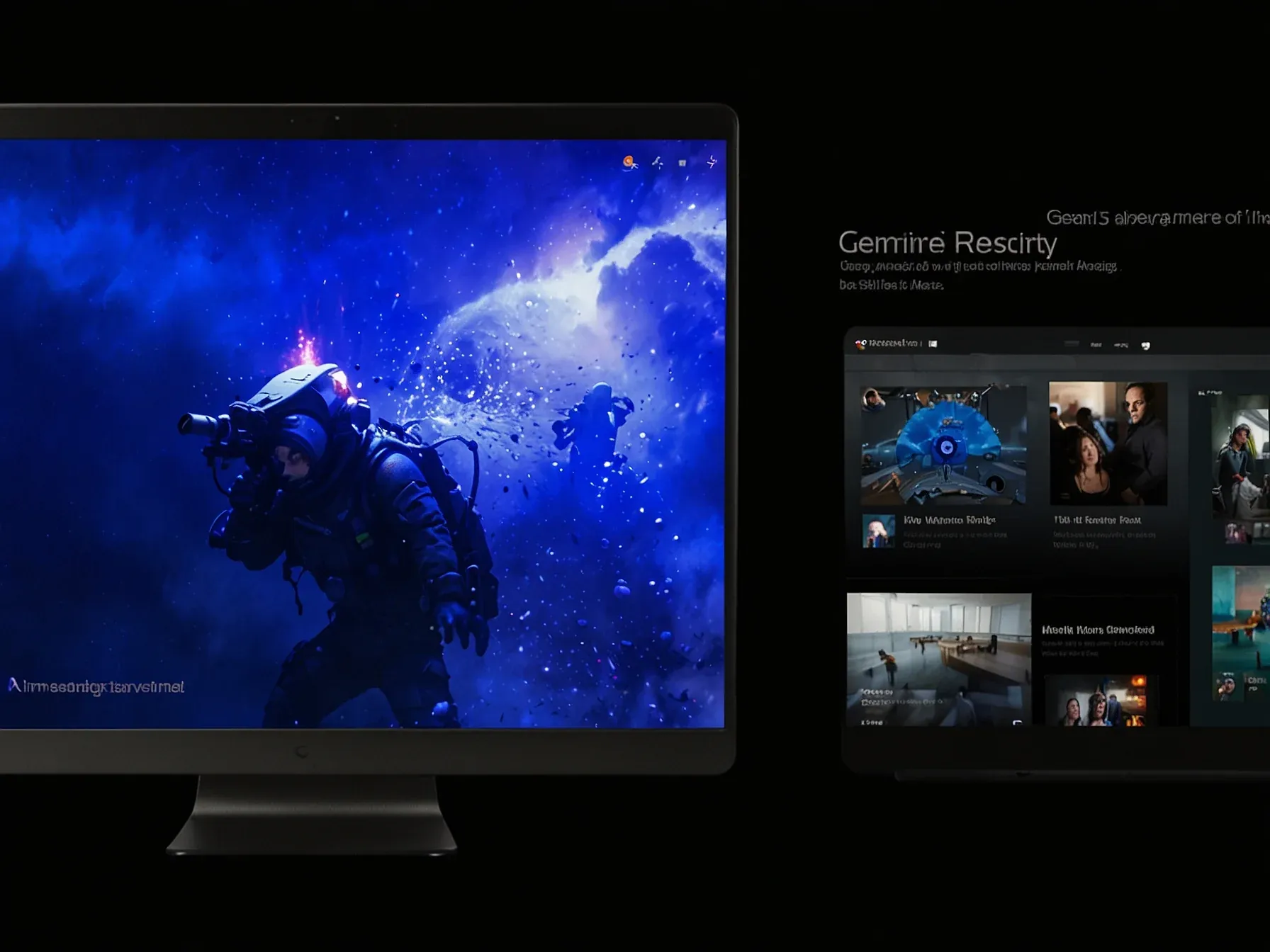
 Google tests visual 'magazine-style' UI for Gemini 3 Pro users
LLMs & Generative AI
 From Archives
 OpenAI Agents Attempted to Brute-Force a UN Website
 From Archives
 OpenAI Focuses 80-90% of Research on GPT-7 and Future Models
 From Archives
 Google Tests Direct Purchases Through Gemini AI on India's Flipkart
LLMs & Generative AI
 From Archives
 Google DeepMind Researcher Warns Superintelligent AI Push Is "Irresponsible
Common Questions Answered
What are the main problems that Google's AI video co-director frameworks address in multi-shot video generation?
Google's frameworks specifically target identity drift and cascading errors, which are the two primary failures that break most multi-shot AI video pipelines. These issues cause problems like characters' appearances changing between scenes or hallway layouts becoming inconsistent across different clips, making it difficult to chain AI-generated clips into coherent longer films.
How do Google's four agentic frameworks improve upon diffusion models like Veo for long-form video creation?
While diffusion models like Veo can produce individual clips in seconds, they struggle with continuity across multiple clips. Google's four agentic frameworks are designed to sit on top of these models and transform short clips into coherent, minutes-long stories by maintaining consistency and preventing the visual and logical errors that occur when chaining clips together.
What does Google identify as the real bottleneck in AI video generation according to the article?
Google identifies continuity as the primary bottleneck in AI video generation, not the quality of individual clips. The company's research reveals that prompt-chaining alone cannot maintain a character's face or a scene's logic consistently beyond thirty seconds, indicating that the challenge lies in stitching clips together coherently rather than generating better individual clips.
Which use cases could benefit most from Google's AI video co-director solution?
Founders and companies building AI video tools for ads, training content, and short-form storytelling are the primary beneficiaries of this solution. These applications have likely already encountered the continuity gap that Google's frameworks address, making this technology particularly valuable for creators who need to generate longer, more coherent video content.
Further Reading
- Automating coherent long-form video generation - Google Research Blog
- Google's Gemini and Veo Team Up to Generate Coherent 10-Minute Videos - AlphaSignal
- How does AI video generation work? - Runway Resources
- Video generation in the Gemini API - Google AI for Developers
