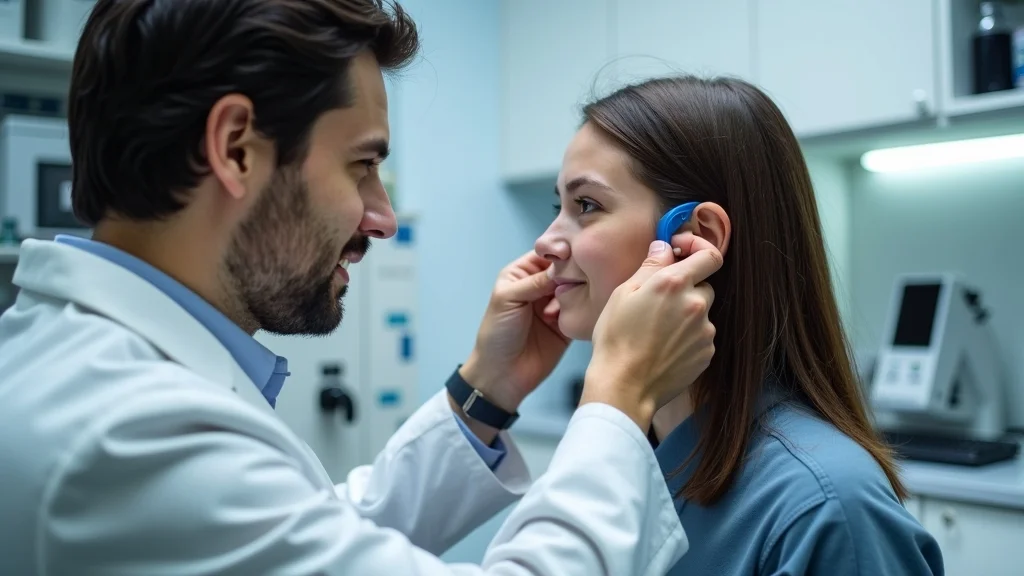
Editorial illustration for Fortell Taps NYU Langone Researchers to Validate Hearing Aid Performance
NYU Researchers Validate Breakthrough Hearing Aid Tech
Fortell hires NYU Langone researchers to scientifically test its hearing aid
Fortell just threw its new hearing aid into a scientific gladiator arena. The startup enlisted audiology and neuroscience experts from NYU Langone Health to design a blind test, pitting its device directly against the reigning champion: Phonak. Phonak's AI-powered aids, which retail for about $4,000, are the undisputed gold standard.
They'll be the control. The battleground is a simulated "cocktail party," with noise firing from three different directions at random intervals.
It's hard to measure hearing quality, but Fortell has set out to prove scientifically that it has a better solution to hearing loss. It contracted researchers in NYU Langone's audiology and neuroscience departments to consult on a blind experiment comparing Fortell with the leading AI-powered hearing aid competitor, a Swiss company called Phonak, whose devices retail for $4,000 and is considered the gold standard in AI hearing products. (In the study, Phonak isn't mentioned by name and is identified only as the control hearing aid group.) The test matched performance in environments where noise was coming at random intervals from three directions--kind of an emulation of the Cocktail Party Problem.
NYU Langone hasn't released the results. Don't expect a simple victory lap from Fortell. This is about the benchmark.
By targeting that specific, chaotic listening scenario with rigorous methodology, the study could finally cut through the marketing haze. It offers a data-driven path, one that any future device—from any company—could be forced to walk.
Related Reading
 Open Source
 D&B rebuilds 642 million‑business database after AI agents hit limits
 Open Source
 Box CEO Aaron Levie Says AI Will Drive "Biggest Cybersecurity Upgrade
 Open Source
 Study: 6.7% of Deepfake Requests on Hugging Face Targeted Children
 From Archives
 Arcee releases Apache-2.0 Trinity Mini (26B) and Nano Preview (6B) models
 From Archives
 Mistral launches Large 3, an Apache-2.0 open-source model for language, images
Common Questions Answered
How is Fortell approaching hearing aid performance validation differently from other manufacturers?
Fortell is taking an unusually rigorous approach by recruiting researchers from NYU Langone's audiology and neuroscience departments to conduct an independent assessment of its technology. Unlike traditional marketing-driven claims, the company is pursuing a blind experiment against an established competitor to scientifically validate its hearing aid performance.
What makes the NYU Langone partnership significant for Fortell's hearing aid technology?
The partnership with NYU Langone researchers provides Fortell with credible, independent scientific validation of its hearing aid performance. By engaging experts in audiology and neuroscience, Fortell is demonstrating a commitment to rigorous testing and moving beyond typical marketing claims in the hearing assistance market.
What is the competitive context of Fortell's hearing aid validation study?
Fortell is conducting a blind experiment comparing its technology against Phonak, a Swiss company considered the gold standard in AI-powered hearing aids with devices retailing for $4,000. This approach signals Fortell's confidence in its technology and its desire to prove superior performance through scientific methodology.
Further Reading
- Papers with Code - Latest NLP Research — Papers with Code
- Hugging Face Daily Papers — Hugging Face
- ArXiv CS.CL (Computation and Language) — ArXiv
