
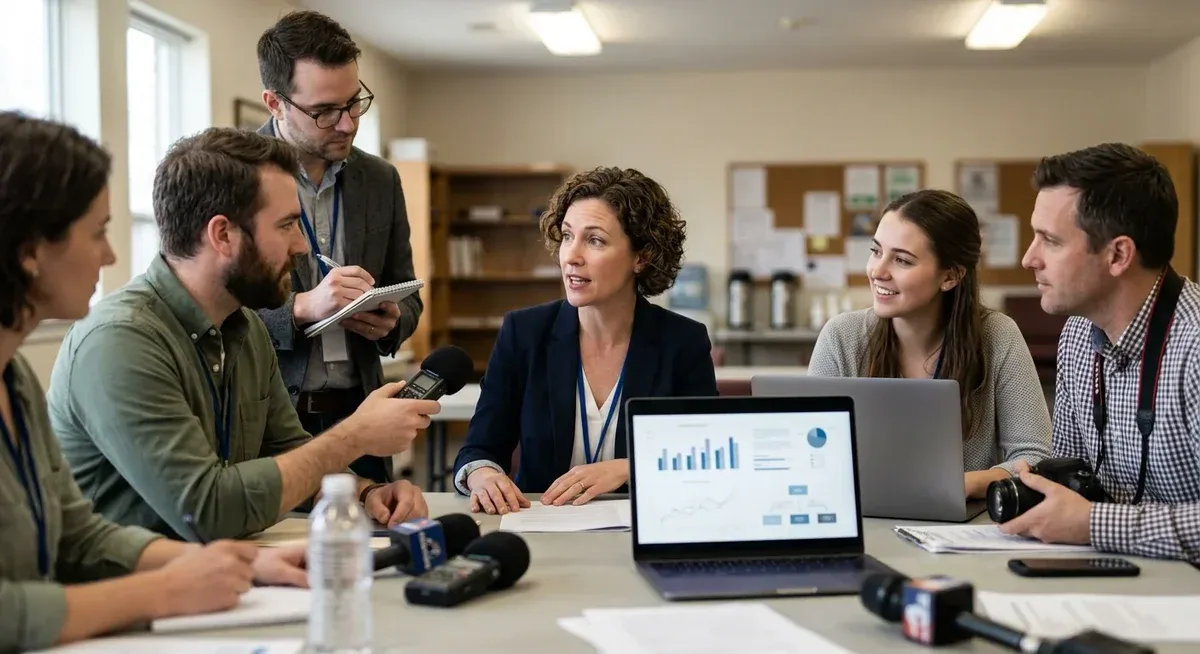
Editorial illustration for Former OpenAI Exec Raises USD 215M to Build AI Drug Labs Guided by Chemists
OpenAI Exec Raises $215M for AI-Powered Drug Labs
Kevin Weil left his job as OpenAI's chief product officer this year to start a chemistry company. Warp Sciences, the result, has now raised $215 million to build drug research labs across the US that pair chemists with AI models and robotic equipment. Lightspeed led the round, with Premji Invest, Mayfield, IVP, Lux, Conviction, Menlo Ventures and 01 Advisors also putting in money, alongside angel investors Brian Armstrong of Coinbase, Databricks co-founder Ion Stoica and Figma's Dylan Field.
The company will run as a chemistry contract research organization, making and testing molecules for pharmaceutical and biotech clients working on drug discovery. Weil co-founded it with Solomon Reisberg, who led medicinal chemistry work at Terremoto Biosciences, Manohar Paluri, formerly a vice-president at Meta Superintelligence Labs, and DJ Patil, a founding executive at Devoted Health who also served as the first US Chief Data Scientist at the White House.
The pitch rests on a gap Weil has watched play out in his own field: AI has transformed how people write code and do math, but hasn't moved the needle much in chemistry or biology, fields that depend on physical experiments rather than pure computation.
Why this matters
Warp's bet is that drug discovery's bottleneck isn't smarter algorithms, it's the slow, expensive loop of making molecules and testing them in a lab. $215 million is a serious sum to throw at that problem, and the CRO model means Warp gets paid by pharma and biotech clients while building a proprietary dataset from every experiment it runs. That's the real asset here: data generated by its own robots and chemists, fed back into its own models, rather than training on scraped or synthetic chemistry data.
For AI builders, this is a reminder that domain-specific feedback loops, chemists plus robotics plus models iterating on real experiments, may matter more than raw model scale in fields like chemistry and biology. For founders eyeing "AI for science" plays, Warp's pitch that humans still guide the experiments while automation does the repetitive work is worth noting; full autonomy isn't the claim being made, and that restraint might be what makes investors comfortable writing nine-figure checks. Worth watching whether Warp's models stay proprietary or eventually license out.
Related Reading
Browse all OpenAI news → Business & Startups
Nordic pilot adds Gemini for Education, NotebookLM to boost AI literacy
 Business & Startups
Kling launches Video O1, all-in-one model with MVL bridge using transformer
 Business & Startups
DeepSeek Seeks More Capital Weeks After USD 7B Funding Round
 Related Topic
OpenAI researcher quits, citing distrust over ad‑driven engagement metrics
LLMs & Generative AI
 Related Topic
OpenAI launches GPT-Image 1.5 with precise editing for enterprise visuals
LLMs & Generative AI
 From Archives
HCLTech Launches NVIDIA-Powered Validation for Software-Defined Vehicles
 From Archives
Nutanix Ties Up With NVIDIA, Supermicro and Netris to Cut AI Costs
 From Archives
OpenAI Seeks USD 30B Raise at USD 1.25T Valuation Ahead of IPO, UAE Compute Deal
 From Archives
OpenAI brings models and Codex to Google Cloud, Brockman says
Common Questions Answered
Who founded Warp Sciences and what was their previous role?
Warp Sciences was founded by Kevin Weil, who previously served as OpenAI's chief product officer before leaving the company this year to start the chemistry-focused startup. The company was also founded by former leaders from Meta, Terremoto Biosciences, and Devoted Health, bringing diverse expertise to the organization.
How much funding did Warp Sciences raise and who were the lead investors?
Warp Sciences raised $215 million in its funding round, with Lightspeed leading the investment. Other major investors included Premji Invest, Mayfield, IVP, Lux, Conviction, Menlo Ventures, and 01 Advisors, along with notable angel investors like Brian Armstrong from Coinbase, Databricks co-founder Ion Stoica, and Figma's Dylan Field.
What is Warp Sciences' business model and how do they generate proprietary data?
Warp Sciences operates as a contract research organization (CRO) that pairs chemists with AI models and robotic equipment to help pharmaceutical and biotechnology companies develop medicines. The company generates proprietary data from every experiment conducted by its own robots and chemists, which is then fed back into its AI models to continuously improve drug discovery capabilities.
What does Warp Sciences identify as the main bottleneck in drug discovery?
Warp Sciences believes that the primary bottleneck in drug discovery is not the lack of smarter algorithms, but rather the slow and expensive process of making molecules and testing them in laboratory settings. By combining AI, robotics, and experienced chemists, the company aims to accelerate this traditionally time-consuming loop.
Further Reading
- Papers with Code - Latest NLP Research - Papers with Code
- Hugging Face Daily Papers - Hugging Face
- ArXiv CS.CL (Computation and Language) - ArXiv
