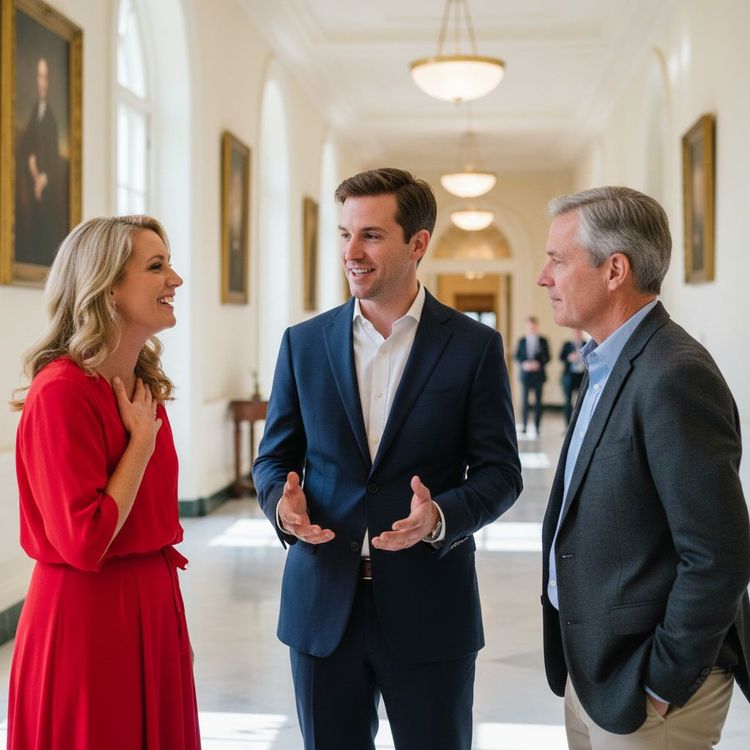
Editorial illustration for Far-Right Protesters Converge on Washington to Challenge Trump's AI Appointee
Far-Right Activists Protest Trump's AI Appointee in DC
Far-right groups rally against Trump’s AI czar David Sacks in Washington
David Sacks was supposed to be the solution. The Silicon Valley billionaire, installed as Trump's AI czar, was meant to translate tech for the base. Instead, he's become the protest sign.
Far-right groups are now organizing in Washington against him. Their target is a proposed federal moratorium on state-level AI laws, a policy Sacks is pushing. To the crowd on the street, it looks like a gift to the very tech elite they hate.
They see AI as a direct threat to jobs, to their families, to what their children see online. A freeze on local rules would protect the companies, not the people.
This puts Trump in a bind. His own appointee is championing a policy that enrages his most loyal voters.
Behind the scenes, AI policy experts, lawyers, and politcal operatives -- regardless of whether they were pro-preemption or not -- were working their connections in the White House, hoping that someone could persuade Trump that a moratorium -- at least, one that was so swift and aggressive -- would be political suicide. Two people familiar with the dynamics of the White House said that the person most likely to succeed at stopping Trump at signing the EO was Susie Wiles, the White House chief of staff who'd successfully imposed a sense of discipline on Trump's political operations, is deeply trusted by Trump, and is famously averse to internal drama. "She's smart," said a Republican operative working on AI policy.
"I think she understands how this could be bad for the president, politically." Recent polling indicates that a vast, bipartisan majority of Americans oppose the idea of a state AI law moratorium. And few demographics are more hostile to the idea than the Republican MAGA base, who have long distrusted Big Tech and view AI as a threat to job security, traditional family values, and the mental health of their children. Backing a moratorium would be disastrous for potential Republican presidential candidates aligned with the MAGA base, such as Vice President J.D.
Recent elections across the country indicate that the Republican Party already finds itself on tenuous footing: last month, New Yorkers soundly elected Democratic Socialist Zohran Mamdani over the Trump-backed Andrew Cuomo for mayor; meanwhile, Virginians elected Democrat Abigail Spanberger to the House over Republican Winsome Earl-Sears by a landslide.
The political math is brutally clear. A huge majority of Americans dislike the moratorium idea. MAGA voters dislike it more.
After recent losses in New York and Virginia, the Republican party cannot afford another self-inflicted wound. So the quiet fight inside the White House isn't about technology. It's about survival.
Staffers are trying to convince Trump this will blow up in his face. Their best hope is chief of staff Susie Wiles, one of the few people who can tell him no.
Trump now has to choose between his billionaire advisor and the people who wave his flags. The protests outside are just the visible part of a much deeper crack.
Related Reading
 Policy & Regulation
 Akamai Proposes SAFE Cybersecurity Guidelines for AI Threats
 Policy & Regulation
 After ditching AI fitness apps and a Fitbit, I return to Peloton classes
 Policy & Regulation
 Sony Music, Warner Chappell Sue Anthropic Over "Blatant Theft
 From Archives
 OpenAI, Microsoft sued for scraping newspapers and using text without license
 From Archives
 OpenAI releases gpt-oss-120B and gpt-oss-20B under Apache-2.0-style license
Common Questions Answered
Who is David Sacks and why are far-right protesters targeting him?
David Sacks is a Trump appointee in the artificial intelligence policy landscape who has become a controversial figure. The far-right protesters are converging on Washington to challenge his position and influence in AI governance, signaling deep ideological tensions around tech policy.
What role is Susie Wiles playing in the White House AI policy discussions?
Susie Wiles, the White House chief, is emerging as a potentially critical moderating voice in the AI policy debates. Multiple sources suggest she might be the most likely person to persuade Trump against signing an overly aggressive executive order on AI regulation.
How are political operatives responding to potential AI policy executive orders?
Political operatives and AI policy experts are working behind the scenes to influence White House decision-making, recognizing the potential political risks of a swift and aggressive AI moratorium. They are strategically leveraging their connections to shape the conversation around AI governance.
Further Reading
- Papers with Code - Latest NLP Research — Papers with Code
- Hugging Face Daily Papers — Hugging Face
- ArXiv CS.CL (Computation and Language) — ArXiv
