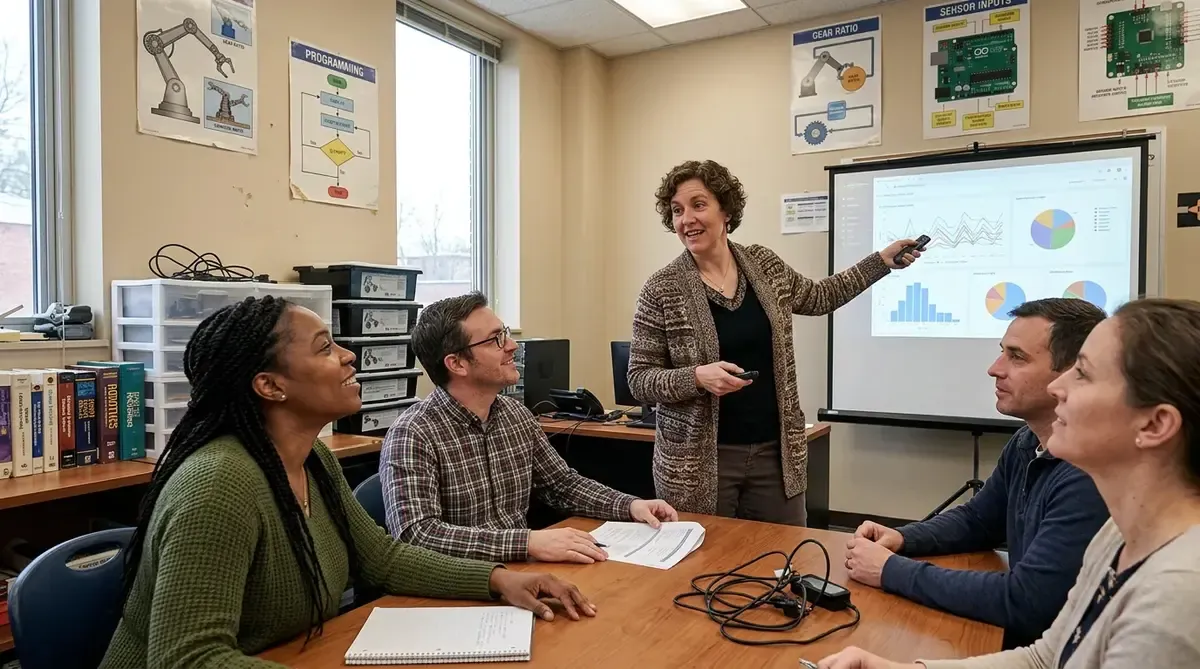
Editorial illustration for The Download: AI in Schools and Shanghai’s Robot Carnival
Schools Train Students to Use AI Responsibly
The Download: AI in Schools and Shanghai’s Robot Carnival
Cheshire Academy's teachers don't hand students a banned-apps list. They train them on how to use AI, full stop, then let a traffic-light system sort out when ChatGPT is fair game for an assignment and when it isn't. That approach sits at the center of today's Download, which looks at what schools are actually doing now that generative AI has moved from novelty to homework helper faster than most administrators could write a policy memo.
OpenAI and UNESCO have both pushed for classroom adoption, but the guidance from the top hasn't translated into clarity on the ground. Teachers are still figuring out where AI belongs in lesson planning versus where it undermines the point of an assignment. Cheshire Academy's experiment, detailed in a new piece from Making AI Work, offers one answer: train on technique, not tools, and let specialized platforms fill in the gaps.
Elsewhere in today's edition, reporter You Xiaoying heads to the outskirts of Shanghai, where a robot "carnival" drew crowds eager to watch humanoids perform for an audience used to seeing them stuck in labs.
Humanoid robots are having a moment in China. The popular machines are part of the country’s strategy to bring AI into daily life. Nearly 90% of the more than 13,000 two-armed, two-legged robots delivered globally last year were made in China.
Why this matters The classroom story matters more than the headline suggests, and not because schools finally have a policy for chatbots. It's because education is the closest thing we have to a controlled experiment on how humans adapt to AI that thinks faster than they do. Every founder building tutoring bots or grading tools should watch how teachers are actually responding, not the marketing decks vendors send to district administrators.
Chatbots caught schools flat-footed once already; a second wave of "smarter" AI in classrooms will test whether educators have learned anything or are just buying new software to patch an old problem. Shanghai's robot carnival is a smaller data point, but it's worth tracking too: China keeps staging public robotics spectacles as soft signals of industrial confidence, and those signals often precede real manufacturing and deployment shifts. For researchers, the real question isn't whether AI belongs in schools.
It's whether anyone designing these tools has talked to a teacher who's actually used one for a semester, not a demo.
Related Reading
 LLMs & Generative AI
 ChatGPT's 'Nerdy' tweak rewards goblin metaphors in answers, study finds
 LLMs & Generative AI
 Google to End Free Access to Gemini AI for Non-Subscribers
 LLMs & Generative AI
 AI Engineers Face Rising Costs, Need New Strategies for Efficiency
 From Archives
 Chomsky: Children Learn Language Too Fast for AI to Match
 From Archives
 Sales Platform Automates Load Alerts, Includes Setup Guide for Non-Technical Staff
Common Questions Answered
How does Cheshire Academy's traffic-light system approach differ from traditional AI bans in schools?
Instead of providing students with a banned-apps list, Cheshire Academy trains them on how to use AI tools and then implements a traffic-light system to determine when ChatGPT is appropriate for assignments and when it isn't. This approach prioritizes AI literacy and responsible usage over outright prohibition, allowing students to learn when and how to appropriately leverage generative AI in their academic work.
What role have OpenAI and UNESCO played in promoting AI adoption in classrooms?
Both OpenAI and UNESCO have actively pushed for classroom adoption of generative AI technologies. Their advocacy has helped shift the conversation from whether AI should be used in education to how schools can effectively integrate these tools into their teaching and learning practices.
What is China's strategy regarding humanoid robots and AI integration?
China is using humanoid robots as part of a broader strategy to bring AI into daily life, with nearly 90% of the more than 13,000 two-armed, two-legged robots delivered globally last year being made in China. This robot carnival approach demonstrates China's commitment to making AI technology accessible and visible in everyday contexts.
Why does the article suggest that education serves as a 'controlled experiment' for human adaptation to AI?
Education represents a unique environment where researchers and educators can observe how humans adapt to AI that processes information faster than they do. The article emphasizes that founders building tutoring bots and grading tools should study how teachers are actually responding to these technologies in practice, rather than relying on vendor marketing materials, as this real-world classroom data provides valuable insights into effective AI integration.
Further Reading
- I spent a day at a robot “carnival” in Shanghai. Here's what I saw. - MIT Technology Review
- Weekly AI-in-Education Brief for School Leaders — July 6, 2026 - The Ed Journal
- ChatGPT Policies at Schools — The 2026 Landscape - Leap AI
- Denver schools blocking ChatGPT for students - Chalkbeat
- ChatGPT in schools in 2026: what teachers need to know now - LearnAway AI
