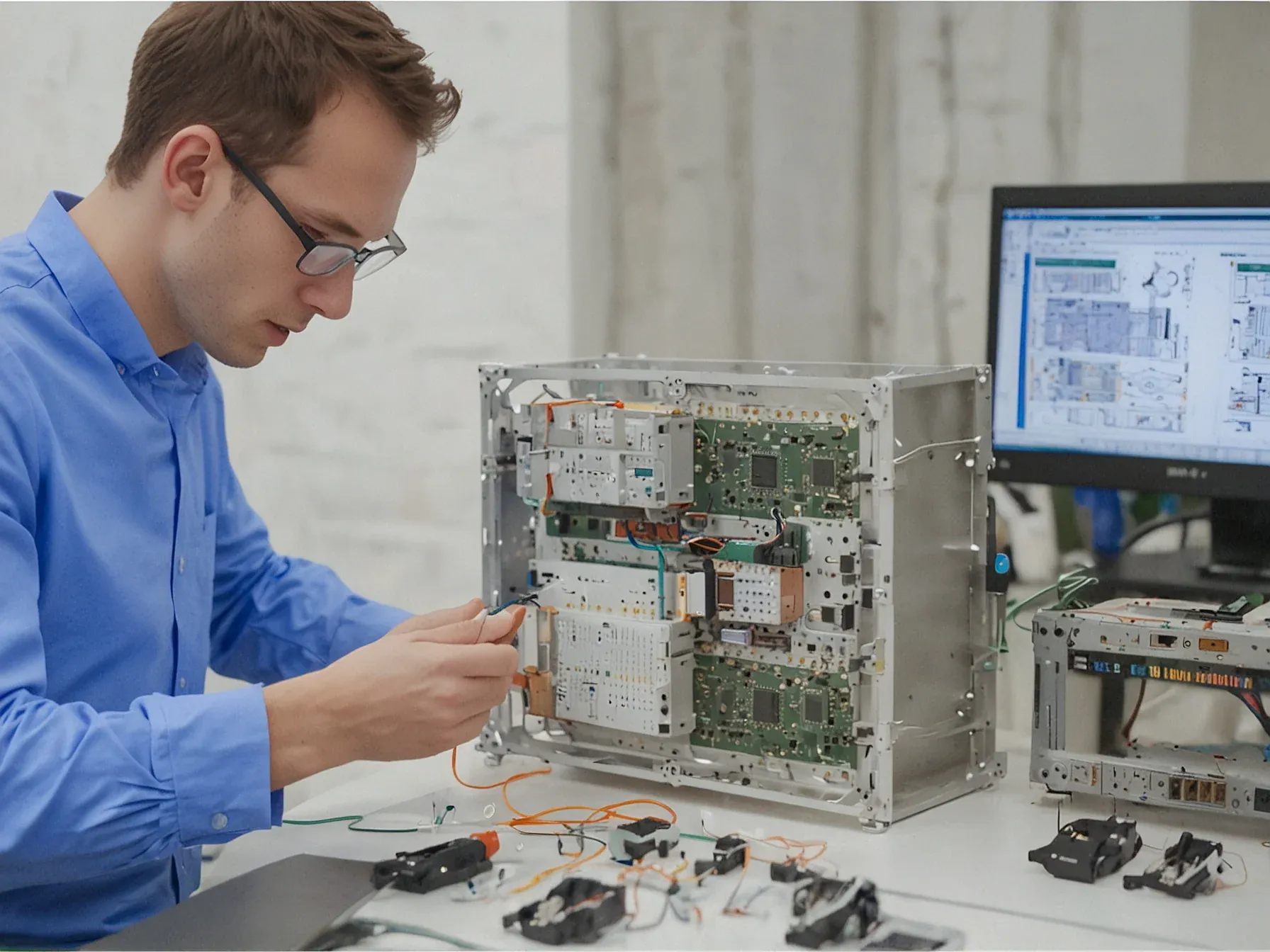
Editorial illustration for DeepSeek Math V2 Introduces Two-Stage Verifier with Dual-Component Design
DeepSeek Math V2 Advances AI Problem-Solving Techniques
DeepSeek Math V2 Deploys Dual-Component Architecture, Two-Stage Verifier Training
Ask an AI for a math answer today, and you'll get one instantly. Ask it to produce a formal proof—the structured, logically sound kind required for publication—and the task becomes fiendishly difficult. DeepSeek Math V2, developed by the Beijing-based DeepSeek company, tackles this by pitting two neural networks against each other.
DeepSeek Math V2's architecture presents two principal components that interact with each other: Training happens in two stages. First, the verifier is trained on known correct and incorrect proofs. Then the generator is trained with the verifier acting as its reward model.
Every time the generator produces a proof, the verifier scores it. Wrong steps get penalized, fully correct proofs get rewarded, and over time the generator learns to produce clean, valid derivations. As the generator improves and starts producing more difficult proofs, the verifier receives extra compute such as additional search passes to catch subtler mistakes.
The objective here, as outlined in a recent guide from Analytics Vidhya, transcends mere calculation. It’s about crafting a self-improving cycle of scrutiny. A sloppy proof from the generator forces the verifier to up its game.
That tougher verification, in turn, trains the generator to be more exact. The result is a form of computational rigor. What emerges isn't just a correct answer, but an argument pre-vetted by an adversarial internal critic.
For mathematics, that distinction is everything.
Related Reading
 Open Source
 D&B rebuilds 642 million‑business database after AI agents hit limits
 Open Source
 Box CEO Aaron Levie Says AI Will Drive "Biggest Cybersecurity Upgrade
 Open Source
 Study: 6.7% of Deepfake Requests on Hugging Face Targeted Children
 From Archives
 SAM3D isolates specific items—like a tall lamp—beyond broad-class segmentation
 From Archives
 DeepSeek launches V3.2 reasoning model, Speciale API available until Dec 15 2025
Common Questions Answered
How does DeepSeek Math V2's two-stage verification process work?
DeepSeek Math V2 uses a unique two-stage training approach where the verifier is first trained on correct and incorrect mathematical proofs. Then, the generator learns by receiving feedback from the verifier, with correct proofs being rewarded and incorrect steps penalized, creating a self-improving mechanism for mathematical reasoning.
What makes DeepSeek Math V2 different from previous mathematical AI models?
Unlike traditional machine learning techniques, DeepSeek Math V2 introduces a sophisticated dual-component design with a verifier and generator that interact and improve each other. This approach allows the AI to tackle complex mathematical reasoning more reliably and precisely than previous models.
How does the verifier component improve mathematical proof generation?
The verifier is initially trained to distinguish between correct and incorrect mathematical proofs, creating a robust evaluation framework. It then acts as a reward model for the generator, scoring each proof and providing feedback that helps the AI learn to produce more accurate and valid mathematical derivations.
Further Reading
- Papers with Code - Latest NLP Research — Papers with Code
- Hugging Face Daily Papers — Hugging Face
- ArXiv CS.CL (Computation and Language) — ArXiv
