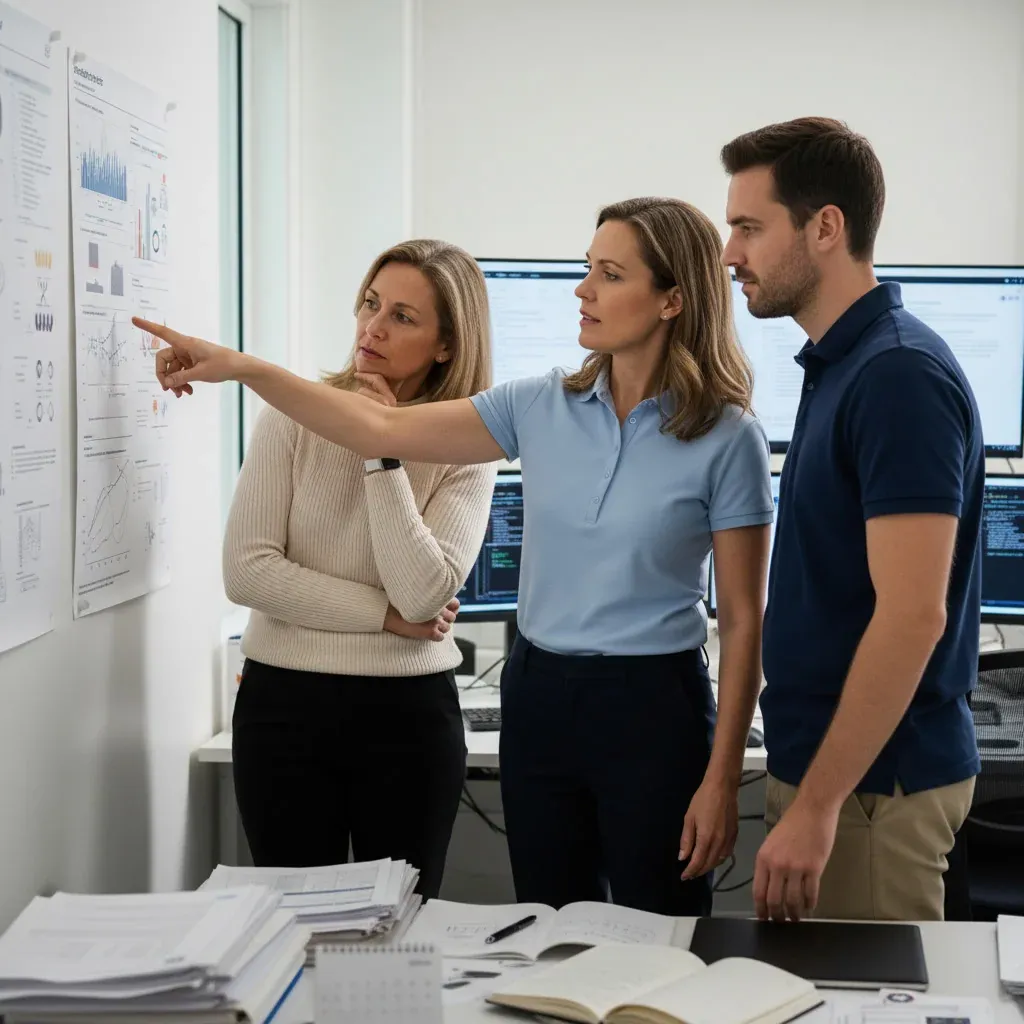
Editorial illustration for CVPR 2026 Friday Session: STARFlow‑V Video Modeling Poster #178, 4‑6 PM
CVPR 2026 Friday Session: STARFlow‑V Video Modeling...
Friday at CVPR 2026 isn’t just another afternoon in Exhibit Hall A & F, it’s a microcosm of the field’s most urgent tensions. At Poster #178, STARFlow-V takes the stage: an end-to-end video generative model that rethinks normalizing flows for temporal coherence. Jiatao Gu and his team from Apple Machine Learning Research are pushing beyond the usual frame-by-frame compromises, asking what happens when video generation is treated as a single, differentiable pipeline rather than a patchwork of heuristics.
That alone would anchor the session. But the hall breathes in parallel. Poster #453 probes a very different question, how multimodal LLMs navigate the gap between spatial reasoning and functional understanding.
Le Zhang and colleagues from Mila and NYU want to know: does a model know *where* a cup is, but fail to grasp *what it’s for*? Meanwhile, Poster #457 compresses images with a ruthless pragmatism, stripping away the pieties of learned codecs to ask what *actually* matters in deployment. Kedar Tatwawadi and the team at WaveOne cut through the noise.
These three posters, running simultaneously from 4 to 6 PM, form a triptych of today’s computer vision: generative fidelity, embodied semantics, and practical efficiency. STARFlow-V is the headliner, but the conversation around it is where the real insight lives. Come ready to move between the rows, the best connections happen in the gaps between posters.
Jiatao Gu will present STARFlow-V: End-to-End Video Generative Modeling with Normalizing Flows.
The Friday session closes with a quiet intensity that only the best poster halls can hold. STARFlow-V doesn’t just push the boundary of generative video, it redefines the starting line, proving that normalizing flows can scale to end-to-end temporal modeling without sacrificing traceability. Beside it, the spatial-functional intelligence benchmark reminds us that vision is never just about seeing; it’s about understanding *why* a thing is where it is.
And the practical image compression work strips away the hype, asking the hard question: what actually survives when theory meets bandwidth? These three posters, in their shared four-to-six window, capture something essential about CVPR this year, the field is no longer satisfied with a single breakthrough. It demands fluency across domains: generation, reasoning, efficiency.
By the time the hall empties, the conversations don’t end. They spill into the Saturday corridors, where sign language bootstrapping, 4D geometry, and multi-speaker audio await. The conference is a machine that learns, but Friday’s session is the gear that turns.
Related Reading
 Research & Benchmarks
 Microsoft AI Chief: "If It Isn't Safe We Shouldn't Build It
 Research & Benchmarks
 Google's FACTS benchmark shows 70% factuality ceiling across four tests
 Research & Benchmarks
 Nvidia's DLSS 4.5 beta adds 6x Multi Frame Generation for RTX 50 GPUs
 From Archives
 USD E^3USD ‑Agent splits fast router from LLM meta‑controller for edge inference
 From Archives
 Sakana AI's DiffusionBlocks Apply Uniform [4,4,4] Layers Across Three Blocks
Common Questions Answered
What is STARFlow-V and how does it differ from traditional video generation approaches?
STARFlow-V is an end-to-end video generative model developed by Jiatao Gu's team at Apple Machine Learning Research that rethinks normalizing flows for temporal coherence. Unlike traditional frame-by-frame approaches, STARFlow-V treats video generation as a single, differentiable pipeline rather than a patchwork of separate processes, enabling better temporal consistency and coherence throughout the generated video.
What are the key advantages of using normalizing flows in STARFlow-V for video modeling?
STARFlow-V demonstrates that normalizing flows can scale to end-to-end temporal modeling without sacrificing traceability, which is a significant advancement in generative video technology. This approach maintains mathematical interpretability while handling the complex temporal relationships required for high-quality video generation across entire sequences.
Where can attendees see STARFlow-V presented at CVPR 2026?
STARFlow-V will be presented as Poster #178 during the Friday session at CVPR 2026, held in Exhibit Hall A & F from 4-6 PM. This poster presentation is part of a session showcasing some of the field's most urgent tensions and cutting-edge developments in computer vision and video generation.
What makes the Friday CVPR 2026 session significant for the video generation field?
The Friday session at CVPR 2026 represents a microcosm of the field's most urgent tensions, with STARFlow-V exemplifying how generative video is being fundamentally rethought through end-to-end differentiable pipelines. The session demonstrates the shift from traditional compromises in video generation toward more integrated and theoretically grounded approaches that redefine the starting line for the field.
Further Reading
- Apple at CVPR 2026: STARFlow-V: End-to-End Video Generative Modeling with Normalizing Flows — Apple Machine Learning Research
- CVPR Poster STARFlow-V: End-to-End Video Generative Modeling with Autoregressive Normalizing Flows — CVPR / CVF
- CVPR 2026 Papers — CVPR / CVF
- CVPR 2026 Conference — CVPR / CVF
- CVPR 2026 Workshops — CVPR / CVF
