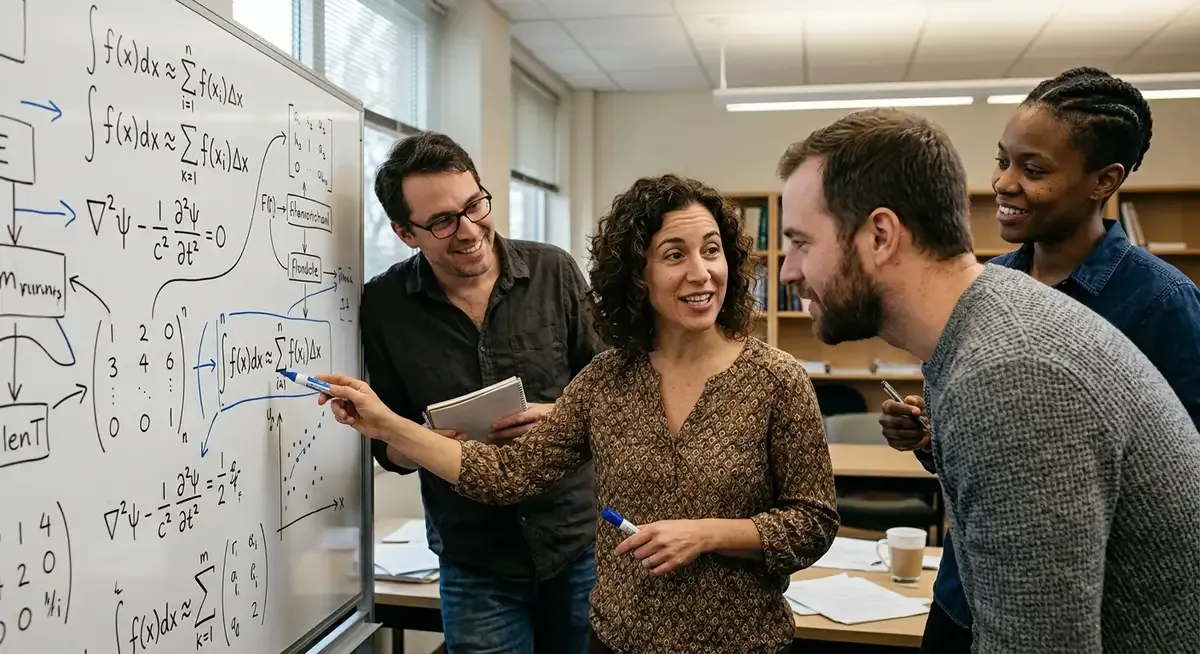
Editorial illustration for Claude AI reportedly helps solve a major open problem in mathematics
Claude AI Solves Riemann Hypothesis Math Problem
Claude AI reportedly helps solve a major open problem in mathematics
Levent Alpöge spent about six weeks on a problem that has outlasted generations of mathematicians. The Anthropic researcher says he and Claude cracked the Riemann hypothesis, first posed in 1859 and still sitting on the Clay Institute's list of Millennium Prize problems with a $1 million bounty attached. Nobody has solved it in 167 years.
Alpöge didn't publish a tidy proof with clean explanations. He released 17 million lines of machine-checkable math, the kind of output that verification software can confirm line by line even when no human can trace the whole argument from start to finish.
That's the strange part. The group behind Lean, the programming language used to check the work, certified it over the weekend. Their confidence is "full." Human confidence is another matter, since the proof is long enough and strange enough that nobody has fully absorbed how it works. It's the latest case of AI producing results that check out mechanically while outrunning the mathematicians meant to understand them, and it's reopening an old argument about what counts as mathematical proof once a model is doing the heavy lifting.
Levent Alpöge says they just proved the Riemann hypothesis, a 167-year-old prime-number puzzle that carries a $1M Millennium Prize and has long been seen as math's most famous open problem.
Why this matters
A single researcher claiming to have cracked the Riemann hypothesis with Claude's help is the kind of headline that deserves a raised eyebrow before a celebration. Levent Alpöge works at Anthropic, Anthropic makes Claude, and the proof hasn't gone through peer review yet. That's not a dismissal, it's just how math works: Andrew Wiles sat on Fermat's Last Theorem for seven years before anyone else checked his arithmetic.
What's worth watching is the pattern underneath the hype. Over the past year, AI models have gone from flagging arithmetic errors to reportedly assisting on problems that have stumped specialists for over a century. For researchers, that's a signal to start treating these tools as actual collaborators on hard proofs, not just faster calculators.
For founders building on top of frontier models, it's a reminder that the next wave of "AI did X" stories will need the same scrutiny we'd give any single-author claim, verified math, not just a confident press release.
Related Reading
Browse all Anthropic news → LLMs & Generative AI
ChatGPT's 'Nerdy' tweak rewards goblin metaphors in answers, study finds
 LLMs & Generative AI
Google to End Free Access to Gemini AI for Non-Subscribers
 LLMs & Generative AI
AI Engineers Face Rising Costs, Need New Strategies for Efficiency
 Related Topic
Claude gains shared context in Excel, PowerPoint; Microsoft adds Copilot Cowork
AI Tools & Apps
 Related Topic
Trump cracks down on Anthropic after Amazon tip; staff largely foreign
Open Source
 From Archives
AI Vibe-Coding Sparks Device Maker Arms Race
 From Archives
Google AI's Gemini API defers tool parameter loading
 From Archives
Anthropic Launches Memoket for Client Conversation Analysis
Business & Startups
 From Archives
Anthropic mathematician claims Claude solved Millennium Prize problem
Common Questions Answered
What is the Riemann hypothesis and why has it remained unsolved for so long?
The Riemann hypothesis is a 167-year-old mathematical problem first posed in 1859 that concerns prime numbers and has been listed on the Clay Institute's Millennium Prize Problems with a $1 million bounty attached. Despite generations of mathematicians attempting to solve it, no one has successfully cracked this famous open problem, making it one of mathematics' most enduring challenges.
How did Levent Alpöge and Claude present their proof of the Riemann hypothesis?
Rather than publishing a traditional proof with clean explanations, Alpöge released 17 million lines of machine-checkable math that can be verified using verification software. This unconventional format reflects the computational nature of the solution generated with Claude's assistance.
Why should the Riemann hypothesis proof claim be viewed with caution before celebration?
The proof has not yet gone through peer review, which is a critical step in mathematics before a solution is accepted by the scientific community. Additionally, Levent Alpöge works at Anthropic, the company that created Claude, which adds potential bias considerations to the claim that deserves scrutiny before full acceptance.
What historical precedent exists for mathematicians taking time to verify major proofs?
Andrew Wiles famously sat on his proof of Fermat's Last Theorem for seven years before allowing anyone else to check his arithmetic, demonstrating that even groundbreaking mathematical proofs require extensive verification time. This historical example illustrates why the mathematical community typically takes considerable time to validate solutions to major open problems.
Further Reading
- AI may have solved math's greatest mystery. Can humans understand the answer? - Science
- Anthropic researcher says he used AI to solve math's greatest riddle - Deutsche Welle
- Anthropic researcher says he and Claude proved the Riemann hypothesis, first posed in 1859 - Phys.org
- Mathematician says he and AI solved Riemann hypothesis — the field's biggest outstanding challenge - Nature
- Alpöge/Claude proof of the Generalized Riemann Hypothesis - University of Waterloo
