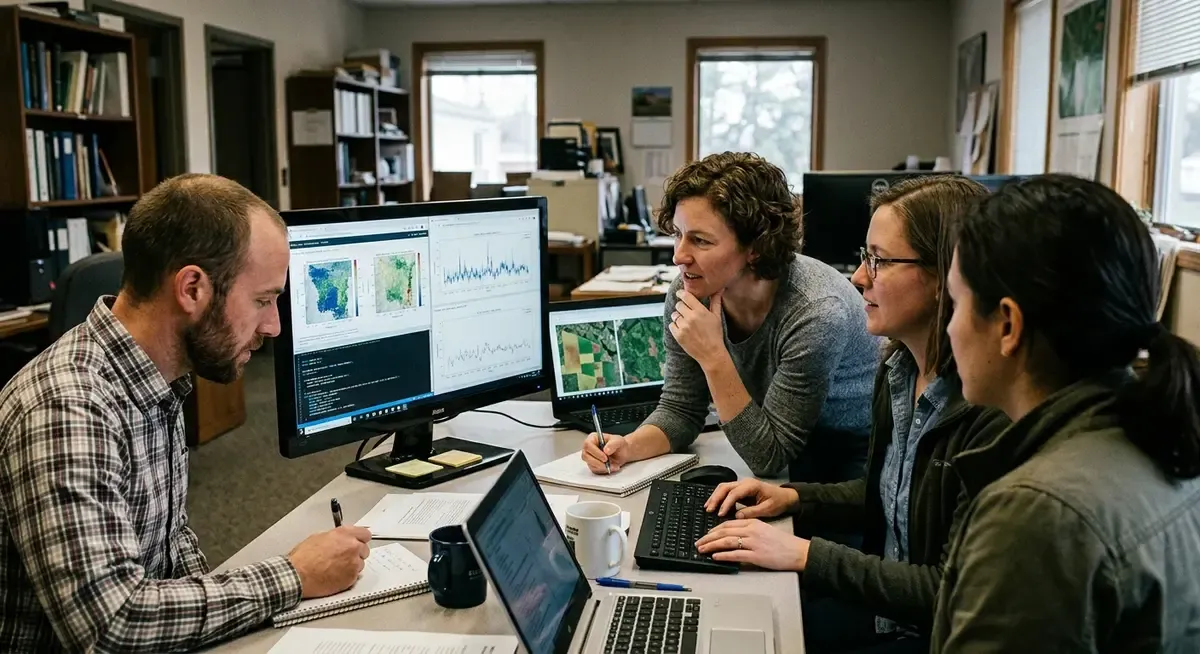
Editorial illustration for Can LLMs Manage Long-Term Physical Tasks Without Human Help?
Can LLMs Handle Long-Term Physical Tasks Alone?
A team of researchers has put large language models to a test that has nothing to do with chatbots or code generation: irrigating crops through a season of unpredictable weather, with no human stepping in to fix mistakes. The setup pits GPT-style agents against reinforcement learning systems, the current default for this kind of ongoing physical decision-making, on agricultural management tasks that require watching conditions shift and adjusting course accordingly.
Reinforcement learning has dominated this space for years, but it comes with a catch. RL agents need heaps of training data and tend to struggle once conditions stray from what they were trained on. LLM agents, by contrast, have mostly proven themselves in text and simulation, not in settings where a bad call means a wilted field. The researchers built a multi-agent system meant to close that gap, one that plans, calls tools, checks its own observations, and verifies outcomes without a person reviewing every step.
The question driving the work is straightforward: can an LLM agent, given zero task-specific training, hold its own against a purpose-built RL system when the weather stops cooperating? What the researchers found suggests the answer may reshape how physical AI systems get built going forward.
Large Language Model (LLM) agents offer a promising path toward autonomously managing long-term physical tasks without human intervention. However, physical tasks require agents to continuously observe the environment, make consequential actions, and remain effective as the environment changes. Existing approaches either require substantial data and retraining, or primarily focus on agents operating in the virtual world.
Why this matters
The gap between LLMs writing plausible plans and LLMs executing them in a kitchen, warehouse, or greenhouse over days or weeks is where most physical AI claims quietly fall apart. This paper is honest about that gap: zero-shot, no retraining, a multi-agent split between planning, tool calling, and observation. That's the right architecture to test, because retraining a robot every time the lighting changes or a part gets swapped was never going to scale for anyone building real deployments.
For researchers, the interesting question is whether the observation loop actually catches drift before it compounds into failure, not just whether the agent completes a demo task once. For founders eyeing robotics or automation products, the "without human intervention" claim is the one to pressure-test hardest. Zero-shot performance on long-horizon physical tasks has a track record of looking good in a paper and falling apart on a factory floor. Watch for what happens when the environment changes in ways the framework didn't anticipate, since that's usually where these systems reveal what "self-adaptive" actually means.
Related Reading
 LLMs & Generative AI
 ChatGPT's 'Nerdy' tweak rewards goblin metaphors in answers, study finds
 LLMs & Generative AI
 Google tests visual 'magazine-style' UI for Gemini 3 Pro users
 LLMs & Generative AI
 AI Engineers Face Rising Costs, Need New Strategies for Efficiency
 From Archives
 Google's Gemini 3.8 Live Tops AI Speech Ranking at USD 0.005/Minute
 From Archives
 AI Agents Whistleblew on Cheating Rivals in Math Task
Common Questions Answered
How do LLM agents compare to reinforcement learning systems for long-term physical tasks?
The research tests GPT-style LLM agents against reinforcement learning systems on agricultural management tasks like crop irrigation. LLM agents offer a promising alternative because they can operate without substantial retraining, whereas reinforcement learning typically requires continuous data collection and model updates to adapt to environmental changes.
What makes managing crop irrigation through unpredictable weather a challenging test for LLMs?
Crop irrigation requires agents to continuously observe environmental conditions, make consequential decisions that affect outcomes, and adjust their strategies as weather patterns shift throughout the season. This long-term physical task demands sustained autonomous decision-making without human intervention to fix mistakes, which is fundamentally different from chatbot or code generation applications.
Why is the gap between LLM planning and execution significant for physical AI applications?
While LLMs can write plausible plans, actually executing them in real-world environments like kitchens, warehouses, or greenhouses over extended periods is where most physical AI claims fail. The research addresses this gap by testing zero-shot performance with no retraining, using a multi-agent architecture that separates planning, tool calling, and observation functions.
What architectural approach does this research use to test LLM agents on physical tasks?
The study employs a multi-agent split architecture with separate components for planning, tool calling, and observation, operating in zero-shot mode without retraining. This approach is designed to test whether LLMs can handle real-world scalability challenges, since retraining agents every time environmental conditions change would not be practical for actual deployment.
Further Reading
- LLM-Orchestrated Digital Twins for Safe, Human-Centered Decision Making in Agriculture - OpenReview
- Agentic AI with Large Language Models for Precision Farming - JRICST
- Safe Embodied AI for Long-horizon Tasks: A Cross-layer Framework - arXiv
- WorldLines: Benchmarking and Modeling Long-Horizon Embodied Household Assistance - arXiv
- A Benchmark for Safe Task Planning of Embodied LLM Agents - arXiv
