
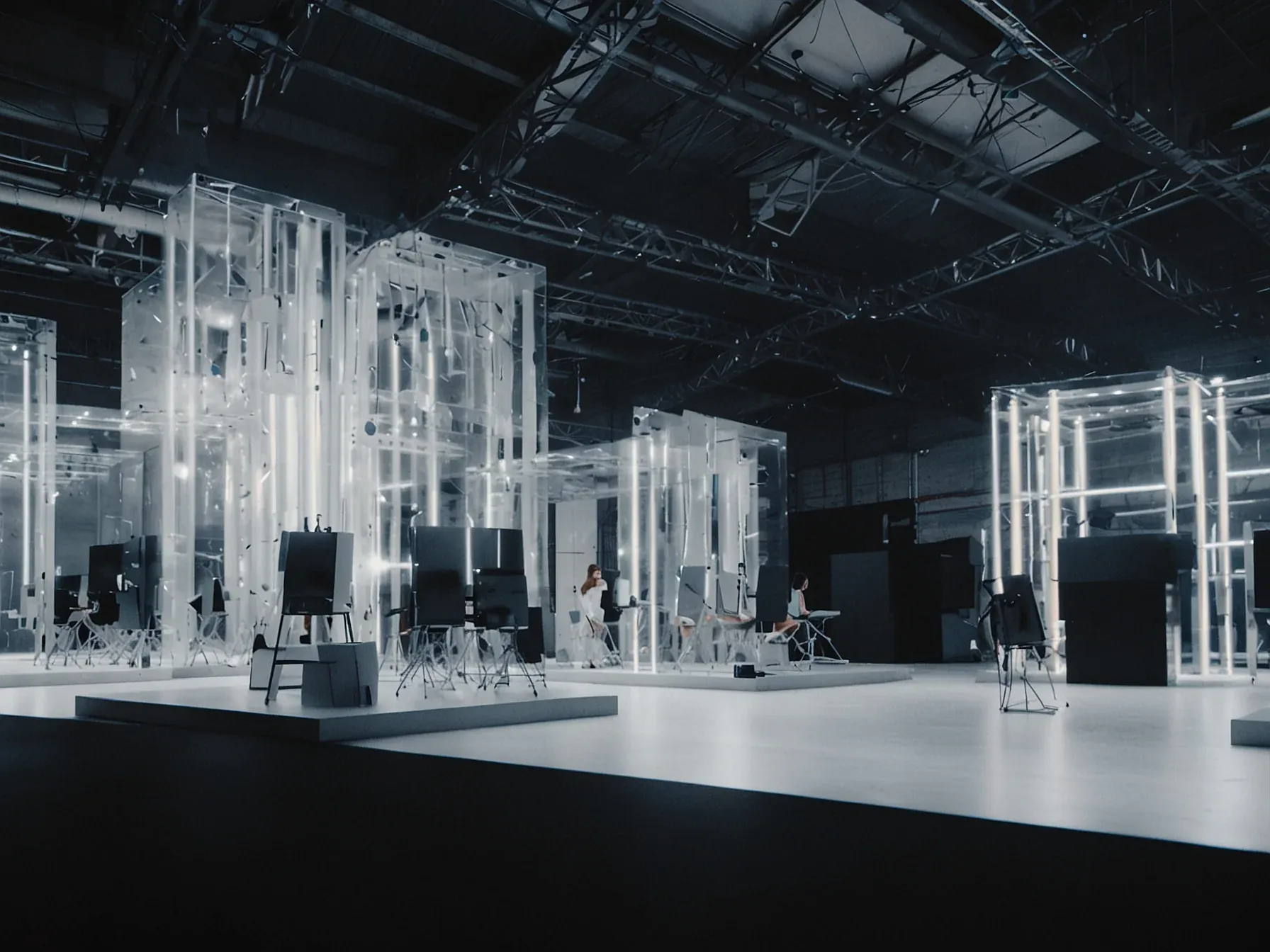
Editorial illustration for Asteria and InterPositive Offer AI Tools to Accelerate Film Production Costs
AI Startups Revolutionize Film Production Costs
Asteria and InterPositive Offer AI Tools to Accelerate Film Production Costs
Hollywood's AI whispers have stopped. Now, there's a pitch. Two firms, Asteria and InterPositive, are selling studios on a simple, even boring idea: use our software to make movies faster.
Keep the budget flat. It’s a practical argument stripped of hype. And it’s finally cutting through.
The caution is gone. For years, outside of Netflix’s very public bets, studios treated AI like a secret experiment. That’s over.
The turning point came from an unexpected quarter: Adobe. The company that built tools for an entire creative industry announced partnerships to bake "IP-safe" AI directly into its editing suites. The fantasy became a feature.
A lever to pull.
Asteria and InterPositive both see their products as tools that can help speed production timelines up without spending more money, and that framing seems to be the main thing that's driving more traditional studios to hop on the AI bandwagon. Compared to Netflix, most other production houses haven't been quite as open about their interest in and experimentation with AI. But you can see the industry shifting in a pro-AI direction in things like Adobe's recently announced partnership with multiple studios to develop "IP-safe" models that can be used across the company's larger suite of production tools.
This isn't really about speed. It's about control. The goal is a private model—AI trained only on a studio’s own film library, generating storyboards and effects that never leave the lot. Tools from Asteria and InterPositive are just the path to that closed system.
The industry isn't being remade overnight. It's doing what it always does: absorbing a new technology to guard its old assets and workflows. You won't see this transformation on a red carpet. Look for it in pre-production offices, or on server farms packed with proprietary data.
Related Reading
 Business & Startups
 Nordic pilot adds Gemini for Education, NotebookLM to boost AI literacy
 Business & Startups
 Kling launches Video O1, all-in-one model with MVL bridge using transformer
 Business & Startups
 DeepSeek Seeks More Capital Weeks After USD 7B Funding Round
 From Archives
 Perplexity's Personal Computer makes spare Macs AI agents for professionals
 From Archives
 Perplexity unveils Tely AI for 1‑week content recommendations, no writers needed
Common Questions Answered
How are Asteria and InterPositive using AI to transform film production costs?
Asteria builds custom AI models that can be trained on a studio's own footage, while InterPositive offers plug-in solutions for visual effects creation. Both companies aim to reduce production timelines and costs by leveraging AI tools that can streamline traditional filmmaking processes.
What makes Asteria's approach to AI model training unique in the film industry?
Asteria specializes in creating custom AI models that can be specifically trained on a studio's existing footage, allowing for more tailored and precise content generation. This approach enables studios to develop AI tools that are directly aligned with their specific visual style and production needs.
Why are traditional studios becoming more interested in AI film production tools?
Studios are increasingly attracted to AI tools that can potentially reduce production timelines and costs without significantly increasing budgets. Companies like Asteria and InterPositive are positioning their solutions as practical allies that can help streamline complex filmmaking processes, making AI more appealing to traditional production houses.
Further Reading
- Papers with Code - Latest NLP Research — Papers with Code
- Hugging Face Daily Papers — Hugging Face
- ArXiv CS.CL (Computation and Language) — ArXiv
