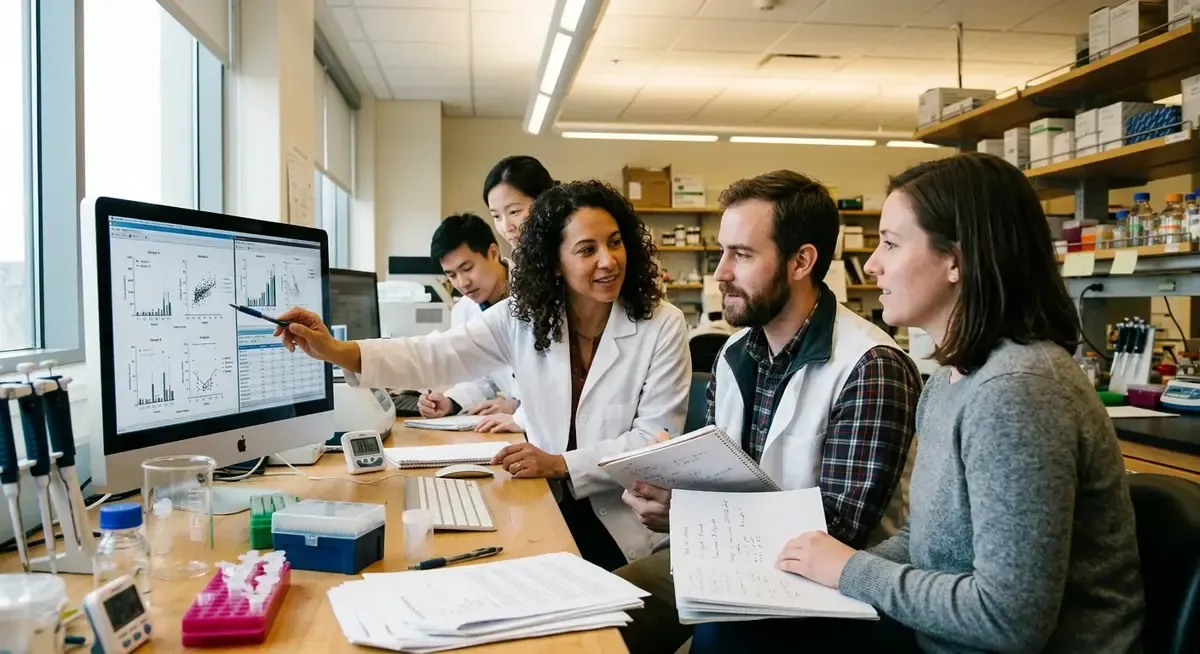
Editorial illustration for Anthropic publishes first AI biology lab findings
Claude Discovers Unknown Virus System in DNA Database
Anthropic publishes first AI biology lab findings
Claude spent less than 24 hours combing through a DNA database this week and came back with something even its makers can't fully explain. Anthropic says its AI biology lab has produced its first real find: a system inside bacteria-infecting viruses that nobody had flagged before, built around a stretch of repeating DNA that looks a lot like CRISPR, the gene-editing tool that's already spun off a wave of new medicines.
The setup was 950 agents working for under a day, burning through 210 million tokens as they sifted genetic sequences. One agent, reading code near a known enzyme, stopped and typed something close to a double-take. Anthropic had seen that enzyme before. What it hadn't seen was the machinery sitting next to it, a combination the company says only shows up in systems built to cut, copy, and paste DNA.
CEO Dario Amodei is careful about how much credit to hand Claude here, but he's also floated a bigger idea: that this newly spotted system, which the team is calling ART, might turn out to be a new kind of gene editor.
Anthropic said its AI biology lab just made its first discovery, identifying an unfamiliar system inside viruses that could offer new gene-editing clues.
Why this matters
Anthropic is framing Claude as a research partner, not just a coding assistant, and the CRISPR-like find is the first receipt. 950 agents burning 210 million tokens in under a day to flag an unfamiliar viral system is a real signal of what agentic swarms can do against messy biological data. But the honest part of this story is that nobody, including Anthropic, knows what the system does yet.
That's the gap between "Claude found something interesting" and "Claude made a discovery." For researchers, this is a genuine lead worth chasing in a lab, not a headline to take at face value. For founders and developers watching Anthropic's self-reported benchmarks (that 26% "leads" claim included), the pattern is familiar: impressive scale, thin independent verification. We'd treat this less as proof that AI is doing biology now and more as a proof of concept for agent orchestration at volume.
The thing to watch is whether wet-lab scientists confirm the mystery system does anything at all.
Related Reading
Browse all Anthropic news → LLMs & Generative AI
 ChatGPT's 'Nerdy' tweak rewards goblin metaphors in answers, study finds
 LLMs & Generative AI
 Google tests visual 'magazine-style' UI for Gemini 3 Pro users
 LLMs & Generative AI
 AI Engineers Face Rising Costs, Need New Strategies for Efficiency
 Related Topic
 Claude gains shared context in Excel, PowerPoint; Microsoft adds Copilot Cowork
AI Tools & Apps
 Related Topic
 Trump cracks down on Anthropic after Amazon tip; staff largely foreign
Open Source
 From Archives
 Appeals Court Panel Divided Over Pentagon's Anthropic Designation
 From Archives
 The Download: AI lie detectors, young organ limits, and Batman's seat effect
 From Archives
 Federal Court Upholds Pentagon's Security Risk Label for Anthropic
Open Source
 From Archives
 Anthropic to Pay Akamai USD 11.6 Billion for Cloud Services
Open Source
Common Questions Answered
What discovery did Anthropic's AI biology lab make using Claude?
Claude identified an unfamiliar system inside bacteria-infecting viruses that features a stretch of repeating DNA resembling CRISPR, the gene-editing tool. This discovery was made by 950 AI agents working through a DNA database in less than 24 hours, burning through 210 million tokens to flag this previously undetected viral system.
How does Anthropic's agentic swarm approach differ from traditional AI research methods?
Anthropic deployed 950 agents working in parallel to process messy biological data, demonstrating the capability of agentic swarms to analyze complex datasets at scale. This approach allowed Claude to comb through a DNA database and identify novel patterns in under a day, showing a new model for how AI can function as a research partner rather than just a coding assistant.
What is the significance of the CRISPR-like system found in the viral genome?
The discovery of a CRISPR-like system in bacteria-infecting viruses could potentially offer new insights for gene-editing applications and therapeutic development. Since CRISPR has already spawned a wave of new medicines, this related system found by Claude may unlock additional gene-editing tools and biological mechanisms previously unknown to researchers.
Why does Anthropic acknowledge uncertainty about the viral system Claude discovered?
Anthropic is being transparent that while Claude successfully identified an interesting and unfamiliar system within the viral genome, neither the AI nor its creators fully understand what this system actually does yet. This distinction highlights the gap between finding something novel and making a complete scientific discovery with understood function and applications.
Further Reading
- Anthropic says its biology lab has already found something big - TechCrunch
- Anthropic is operating a lab that conducts biology experiments - TechCrunch
- Anthropic's A.I. Is Teaching Itself Biology. Now It's Made a Discovery. - The New York Times
- Anthropic says Claude AI helped discover novel enzyme system - Reuters
- Anthropic's Secretive AI-Powered Wet Lab Breaks Cover and Makes First Discovery - The Scientist
