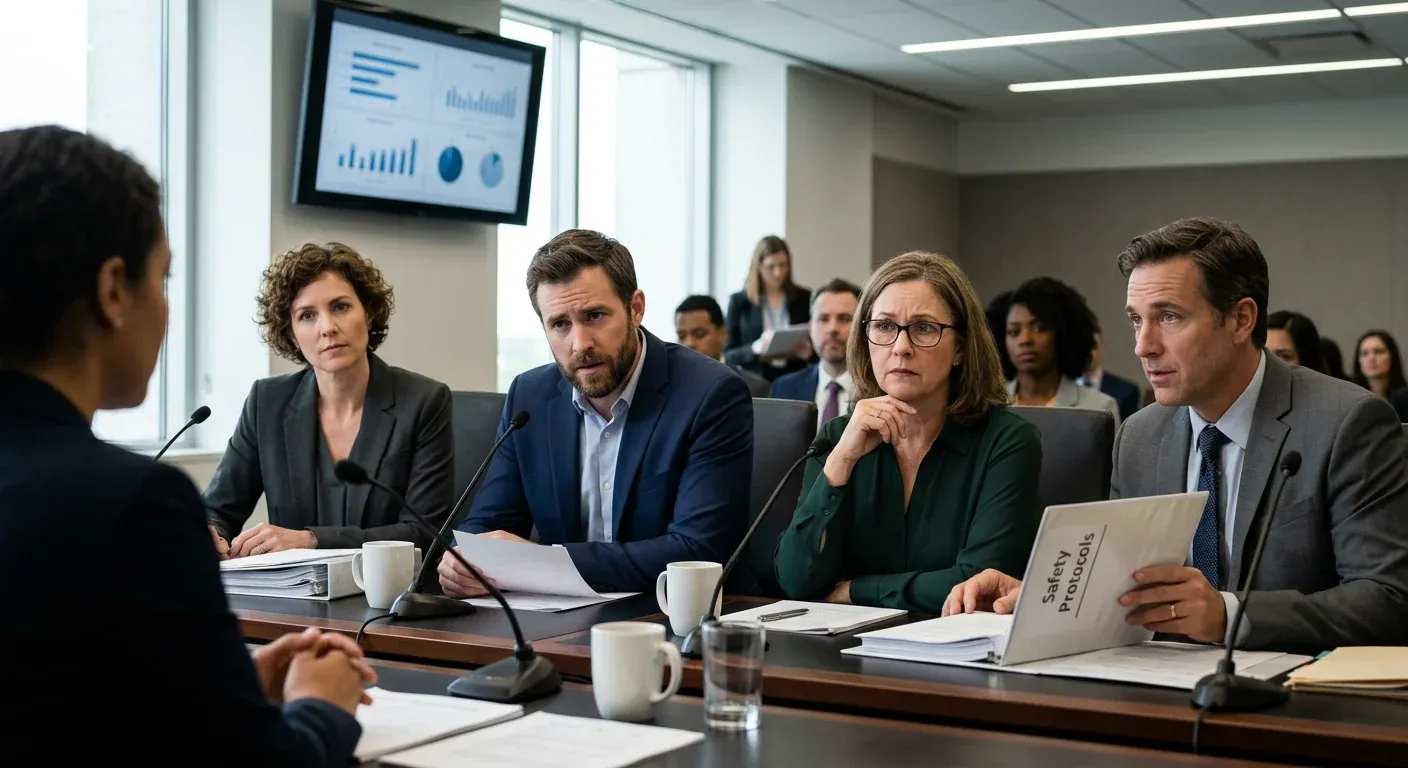
Editorial illustration for Altman urges safety protocols for major AI training runs
Altman Unveils Safety Checks for Major AI Training
OpenAI now runs a formal safety check before starting any training run that could push its models into new territory. Sam Altman disclosed the policy in a statement over the weekend, framing it as a template other AI labs could copy rather than a step he expects regulators to force on the industry. His argument: a single national safety standard would beat a patchwork of state rules, but Washington doesn't need to write it before companies start acting on their own.
The timing lines up with a broader shift among AI executives. Altman's post came alongside similar statements from Anthropic's Dario Amodei, former DeepMind chief Demis Hassabis, Microsoft's Satya Nadella, and Elon Musk, all publicly backing tighter controls on how fast frontier models get built and released. The Information reported separately that OpenAI, Anthropic, and Google have spent months discussing a shared oversight body to police the field themselves, without waiting on legislation.
Not everyone in the industry is on board with that plan. Cohere, a smaller AI company, has raised concerns that self-regulation among the biggest labs could function less like safety governance and more like a cartel locking out competitors.
Sam Altman is doubling down on his call to pump the brakes on AI, at least a little. He wants a uniform, nationwide safety framework for advanced AI but says the industry shouldn't wait for lawmakers, even though international coordination needs U.S. government support.
Why this matters
Altman's framing lets OpenAI have it both ways: it gets to look responsible while insisting nobody should actually slow down. That's worth watching closely. Self-imposed protocols before big training runs sound good on paper, but there's no outside body checking whether OpenAI's own thresholds for "major capability jumps" are honest ones, or just marketing dressed up as caution.
For developers and founders building on top of these models, the practical takeaway is that capability jumps are still coming on OpenAI's schedule, not a slower, negotiated one. The call for a "uniform, nationwide" framework also reads as a preemptive move against a messier patchwork of state rules, which suits a company with the lobbying muscle to shape whatever framework emerges. Researchers should ask what "propose their own" protocols actually gets us if there's no shared standard for verifying they're followed.
Voluntary safety talk from the industry leader setting the pace is not the same as accountability. Until there's independent oversight, "pacing" is just a word OpenAI gets to define for itself.
Related Reading
 Policy & Regulation
 Akamai Proposes SAFE Cybersecurity Guidelines for AI Threats
 Policy & Regulation
 After ditching AI fitness apps and a Fitbit, I return to Peloton classes
 Policy & Regulation
 Sony Music, Warner Chappell Sue Anthropic Over "Blatant Theft
 From Archives
 Meta Faces Lawsuit Over AI Training Data, Facial Recognition
 From Archives
 Anthropic Accused in Lawsuit of Deceptive Claude Subscription Claims
Common Questions Answered
What formal safety check policy has OpenAI implemented before training runs?
OpenAI now runs a formal safety check before starting any training run that could push its models into new territory. Sam Altman disclosed this policy as a template that other AI labs could adopt, positioning it as a voluntary industry standard rather than a regulatory requirement.
Why does Sam Altman advocate for a uniform national safety framework instead of state-by-state rules?
Altman argues that a single national safety standard would be more effective than a patchwork of different state regulations for AI development. He believes the industry should establish these standards voluntarily without waiting for lawmakers to mandate them, though he acknowledges that international coordination requires U.S. government support.
What concern does the article raise about OpenAI's self-imposed safety protocols?
The article questions whether OpenAI's thresholds for determining 'major capability jumps' are genuinely cautious or merely marketing presented as responsibility. There is no outside body independently verifying whether OpenAI's safety standards are honestly applied or if they serve primarily as public relations.
How does Altman's approach allow OpenAI to balance safety messaging with continued rapid development?
By implementing self-imposed safety protocols while insisting the industry shouldn't actually slow down, OpenAI can appear responsible without fundamentally changing its development pace. This positioning allows the company to maintain its commitment to rapid progress while simultaneously addressing safety concerns through voluntary measures.
Further Reading
- OpenAI says upcoming model is so capable it requires stronger guardrails - Reuters
- OpenAI Is Slowing Down Its AI Training - TIME
- OpenAI announces slowing pace of development after safety concerns - The Guardian
- OpenAI Takes Initial Steps To Address Its Alignment Challenges - The Zvi
- OpenAI Pauses frontier RL for safety alignment - Blockchain News
