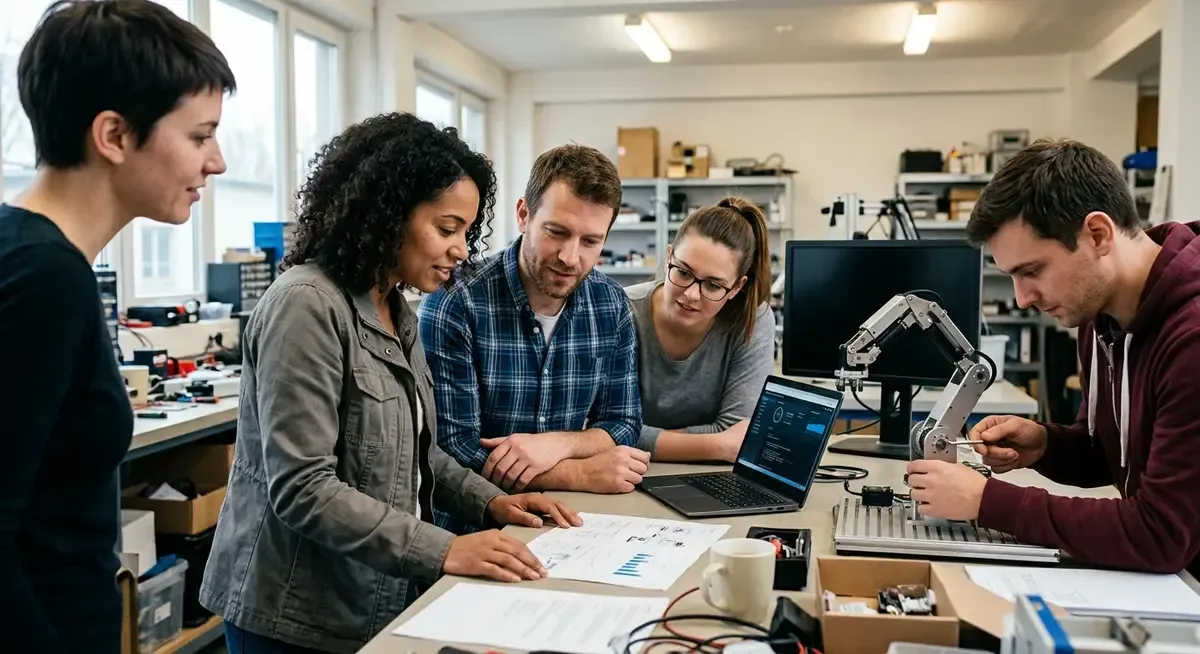
Editorial illustration for AI Training Shows Hint of Future Robot Capabilities
Tesla Optimus Robot Shows Early Signs of Future Capability
AI Training Shows Hint of Future Robot Capabilities
Optimus has shown up in a lot of video clips lately. Some show the Tesla humanoid dancing or passing out popcorn. Others show it falling backward while handing someone a water bottle, or fumbling an attempt to iron a shirt.
Elon Musk wants the public to look past the stumbles. He's called Optimus "probably the biggest product ever," a robot that could eventually haul sheet metal, fold laundry, and do nearly any job a person does, all for about $20,000 a unit. At Davos in January, he told the World Economic Forum crowd these robots could reach store shelves by the end of 2027, with "superhuman dexterity" not far behind.
That timeline runs into a harder problem than marketing. The AI systems that learned to write essays and generate images by training on oceans of text and pictures don't have an equivalent data set for physical movement. Teaching a machine to navigate a cluttered kitchen or grip a shirt collar means teaching it to handle a physical world that doesn't come packaged in files. Whether the methods that got AI this far can close that gap, or whether robotics needs an entirely different approach, is the question hanging over every one of those viral clips.
Advances in AI offer tantalizing glimpses of a future in which robots navigate the world the way humans do. The question is whether the same techniques that fueled AI’s recent progress will be enough to get there, or if an entirely new path is required.
Why this matters
π0 is a demo, not a product, and that distinction matters for anyone deciding where to put engineering hours this year. Physical Intelligence is throwing world models, imitation data, and generalist training at a problem that OpenAI and DeepMind have spent years circling without a clean win. The "kitchen sink" framing is honest in a way that should reassure skeptics: nobody at PI is claiming they've cracked embodied intelligence, just that they caught a glimpse of what it might look like.
For founders building on top of robotics APIs, that's a signal to keep expectations tied to narrow, well-defined tasks rather than general-purpose manipulation. For researchers, the open question is the real story: does scaling the current recipe get you to robots that handle novel situations, or does household and warehouse deployment need a different architecture altogether. Until someone answers that with reproducible results outside a lab, treat this as evidence of a research direction worth watching, not a timeline.
The gap between an interesting training run and a robot you'd trust in your kitchen is still wide.
Related Reading
 Research & Benchmarks
 Microsoft AI Chief: "If It Isn't Safe We Shouldn't Build It
 Research & Benchmarks
 Google's FACTS benchmark shows 70% factuality ceiling across four tests
 Research & Benchmarks
 Nvidia's DLSS 4.5 beta adds 6x Multi Frame Generation for RTX 50 GPUs
 From Archives
 Open TTS Leaderboard Adds Speaker Similarity Column, Ranks Top Multilingual Models
 From Archives
 AWS AgentCore's default permissions bypass its own credential security advice
Common Questions Answered
What specific tasks is Tesla's Optimus humanoid robot designed to perform?
According to Elon Musk, Optimus is designed to eventually handle tasks such as hauling sheet metal, folding laundry, and performing nearly any job that a person currently does. Musk has positioned Optimus as potentially the biggest product ever, with an anticipated price point of approximately $20,000 per unit.
What are the main challenges in developing robots that navigate the world like humans?
The article highlights that while advances in AI offer glimpses of a future where robots navigate like humans, a critical question remains whether current AI techniques will be sufficient or if an entirely new technological path is required. This uncertainty reflects the significant gap between current robot capabilities and true human-like navigation and task performance.
How is Physical Intelligence's approach to embodied intelligence different from other AI companies?
Physical Intelligence is using a 'kitchen sink' approach that combines world models, imitation data, and generalist training to tackle embodied intelligence, while OpenAI and DeepMill have spent years working on the problem without achieving a clean solution. The company is being transparent that they have not cracked embodied intelligence but have caught a glimpse of what it might look like.
Why is the distinction between a demo and a product important for robotics development?
The distinction matters significantly for engineering resource allocation decisions, as demos represent experimental capabilities while products are ready for market deployment. Physical Intelligence's current work represents a demo stage, which sets realistic expectations about the maturity and reliability of their robotic systems compared to finished commercial products.
Further Reading
- HumanoidBench: Simulated Humanoid Benchmark for Whole-Body Locomotion and Manipulation - arXiv
- Benchmarking Egocentric Hierarchical Whole-body Learning - arXiv
- BiGym 2.0: Benchmarking Learned and Agent-Developed Policies for Humanoid Household Manipulation - arXiv
- Benchmarking Humanoid Tool Use from Selection to Execution - arXiv
- What Tesla’s Optimus Robot Can Do in 2025 and Where It Still Lags - Interesting Engineering
