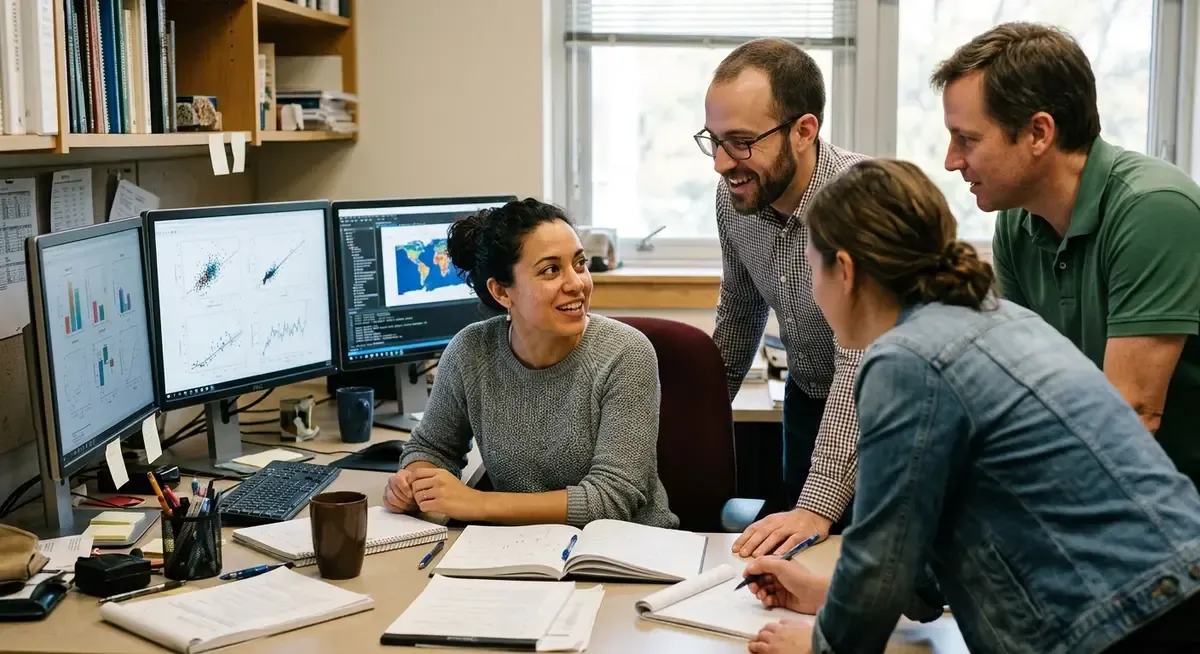
Editorial illustration for AI solves hundreds of math problems, triggering calls for limits
AI Cracks Hundreds of Math Problems, Experts Warn
AI solves hundreds of math problems, triggering calls for limits
Neil Thompson spent half an hour at MIT last week making a case that should worry anyone who thought AI's reach into math was a one-field problem. Thompson, who studies how computing advances shape innovation, laid out data on six areas of theoretical science where AI models are closing in fast: probability, statistics theory, economic theory, high-energy theory, gravitation and cosmology, and quantum physics. The numbers are stark.
Between mid-2024 and mid-2026, the best models went from solving roughly 2 percent of theoretical problems in these fields to about 35 percent. Thompson ran the study with PhD student Gabriel Manso and research scientist Claudio Mayrink Verdun, pulling problems straight from papers posted online between December 2025 and May 2026 and testing them against a run of OpenAI models, from o1 through GPT-5.5. The design matters: solutions appeared in papers published after the training cutoff for the newest models tested, so there was no way to simply recall an answer.
Whatever these systems produced, they had to work out on their own.
As mathematicians reel from the way AI is automating their field, Thompson’s latest study suggests that probability, statistics theory, economic theory, high-energy theory, gravitation and cosmology, and quantum physics may be next, thanks to the rapidly evolving capabilities of frontier models.
Why this matters
The math crisis is a preview, not an anomaly. If Thompson's data holds, the same pattern that let OpenAI and others rack up hundreds of solved problems in weeks is about to hit probability theory, economic theory, and quantum physics on a similar timeline. For researchers in those fields, the lesson from mathematicians isn't "AI will replace you," it's "the value of your work is about to get redefined faster than your institutions can adjust." Journals, tenure committees, and funding bodies still reward final proofs and clean results. They're not built to credit the reasoning process AI tends to skip over, which is exactly what mathematicians are now arguing was the point all along.
For founders and developers building research tools, this is a narrow window. The fields Thompson flags aren't fully saturated yet. Whoever ships systems that preserve and expose intermediate reasoning, not just answers, will matter more to working scientists than another benchmark-topping solver. The math field's pushback is a signal: demand for transparent process is going to outpace demand for raw output, and the tools that ignore that will get adopted fast and resented just as quickly.
Related Reading
 Research & Benchmarks
 Microsoft AI Chief: "If It Isn't Safe We Shouldn't Build It
 Research & Benchmarks
 Google's FACTS benchmark shows 70% factuality ceiling across four tests
 Research & Benchmarks
 Nvidia's DLSS 4.5 beta adds 6x Multi Frame Generation for RTX 50 GPUs
 From Archives
 Anthropic Self-Replicating AI Warning: Gemma 4 Split Across 15 Devices
 From Archives
 Floqer's AI agents research sales prospects so teams don't have to
Common Questions Answered
What six areas of theoretical science does Neil Thompson's research indicate AI models are closing in on?
According to Thompson's MIT study, AI models are rapidly advancing in probability, statistics theory, economic theory, high-energy theory, gravitation and cosmology, and quantum physics. Thompson presented data showing that between mid-2024 and mid-2026, the best AI models demonstrated significant progress in solving problems across these six theoretical science domains.
How quickly has AI progressed in solving mathematical problems according to the article?
The article indicates that AI models went from solving a limited number of mathematical problems to solving hundreds of them between mid-2024 and mid-2026, representing a dramatic acceleration in capabilities. This rapid advancement has prompted calls for limits on AI's reach into mathematical and scientific fields.
What does Neil Thompson suggest is the real concern for researchers beyond mathematics?
Thompson warns that the same pattern enabling AI to solve hundreds of math problems in weeks will soon impact probability theory, economic theory, and quantum physics on a similar timeline. For researchers in these fields, the key lesson is that the value and definition of their work will be redefined faster than their institutions can adapt, rather than facing outright replacement.
Why does the article describe the current math crisis as a preview rather than an anomaly?
The article suggests that mathematicians' experience with AI automation is not an isolated incident but rather a harbinger of what other scientific fields will soon experience. If Thompson's data holds true, the rapid advancement pattern in mathematics will repeat across probability, economic theory, and quantum physics, affecting how institutions like journals and tenure committees evaluate research.
Further Reading
- HorizonMath: Measuring AI Progress Toward Mathematical Discovery with Automatic Verification - arXiv
- FrontierMath: LLM Benchmark for Advanced AI Math Reasoning - Epoch AI
- Pushing the Boundaries of AI in Mathematics - Epoch AI
- What Is the Frontier Math Benchmark? Why Open Research Problems Matter for AI - MindStudio
- AI in Math: Data & Research - Epoch AI
