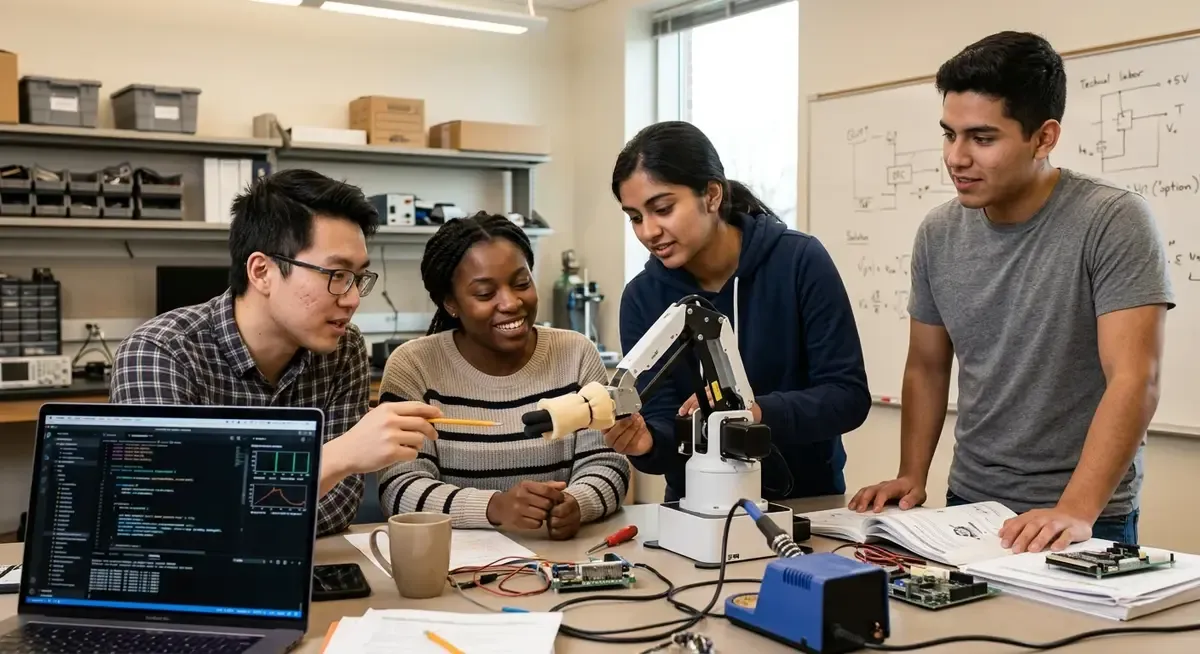
Editorial illustration for AI-Powered Robot Learns How to Assist Stroke Patients in Therapy
AI Robot Transforms Stroke Therapy Rehabilitation
AI-Powered Robot Learns How to Assist Stroke Patients in Therapy
Fifteen million people worldwide have a stroke every year, and five million of them end up with a permanent disability, according to figures cited by MIT researchers behind a new robotic therapy project. Getting consistent rehab care to that many patients is hard enough on its own. It gets harder when you factor in a shortage of physical therapists that's been building for years, leaving many stroke survivors with less hands-on time than they need to recover motor function.
A team at MIT's Department of Mechanical Engineering thinks part of the fix lies in AI, not to replace therapists, but to stretch their expertise further. Johannes Lachner, who did the work as an MIT-Novo Nordisk Artificial Intelligence Postdoctoral Fellow before moving to Purdue University as an assistant professor, teamed up with Noah Geiger, a former MIT visiting student now at Robert Bosch GmbH, to build a dual-arm robot that learns directly from physical therapists. The system pairs transformer-based diffusion models, the same underlying tech behind AI image generators, with real-time force feedback, letting the robot adjust how much physical support it gives based on what it observes a therapist doing during training sessions.
“A core innovation of our system is that physical therapists can train their own robot using AI, enabling personalized, scalable support tailored to each patient’s needs.”
Why this matters
For anyone building AI systems meant to work alongside people, this MIT project is a useful test case. The team didn't train a robot to mimic a therapist's script. They trained it on the underlying decision-making, how much physical assistance to give, when to back off, when to push, the same generative modeling approach behind image tools like ChatGPT's, but pointed at physical behavior instead of pixels. That's a meaningful distinction for founders chasing "AI for healthcare" headlines: the hard part isn't slapping a model onto a robot arm, it's capturing the judgment calls a skilled human makes moment to moment.
The physical therapist shortage gives this work a real deadline, not a hypothetical one. Fifteen million strokes a year, five million people left with lasting impairments, and not enough clinicians to go around. If a robot can reliably deliver "just the right amount" of support, that's a genuine gap being addressed. Worth watching: how MIT's team validates safety and effectiveness before this moves anywhere near a real clinic.
Related Reading
 Research & Benchmarks
 Microsoft AI Chief: "If It Isn't Safe We Shouldn't Build It
 Research & Benchmarks
 Google's FACTS benchmark shows 70% factuality ceiling across four tests
 Research & Benchmarks
 Nvidia's DLSS 4.5 beta adds 6x Multi Frame Generation for RTX 50 GPUs
 From Archives
 LiveKit Updates Voice AI Benchmark to 10k Token Prompts, Citing Real-World Use
 From Archives
 Google AI's EnvHarness Makes Static AI Training Worlds Adaptable
Common Questions Answered
How does the MIT AI-powered robot system enable personalized stroke rehabilitation therapy?
Physical therapists can train their own robot using AI, allowing the system to be customized to each patient's specific needs and recovery goals. Rather than following a scripted approach, the robot learns the underlying decision-making process of how much physical assistance to provide, when to reduce support, and when to increase intensity for optimal patient outcomes.
What is the key difference between this MIT robot's training approach and traditional therapy mimicry?
The MIT team trained the robot on the underlying decision-making and physical behavior patterns of therapists rather than simply programming it to mimic a therapist's script. This generative modeling approach, similar to how image generation tools work, allows the robot to understand the nuanced judgment calls therapists make during rehabilitation sessions.
Why is AI-powered robotic therapy important for addressing the stroke rehabilitation shortage?
With fifteen million people worldwide suffering strokes annually and five million experiencing permanent disability, the shortage of physical therapists has left many stroke survivors without adequate hands-on rehabilitation time. AI-powered robots can provide consistent, scalable support to help address this gap and enable more patients to receive the therapy they need for motor function recovery.
What specific challenge in stroke patient care does this MIT robotic system address?
The system tackles both the high volume of stroke patients requiring rehabilitation and the chronic shortage of physical therapists available to provide consistent care. By enabling therapists to train robots that can deliver personalized assistance, the technology helps ensure more stroke survivors receive adequate hands-on therapy time for recovery.
Further Reading
- Personalized physical therapy: Stroke rehabilitation powered by AI - MIT News
- Robotic exoskeleton could redefine how stroke survivors relearn to walk - Northwestern University News
- Effects of robotic-assisted upper extremity therapy for stroke rehabilitation: systematic review and meta-analysis - PubMed
- AI-driven hybrid rehabilitation: synergizing robotics and electrical stimulation - PMC
- AI-driven Rehabilitation Robotics: Advancements in and ... - PMC
