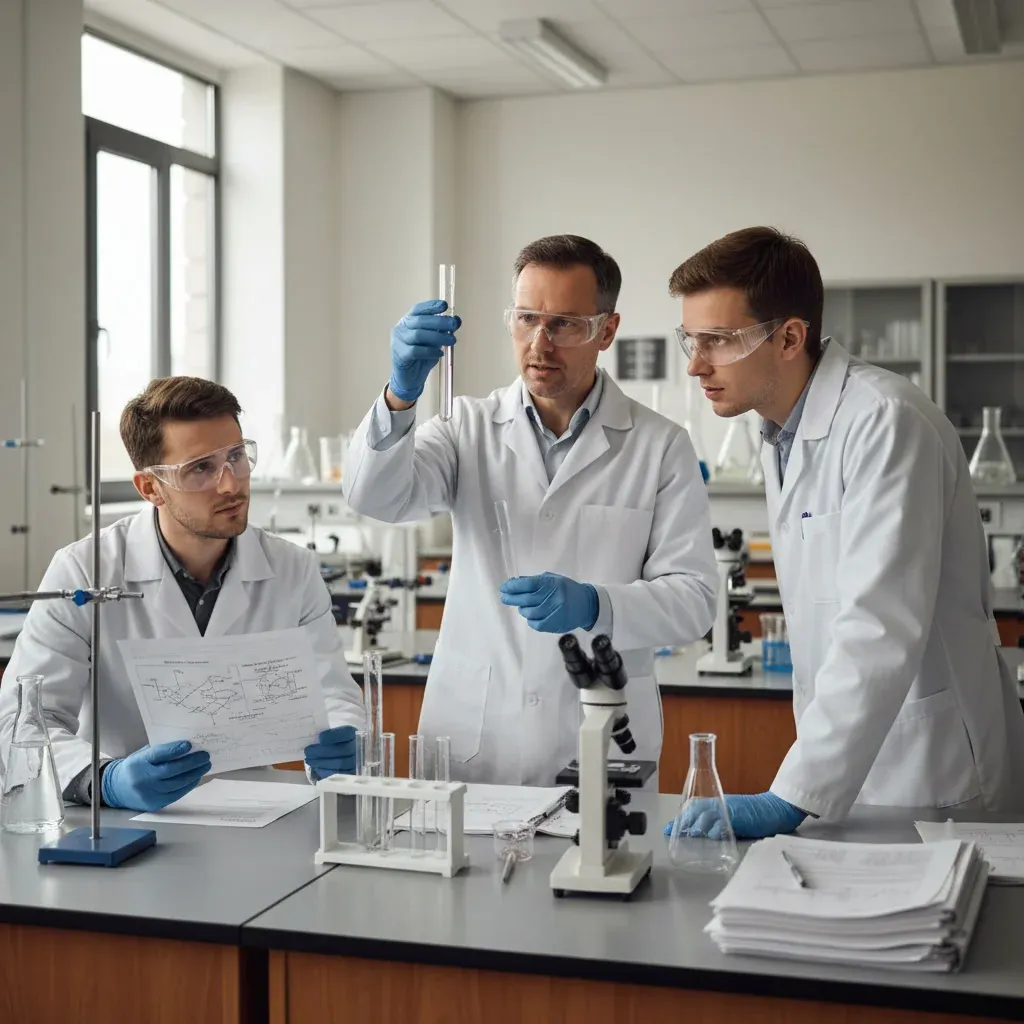
Editorial illustration for AI models learn chemistry; talent and collaborations offset location concerns
AI models learn chemistry; talent and collaborations...
Connor Coley started his career as a traditional MIT chemist. Then, he learned to code. That single, practical skill—writing software to parse chemical reactions—rerouted his entire profession into machine learning, where he now builds models to predict molecular behavior. For Coley, talent and collaboration, not a lab's zip code, drive progress.
That was my real entry point into thinking about cheminformatics, thinking about machine learning, and thinking about how we can use models to understand how different chemicals can be made and what reactions are possible,” Coley says.
The outcome is unmistakable in the research. Projects now actively link teams at MIT, Stanford, and beyond through shared models, a direct result of Coley's approach. These AI tools, trained on millions of reaction datasets, are the new meeting place.
Geography is fading. The model itself is the lab.
Related Reading
 Research & Benchmarks
 Microsoft AI Chief: "If It Isn't Safe We Shouldn't Build It
 Research & Benchmarks
 Google's FACTS benchmark shows 70% factuality ceiling across four tests
 Research & Benchmarks
 Nvidia's DLSS 4.5 beta adds 6x Multi Frame Generation for RTX 50 GPUs
 From Archives
 Real-Time Diffusion on Apple M3 Ultra: CoreML, Quantization, Neural Engine
 From Archives
 Evaluating AI Agents: Does the Engine Grasp Instructions and Reason Facts?
Common Questions Answered
How did Connor Coley transition from traditional chemistry to machine learning?
Connor Coley started his career as a traditional MIT chemist but learned to code, which fundamentally redirected his professional path. He began writing software to parse chemical reactions, which led him into machine learning where he now builds models to predict molecular behavior. This practical coding skill became the catalyst for his entire career transformation.
What role do AI models play in predicting molecular behavior?
AI models trained on millions of reaction datasets are now used to predict molecular behavior, replacing some traditional laboratory work. These models enable researchers to forecast chemical reactions and molecular properties without requiring physical experimentation for every scenario. The models serve as a new collaborative platform where teams can share findings and insights.
How has geographic location become less important in chemistry research according to this article?
Geographic location has become less significant because talent and collaboration now drive progress in chemistry research rather than physical lab locations. Research projects actively link teams at MIT, Stanford, and beyond through shared AI models, allowing seamless collaboration across distances. The AI tools themselves have become the central meeting place, making the model itself function as the lab.
What datasets do the AI chemistry models use for training?
The AI chemistry models are trained on millions of reaction datasets that provide comprehensive information about chemical reactions and their outcomes. These extensive datasets enable the models to learn patterns and make accurate predictions about molecular behavior. The scale of these datasets is crucial to the models' ability to generalize across different chemical scenarios.
Further Reading
- Building AI models that understand chemical principles — MIT News
- Generative AI for computational chemistry: A roadmap to predicting ... — PNAS
- AI models for chemistry: Charting the landscape in materials and life sciences — CAS Insights
- Developing an AI Course for Synthetic Chemistry Students — ACS Publications
- The Best AI for Chemistry in 2026 -Top Tools Transforming the Field — ChemCopilot
