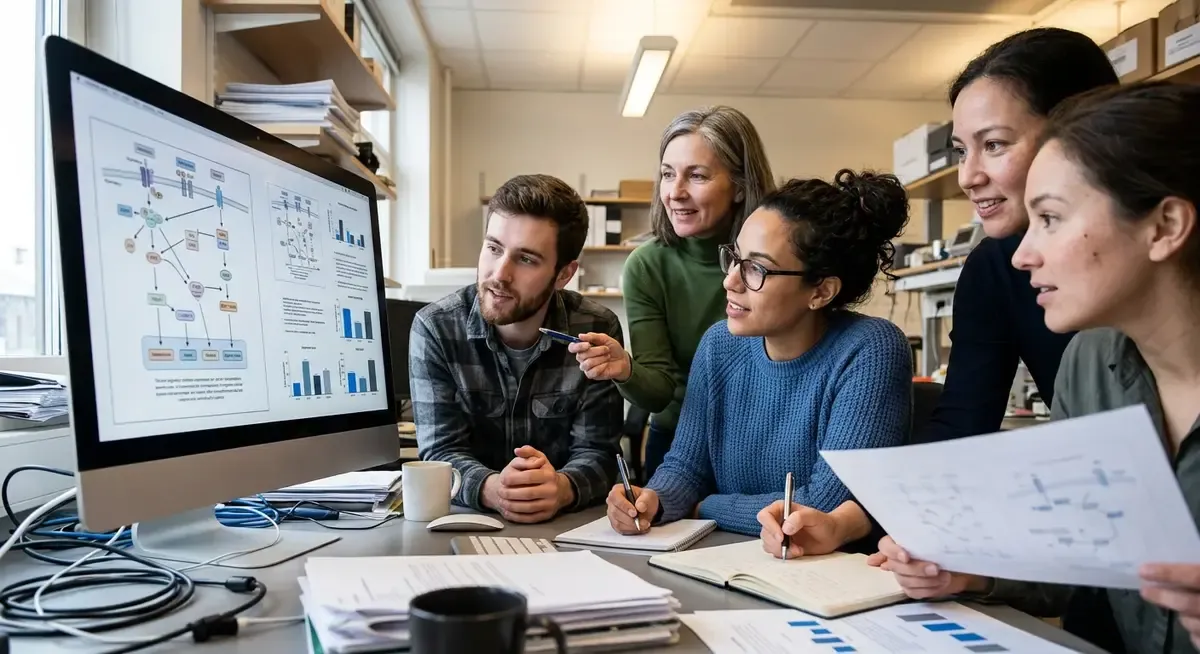
Editorial illustration for AI model decodes the language cells use to communicate, MIT study finds
MIT AI Decodes How Cells Communicate, Study Reveals
A human embryo starts as a clump of identical stem cells and ends up with a liver, a brain, and a few hundred other specialized tissues, each built from cells that somehow knew what to become. That decision doesn't happen in isolation. Cells trade chemical messages with their neighbors, and those messages travel through signaling pathways, multi-step relay systems that convert an external signal into a change in gene activity inside the cell. The result tells a cell where it sits in the body, what point in development it has reached, and what job it needs to do next.
Scientists have wanted a way to read that relay backward, to take a cell and reconstruct the sequence of signals that shaped it. That kind of reconstruction could explain how tissues assemble correctly, and how that assembly breaks down in diseases like cancer or birth defects. The obstacle has been scale: researchers have assumed each signaling pathway behaves differently depending on the cell type it's acting in, which would mean mapping every pathway separately across every cell type, a project too large for standard lab methods to tackle.
A team at MIT and the Whitehead Institute, led by assistant professor Pulin Li and graduate student Nicholas Hutchins, set out to test that assumption.
Now, in a new study led by MIT assistant professor of biology and Whitehead Institute for Biomedical Research member Pulin Li and graduate student Nicholas Hutchins, researchers have discovered that each signaling pathway leaves behind a unique “fingerprint” — a distinctive pattern of gene activity that reflects the particular signals the cell has encountered.
Why this matters
This is a reminder that the most interesting AI applications right now aren't chatbots, they're pattern-recognition tools aimed at biology's oldest unsolved problem: how a single cell becomes a liver, a neuron, a muscle fiber. Pulin Li and Nicholas Hutchins didn't build a model that writes essays. They built one that reads "fingerprints" in gene activity left by signaling pathways, the molecular chatter cells use to decide what to become.
For researchers in AI, this is a useful case study in what a narrow, well-scoped model can do when trained on the right data: find structure that's been invisible to human eyes despite decades of study. For founders eyeing biotech, it's a signal that gene-activity pattern recognition is a real product category, not a thought experiment. We'd push back on any instinct to hype this as "AI decoding life's code" in some sweeping sense.
It decoded one specific kind of cellular signal. The next question worth watching: does this fingerprinting approach generalize across cell types and species, or is it a result specific to the pathways Li's team studied?
Related Reading
 LLMs & Generative AI
 ChatGPT's 'Nerdy' tweak rewards goblin metaphors in answers, study finds
 LLMs & Generative AI
 Google to End Free Access to Gemini AI for Non-Subscribers
 LLMs & Generative AI
 AI Engineers Face Rising Costs, Need New Strategies for Efficiency
 From Archives
 Snyk CTO: Firms patch one bug per eight found, AI companies not paying for mess
 From Archives
 NVIDIA Nemotron 3.5 Super VL customizes agents for domain data, tools
Common Questions Answered
What is the 'fingerprint' that MIT researchers discovered in cell signaling pathways?
According to the MIT study led by Pulin Li and Nicholas Hutchins, each signaling pathway leaves behind a unique 'fingerprint' — a distinctive pattern of gene activity that reflects the particular signals a cell has encountered. This fingerprint allows researchers to decode the chemical messages cells exchange with their neighbors to determine their specialized function in the body.
How do cells decide what specialized tissue to become during embryonic development?
Cells trade chemical messages with their neighbors through signaling pathways, which are multi-step relay systems that convert external signals into changes in gene activity inside the cell. These molecular communications tell a cell where it sits in the body and what specialized role it should take on, allowing a human embryo to develop from identical stem cells into hundreds of different tissue types like the liver and brain.
What makes this MIT AI model different from typical AI applications like chatbots?
Rather than generating text like chatbots, the MIT model is a pattern-recognition tool designed to read and interpret 'fingerprints' in gene activity left by signaling pathways. This AI application addresses one of biology's oldest unsolved problems: understanding how a single cell becomes specialized tissues like a liver, neuron, or muscle fiber.
Who led the MIT research team that discovered this breakthrough in cellular communication?
The study was led by MIT assistant professor of biology and Whitehead Institute for Biomedical Research member Pulin Li, along with graduate student Nicholas Hutchins. Together, they developed the AI model that can decode the distinctive patterns of gene activity created by cellular signaling pathways.
Further Reading
- AI model decodes the language cells use to communicate - MIT News
- Illuminating cell states by a comprehensive and interpretable single cell foundation model - PubMed
- scLong: a billion-parameter foundation model for capturing long-range gene dependencies in single-cell transcriptomics - PubMed
- Artificial intelligence: Accelerating discovery in biology research - Whitehead Institute
