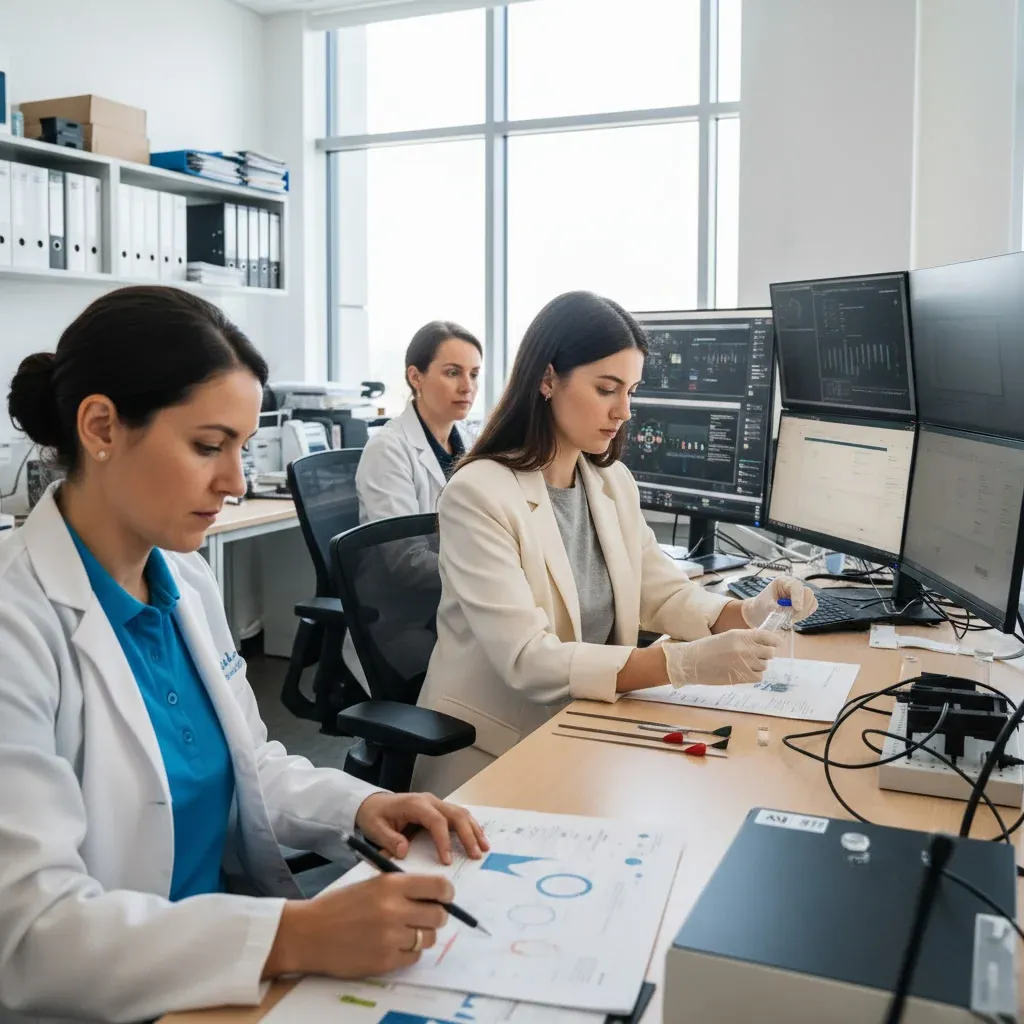
Editorial illustration for AI chemist proposes plans; humans pick four for lab testing, boosting reaction
AI chemist proposes plans; humans pick four for lab...
Forget the hype about AI designing drugs. The real work is much dirtier, happening one stubborn chemical reaction at a time.
Researchers recently turned a model loose on the Chan-Lam coupling, a notoriously sloppy reaction used to build sulfonamides for drug discovery. The AI produced hundreds of proposals. Human chemists sifted the top-ranked ones and picked four to test.
The machine took those plans, ran thousands of high-throughput experiments, and spat back the data. The most interesting result involved an oxidant called TEMPO. Using a mild oxidant to improve this specific reaction was a weird suggestion.
It contradicted standard thinking. But it worked.
Human chemists reviewed the small subset of proposals that ranked highest according to the system and selected four for laboratory testing. Maria AI then translated selected high-level plans into detailed lab instructions, ran thousands of high-throughput experiments, analyzed the raw data, and returned structured results to GPT‑5.4. One of the four selected proposals, OAI-M1-03, suggested using mild oxidants such as TEMPO to improve the performance of the Chan-Lam reaction for sulfonamide synthesis.
Chemists found the suggestion both surprising and interesting. We share the detailed findings from OAI-M1-03 in this blog post and in the paper(opens in a new window). The final research proposal was then used by Maria to generate experimental grids, with slight corrections by humans.
The largest human correction was to avoid dimethyl sulfoxide, or DMSO, as a solvent because chemists were concerned it could react with the stronger oxidants used as comparisons.
This wasn't full automation. The human team made a key solvent swap, nixing DMSO because it might interfere. The final protocol needed only minor tweaks.
The point is the division of labor. The model brute-forced combinatorial possibilities at a scale humans can't match. The chemists provided the veto power and the deep, tacit knowledge of what might explode.
They amplified each other. The output isn't a sentient lab partner. It's a better yield on a reaction that matters, born from a suggestion no chemist would have prioritized.
That's the model. Not a replacement, but a very fast, somewhat surprising intern that never sleeps.
Related Reading
 Industry Applications
 Westinghouse teams with Google Cloud to build AI platform for nuclear power
 Industry Applications
 NVIDIA NeMo powers telco reasoning model for autonomous network workflows
 Industry Applications
 Month-1 Agent Adds Holistic Observability with Trace IDs and Token Tracking
 From Archives
 Typed Answer Contract Prevents RAG Hallucination With Programmatic Signals
 From Archives
 Gemini Update Adds Screen Reactions, AI Video Creation in June 2026
Common Questions Answered
How did researchers use AI to improve the Chan-Lam coupling reaction?
Researchers deployed an AI model to generate hundreds of proposals for optimizing the Chan-Lam coupling, a notoriously difficult reaction used in sulfonamide synthesis for drug discovery. Human chemists then selected the top four proposals to test in the lab, and the AI ran thousands of high-throughput experiments to analyze the results and identify the most promising approach.
What role did human chemists play in the AI-assisted reaction optimization?
Human chemists provided critical oversight and domain expertise throughout the process, including making a key decision to swap solvents by eliminating DMSO to prevent interference. They also applied their deep, tacit knowledge to determine which experimental proposals were viable and which might be dangerous, effectively serving as a veto power to the AI's suggestions.
Why was the solvent swap from DMSO significant in this experiment?
The human team identified that DMSO could potentially interfere with the reaction outcome, so they made the strategic decision to remove it from the protocol. This intervention demonstrates how human chemical intuition and knowledge of molecular interactions complemented the AI's computational approach to achieve better results.
What does this AI chemistry approach reveal about the division of labor between machines and humans?
The AI excelled at brute-forcing through combinatorial possibilities at a scale humans cannot match, while chemists provided essential judgment, safety considerations, and deep tacit knowledge about what might work or fail. Rather than full automation, this collaboration amplified each capability, resulting in improved reaction yields through complementary strengths rather than AI replacing human expertise.
Further Reading
- OpenAI’s AI chemist improved a difficult drug-making reaction by proposing experiments humans selected for lab testing — TechTimes
- OpenAI's Post: A near-autonomous AI chemist improves a challenging reaction in drug discovery — OpenAI (LinkedIn)
- GPT-5.4 drives medicinal chemistry project from literature review to validated experimental result, improving yields in Chan–Lam coupling — Glen Rhodes
- molecule.one — Chemistry AI for Autonomous Discovery — Molecule.one
- OpenAI’s AI Chemist Improved a Difficult Drug-Making Reaction ... — Reddit
