Editorial illustration for AI Agents Raise Ownership Questions at TechCrunch Disrupt 2026
AI Agents Force Founders to Rethink Hiring
AI Agents Raise Ownership Questions at TechCrunch Disrupt 2026
Josh Reeves hired his first ten people at Gusto years before anyone talked seriously about AI agents doing engineering or customer support work. That calculus has changed. Founders building companies now face a decision Reeves never had to make in Gusto's early days: whether the next hire should be a person at all, or a piece of software that can handle research, operations, or code review without a salary, a Slack account, or a seat at the all-hands meeting.
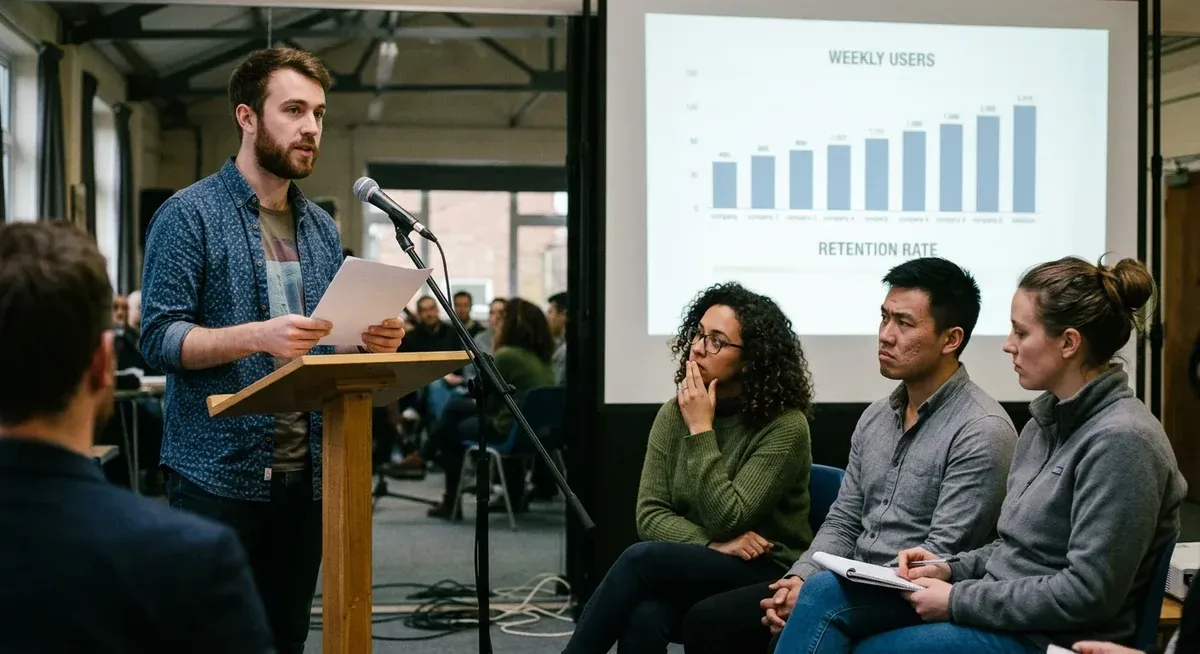
Reeves will take that question to the Builders Stage at TechCrunch Disrupt 2026, alongside Michelle Johnson, senior vice president at Insight Partners, and John Koelliker, CEO and co-founder of Leland. Their session, "Hiring When AI Is a Co-Founder," looks at how early-stage teams are mixing human and AI labor and what that mix demands of a founder trying to keep speed, accountability, and culture intact while headcount stops being the only lever they can pull.
The panel runs October 13-15 at Moscone West in San Francisco, part of a Disrupt lineup expected to draw more than 10,000 startups, investors, and tech decision-makers. Passes are discounted up to $200 before rates rise September 25 at 11:59 p.m. PT, with an added 30% off for group registration.
AI agents are beginning to take on engineering, customer support, research, and operational work that would previously have been assigned to early team members.
Why this matters
For founders, the calculus behind every early hire just got more complicated. It used to be: what role do we need? Now it's: does this need a person at all?
Reeves and his co-panelists at Disrupt made clear this isn't hypothetical anymore. It's showing up in how AI-native companies structure their first ten hires. That's a real shift for anyone building a startup in 2026, not a distant trend to watch from the sidelines.
But the ownership question is the one we'd push on harder. Delegating a task to an agent is easy. Delegating accountability is not.
When something breaks, "the AI did it" isn't an answer investors, customers, or regulators will accept. Teams that treat agent output as reversible and provisional, with a named human backstopping every decision, will handle failures better than teams that treat agents as staff.
Watch which categories of work founders explicitly refuse to delegate. That list will tell you more about where AI agents actually stand today than any capability demo.
Related Reading
 Business & Startups
 Nordic pilot adds Gemini for Education, NotebookLM to boost AI literacy
 Business & Startups
 Kling launches Video O1, all-in-one model with MVL bridge using transformer
 Business & Startups
 DeepSeek Seeks More Capital Weeks After USD 7B Funding Round
 From Archives
 Zuck Absent as AI Products Launch at Tech Event
 From Archives
 OpenAI Proposes Standards for Disclosing AI Model Misbehavior
Common Questions Answered
What types of work are AI agents now capable of handling in startups according to the article?
AI agents are beginning to take on engineering, customer support, research, and operational work that would previously have been assigned to early team members. This represents a significant shift from traditional hiring practices where founders automatically assumed they needed to hire people for these roles.
How has the hiring decision-making process changed for founders building startups in 2026?
The calculus behind early hiring has become more complicated for founders. Previously, founders asked 'what role do we need?' but now they must also consider 'does this need a person at all?' This fundamental shift means evaluating whether an AI agent could handle the work instead of automatically hiring a person.
What advantages do AI agents offer over traditional human employees according to the article?
AI agents can handle work without requiring a salary, a Slack account, or a seat at company all-hands meetings. This makes them an economically attractive alternative for certain roles that would typically require hiring early team members.
Why is Josh Reeves from Gusto discussing AI agents at TechCrunch Disrupt 2026?
Reeves is addressing how the decision to hire AI agents versus people has become a real concern for founders, not just a hypothetical scenario. His experience building Gusto before AI agents existed gives him perspective on how dramatically the startup hiring landscape has changed by 2026.
How are AI-native companies structuring their first ten hires differently than traditional startups?
AI-native companies are incorporating AI agents into their early team structure, fundamentally changing how they approach their first ten hires. This represents a real shift from traditional startup practices where founders would primarily hire human employees for these foundational roles.
Further Reading
- Your startup's next teammate might be an AI agent, and that changes who owns the work - TechCrunch
- A married founder duo's company, 14.ai, is replacing customer support teams at startups - TechCrunch
- AI Agents for Startups 2026: How to Build and Deploy Them - Hypernest Labs
- Prototype to Production: Who Owns AI Agents When They Go Live? - AvePoint
- AI agent security in 2026: what changed for ownership and control - NHIMG
