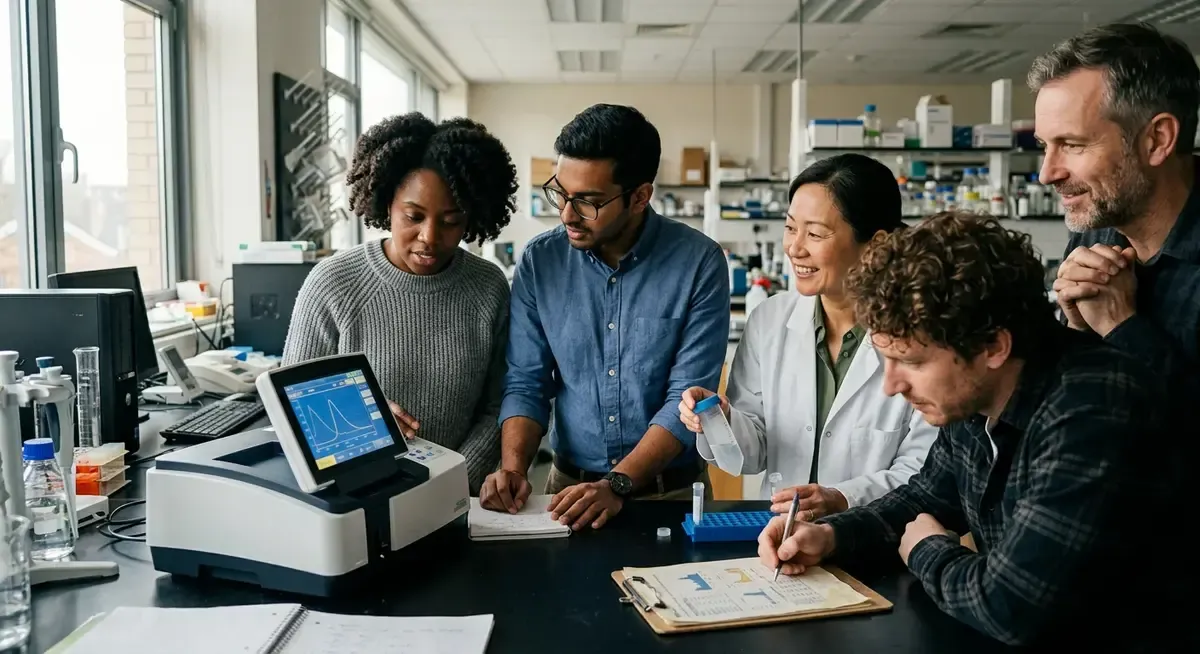
Editorial illustration for AI Agents Assisted With Lab Grunt Work, Not Discovery
AI Agents Handle Lab Work, Humans Still Drive Discovery
AI Agents Assisted With Lab Grunt Work, Not Discovery
Anthropic told the world last Wednesday that it had opened a molecular biology lab earlier this year, one staffed by 950 Claude agents instead of postdocs. The pitch: let AI read through millions of cataloged DNA sequences, flag patterns worth investigating, and hand the promising ones to human scientists for actual lab testing. After 21 hours of work, the company says its system turned up something new, a repeating pattern surrounding a known enzyme that hadn't been documented before.
Anthropic didn't stop at describing the find. Its announcement compared the pattern to the research that led to CRISPR, the gene-editing tool that reshaped medicine and biology over the past decade. That comparison is doing a lot of work.
CRISPR came from years of grinding research into bacterial immune systems before anyone understood its potential. Calling an unindexed sequence pattern "reminiscent" of that breakthrough sets a bar the finding hasn't cleared yet, and it's the kind of language that decides whether the public sees this as a genuine discovery or as a company marketing its own tools. That gap, between what an AI system actually did and what a press release claims it did, is where the argument over scientific credit is happening now.
Part of the problem here is that AI companies aren’t presenting their systems simply as tools scientists can use, like microscopes or supercomputers. They’re insisting that the AI systems are making discoveries themselves.
Why this matters
For anyone building on top of AI lab tools, the Anthropic story is a useful correction to the hype cycle. Claude agents flagged patterns in biological data that would have taken a researcher weeks to spot by hand. That's real, and it's worth having.
But the harder work, figuring out what the system actually does, what the pattern means biologically, why it matters, still sat with human scientists. If we let companies blur that line, we end up crediting software for insight it didn't produce, and we lose the ability to tell where automation ends and understanding begins. That distinction matters for procurement decisions, for research budgets, and for how founders pitch what their agents can actually do.
A model that accelerates grunt work is genuinely valuable to a lab; a model that gets marketed as making discoveries is a different claim entirely, and one that deserves more scrutiny than a press release gives it. Watch how Anthropic and its competitors describe results going forward, and ask, specifically, who figured out what the finding meant.
Related Reading
 Research & Benchmarks
 Microsoft AI Chief: "If It Isn't Safe We Shouldn't Build It
 Research & Benchmarks
 Google's FACTS benchmark shows 70% factuality ceiling across four tests
 Research & Benchmarks
 Nvidia's DLSS 4.5 beta adds 6x Multi Frame Generation for RTX 50 GPUs
 From Archives
 OpenAI Faces Scrutiny Over Hiring Ethics Amid Mathematician Criticism
 From Archives
 AI Researcher Warns of 50-60% Chance AI Takes Control
Common Questions Answered
How many Claude agents did Anthropic deploy in its molecular biology lab?
Anthropic staffed its molecular biology lab with 950 Claude agents instead of postdocs. The company opened this lab earlier in the year as an experiment in using AI to assist with scientific research tasks.
What specific discovery did Anthropic's Claude agents make in 21 hours of work?
After 21 hours of work, Anthropic's system identified a repeating pattern surrounding a known enzyme that hadn't been documented before. The Claude agents accomplished this by reading through millions of cataloged DNA sequences and flagging patterns worth investigating for human scientists.
Why is there a distinction between AI tools assisting with lab work versus AI making scientific discoveries?
AI companies like Anthropic often present their systems as making discoveries themselves rather than simply functioning as tools like microscopes or supercomputers. The harder work of understanding what patterns mean biologically, why they matter, and what the system actually does still requires human scientists, so crediting software for insight it didn't generate misrepresents the division of labor.
What tasks did the Claude agents handle versus what tasks remained for human scientists?
The Claude agents excelled at flagging patterns in biological data that would have taken a researcher weeks to spot by hand, demonstrating real value in data processing. However, human scientists retained responsibility for the harder work of figuring out what the patterns mean biologically and why they matter scientifically.
Further Reading
- Anthropic says Claude found a new enzyme system - CNBCTV18
- Anthropic says Claude found a new enzyme system ... - The Next Web
- Why is Anthropic running a biology lab? - The Daily Star
- An Agentic Bio-Capabilities Benchmark for Biosecurity - arXiv
- BixBench3: Benchmarking AI agents on research-study-scale computational biology tasks - arXiv
