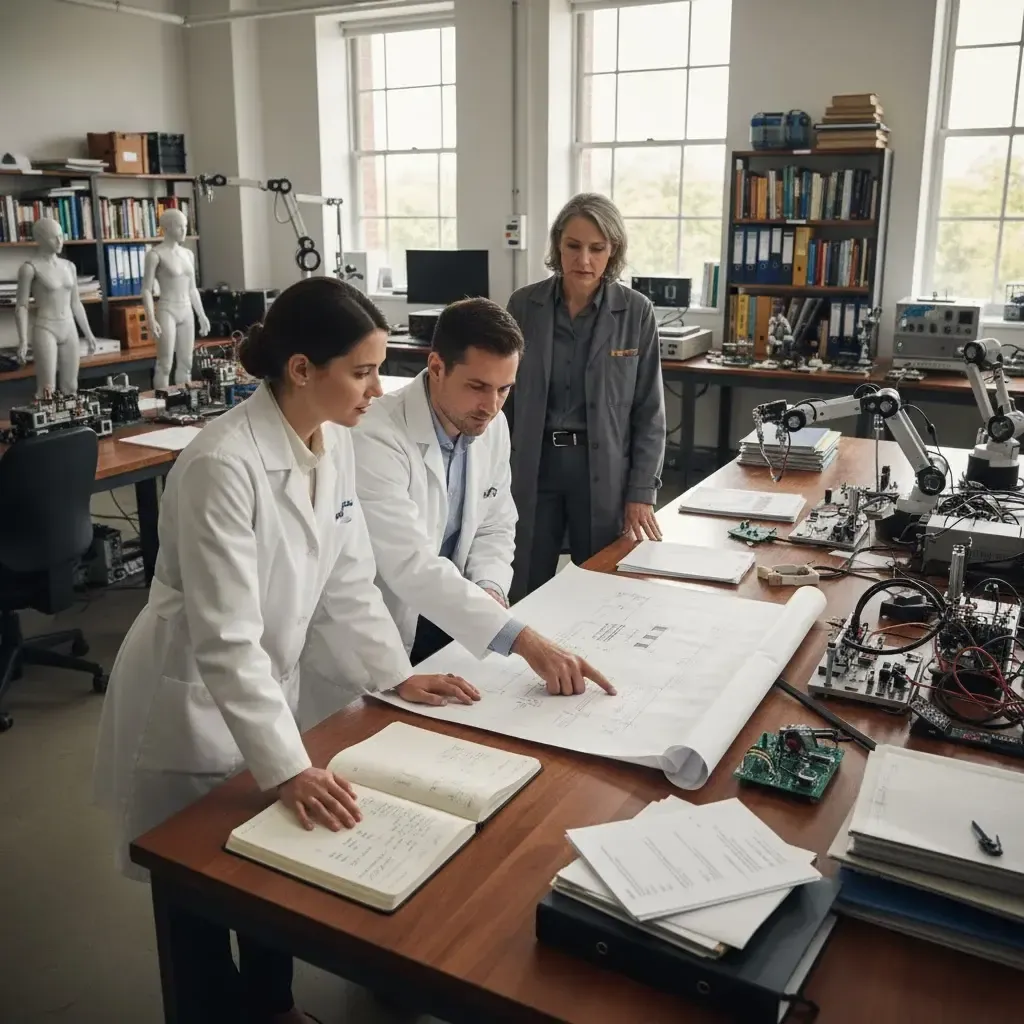
Editorial illustration for AI Agent in EOS Automates Validation, Error Correction for Full Lab Cycle
AI Agent in EOS Automates Validation, Error Correction...
Laboratory work is a grind of meticulous, tedious tasks. It's also notoriously error-prone. Forget robot arms for a moment.
A new AI agent, built into the Experiment Orchestration System (EOS), tackles a different problem: stopping mistakes before they happen. It watches everything. The system writes procedures, runs them, and adjusts experiments autonomously.
Researchers see these plans as interactive diagrams. In simulated tests across three labs, it got the protocol right on the first try 97% of the time. Required clicks and commands fell by ninety percent.
Integrated into the Experiment Orchestration System (EOS), the AI agent operates under an agentic loop with automated validation and error correction, and supports the complete experimental lifecycle: creating protocols, running and monitoring both protocols and closed-loop optimization campaigns, and analyzing results. A visual graph editor renders protocols as interactive node-based diagrams synchronized with the AI agent's protocol representation, enabling seamless alternation between AI-assisted and manual protocol construction. Evaluated on three simulated automated labs spanning chemistry, biology, and materials science, the AI agent achieves a 97% first-attempt protocol generation success rate and an order of magnitude reduction in required interface actions.
That 97% first-try success rate is compelling. It means the agent grasps the rules. The tenfold reduction in manual inputs is the tangible payoff—transforming an hour of button-pushing into minutes of oversight.
This isn't about replacing scientists. It's about collapsing the frustrating distance between an idea and a result. The visual graph editor is critical here.
It makes the AI's logic legible, editable, debatable. The aim is a less brittle workflow. Not a linear checklist, but a collaborative loop.
One tested from chemistry to biology. The real challenge? Moving from clean simulation to the chaotic, spill-prone reality of a lab bench.
The premise, however, is clear. Don't just fix errors. Prevent them.
Related Reading
 AI Tools & Apps
 Claude gains shared context in Excel, PowerPoint; Microsoft adds Copilot Cowork
 AI Tools & Apps
 OpenAI Developer: AI Agent "Swarms" Waste Tokens, Create "Coordination Tax
 AI Tools & Apps
 LG's recent webOS update adds Microsoft Copilot app, now removable
 From Archives
 Google Search agents can act without user input, says VP Robby Stein
 From Archives
 OpenAI and Dell bring Codex to hybrid/on‑premise enterprises automating workflows
Common Questions Answered
How does the AI agent in the Experiment Orchestration System (EOS) reduce manual validation errors in laboratory workflows?
The AI agent autonomously writes procedures, runs them, and adjusts experiments while continuously monitoring the entire lab cycle to catch mistakes before they occur. In simulated tests across three labs, the system achieved a 97% first-try success rate on protocols, demonstrating its ability to grasp and apply laboratory rules accurately.
What is the practical time savings benefit of using EOS's AI agent for laboratory procedures?
The system delivers a tenfold reduction in manual inputs required from researchers, transforming what would typically take an hour of button-pushing and oversight into just minutes. This significant efficiency gain allows scientists to focus on higher-level analysis rather than tedious procedural execution.
How does the visual graph editor in EOS make the AI agent's decision-making process more transparent to researchers?
The visual graph editor presents the AI's logic as interactive diagrams that researchers can view, edit, and debate in real-time. This transparency ensures the AI's reasoning is legible and collaborative rather than a black box, allowing scientists to understand and modify the automated procedures as needed.
What is the primary goal of implementing an AI agent in laboratory automation according to this system?
The goal is not to replace scientists, but rather to collapse the frustrating distance between an idea and its experimental result by creating a less brittle workflow. Instead of following rigid linear checklists, the system enables true collaboration between researchers and AI, streamlining the path from conception to validated results.
Further Reading
- From Prompts to Protocols: An AI Agent for Laboratory Automation — arXiv
- Validating AI Agents for Production: From Engineering Principles to Reliability — Verity AI
- AI agents are rewriting biopharma's $140B playbook — SignalFire
- AI Agents in Labs: From Analysis to Autonomous Action — LabLynx
- Reimagining Prescription Analysis: How Specialized AI Agents Solve Healthcare's Toughest Document Processing Challenges — Cloudera
