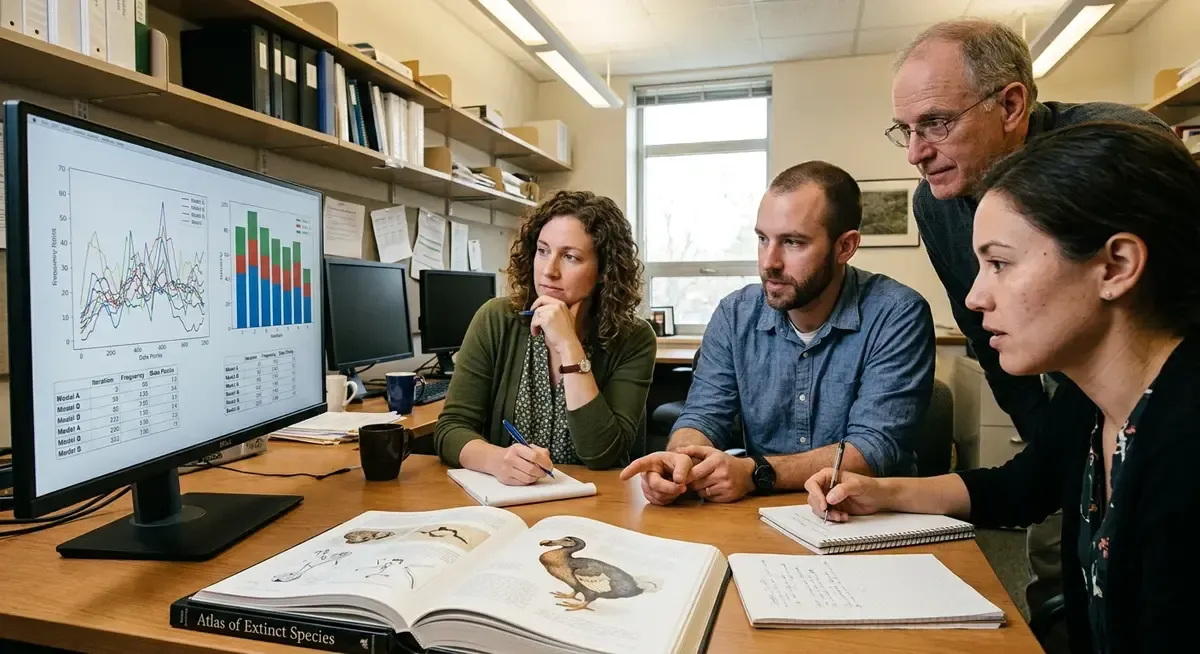
Editorial illustration for At TechCrunch Disrupt, AI Stage to Feature De-Extinction Tech Talk
De-Extinction Tech Talks at TechCrunch Disrupt 2026
TechCrunch Disrupt 2026 is splitting its AI programming in two. The AI Stage returns with its usual lineup, but a second stage is joining it this year: the Real World AI Stage, built around what happens when AI stops living on screens and starts moving through physical space. Think autonomous hardware showing up in homes, public streets, and battlefields, not just self-driving cars.
The lineup leans into that range. Shield AI will talk defense applications, Colossal Biosciences will address efforts to bring back extinct species, and FieldAI and Foxglove round out a roster that organizers say is still growing. The event runs October 13 to 15 at San Francisco's Moscone West, with registration open now.
One of the sessions tackles a question hanging over the entire robotics industry: why hasn't it had its ChatGPT moment yet? Large language models had the internet to train on. Self-driving cars had millions of hours of road data.
Robots have had neither, and that gap in training data is a big part of why general-purpose robotic intelligence still lags behind other corners of AI. A handful of startups think they've found a way around it.
Self-driving cars have millions of hours of road data. Robots have neither. That data gap is the single biggest reason most experts believe general-purpose robotic intelligence is still years away, despite the breakthroughs happening everywhere else in AI.
Why this matters
Putting Colossal Biosciences on a stage called "Real World AI" tells us something about how TechCrunch is framing the industry right now: AI isn't just chatbots and copilots anymore, it's the substrate underneath gene editing, synthetic biology, and species revival. For founders and researchers, that's worth watching closely. The pitch that AI models can help sequence, simulate, and reconstruct extinct genomes is a real technical claim, not just a marketing hook, and it deserves the same scrutiny we'd apply to any AI system making high-stakes predictions from messy data.
We're glad the session frames this as a debate rather than a victory lap. Whether de-extinction is a genuine conservation tool or an expensive distraction from protecting existing ecosystems is exactly the kind of question that gets skipped when a CEO is on a fireside chat couch. If AI's role in biology is going to expand this fast, we want to hear more about validation, failure rates, and who's checking the work, not just what's possible.
That tension is the actual story here.
Related Reading
 LLMs & Generative AI
 ChatGPT's 'Nerdy' tweak rewards goblin metaphors in answers, study finds
 LLMs & Generative AI
 Google to End Free Access to Gemini AI for Non-Subscribers
 LLMs & Generative AI
 AI Engineers Face Rising Costs, Need New Strategies for Efficiency
 From Archives
 Google's New Gemini 3.8 Flash Model Works Harder, Costs More
 From Archives
 Switchyard: A Rust Library That Routes LLM Traffic Between OpenAI and Anthropic
Common Questions Answered
What is the Real World AI Stage at TechCrunch Disrupt 2026?
The Real World AI Stage is a new addition to TechCrunch Disrupt 2026 that focuses on AI applications moving beyond screens into physical space, including autonomous hardware in homes, public streets, and battlefields. This stage complements the traditional AI Stage and represents the industry's shift toward practical, embodied AI implementations rather than just software-based applications.
Why is the data gap preventing general-purpose robotic intelligence according to the article?
Self-driving cars have millions of hours of road data available for training, while robots lack comparable datasets for learning general-purpose tasks. This significant data gap is cited as the primary reason why experts believe general-purpose robotic intelligence remains years away, despite major breakthroughs occurring elsewhere in AI development.
How is Colossal Biosciences using AI for de-extinction technology?
Colossal Biosciences is leveraging AI models to help sequence, simulate, and reconstruct extinct genomes as part of species revival efforts. The company's presence on the Real World AI Stage demonstrates that AI is now functioning as a substrate for gene editing, synthetic biology, and de-extinction applications beyond traditional chatbots and copilots.
What companies are featured on TechCrunch Disrupt 2026's Real World AI Stage?
The Real World AI Stage features companies including Shield AI, which discusses defense applications, and Colossal Biosciences, which addresses de-extinction and synthetic biology. The lineup demonstrates the breadth of real-world AI applications from autonomous defense systems to biotechnology innovation.
Further Reading
- TechCrunch Disrupt 2026's Real World AI Stage features robots, automated factories, and extinct animals - TechCrunch
- The founder's guide to TechCrunch Disrupt 2026: everything you need to know - TechCrunch
- TechCrunch Disrupt 2026 - Agenda - TechCrunch
- De-extinction technology and its application to conservation - Oxford Academic / Journal of Heredity
- Colossal Biosciences raises $200M at $10.2B valuation to bring back woolly mammoths - TechCrunch
