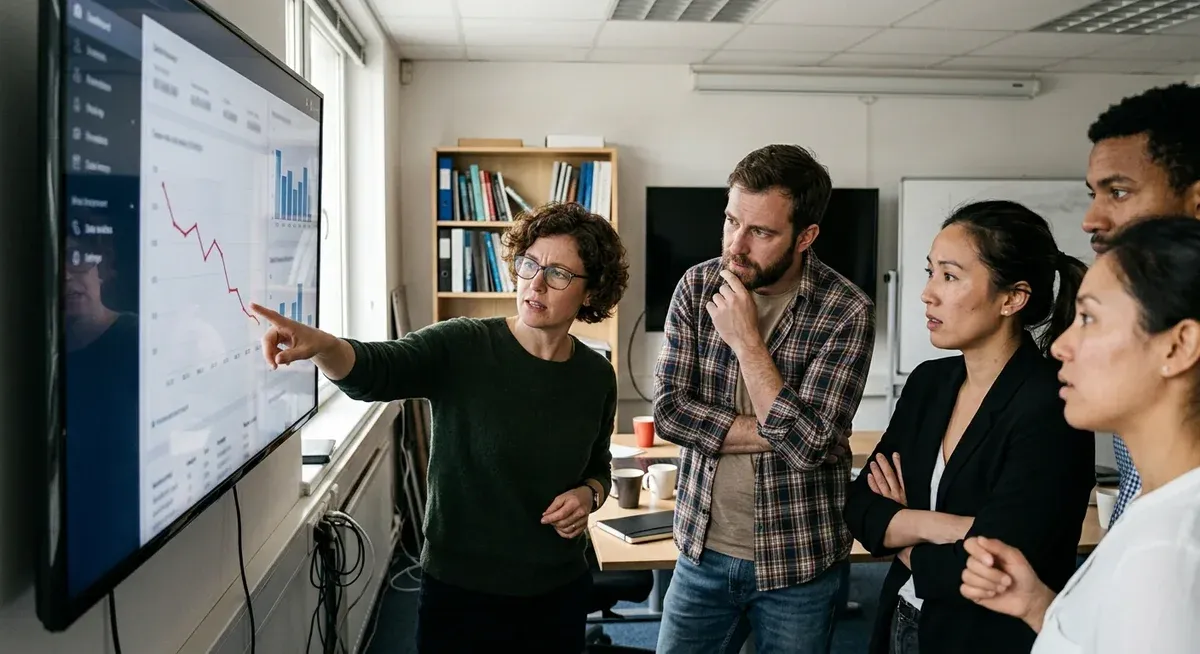
Editorial illustration for Stanford Study: AI Hits Entry-Level Jobs Hardest
AI Job Losses Hit Young Workers Hardest: Stanford Study
Stanford Study: AI Hits Entry-Level Jobs Hardest
Stanford economists have a number, and it's gotten worse since last year. Workers aged 22 to 25 in occupations most exposed to AI now show employment levels 19 percent below their peers in less-exposed fields. Last year that gap sat at 13 percent.
The finding comes from an August 2026 update to "Canaries in the Coal Mine? Six Facts about the Recent Employment Effects of Artificial Intelligence," a paper first published last year and now revised with fresh payroll data.
The researchers pulled a large subsample of anonymized, high-frequency records from ADP, the payroll processing company, to track hiring trends by age and occupation. To sort which jobs count as "AI-exposed," they leaned on two measures: an existing labor market impact gauge from prior research, and the Anthropic Economic Index, which tracks how often occupations actually show up in real-world Claude usage.
What makes the update notable isn't just the bigger gap. It's that older workers in the same exposed occupations aren't showing similar losses, at least not yet. That divide between entry-level and experienced workers is where the paper's authors are focusing their attention, and where the debate over AI's labor impact is likely to keep going.
Specifically, employment levels for workers aged 22 to 25 in the most “AI-exposed” occupations are now 19 percent below those of their peers in fields less exposed to AI disruption.
Why this matters
For founders and hiring managers in AI, this update from Erik Brynjolfsson and his Stanford co-authors is worth sitting with. A one-year-old finding surviving a data refresh is a different kind of signal than a splashy headline from a single quarter. If entry-level roles keep shrinking while senior staff stay untouched, that's not a temporary blip from a rough hiring cycle.
It's a structural shift in who gets to learn a trade on the job. We'd push back on the framing that older workers are simply "safe." More likely, they're harder to replace right now because they hold judgment and context that current models can't fake yet. That gap won't necessarily hold.
Anyone building copilots or agentic tools aimed at junior-level tasks, customer support tickets, first-pass code review, basic research summaries, should read this as a market opportunity and a warning sign at once. The apprenticeship model that trained today's senior talent depends on those entry jobs existing. If Stanford's numbers hold up in the next revision, we're watching the bottom rung of the career ladder get sawed off in real time.
Related Reading
 Research & Benchmarks
 Microsoft AI Chief: "If It Isn't Safe We Shouldn't Build It
 Research & Benchmarks
 Google's FACTS benchmark shows 70% factuality ceiling across four tests
 Research & Benchmarks
 Nvidia's DLSS 4.5 beta adds 6x Multi Frame Generation for RTX 50 GPUs
 From Archives
 Google's ME-POIs Adds "How a Place Is Used" to POI Embeddings
 From Archives
 NVIDIA's Groq 3 LPX Enters Full Production for AI Agents
Common Questions Answered
How much has the employment gap widened for entry-level workers in AI-exposed occupations since last year?
According to the Stanford study, the employment gap for workers aged 22 to 25 in AI-exposed occupations has increased from 13 percent below their peers last year to 19 percent below this year. This represents a significant 6 percentage point deterioration in employment levels for entry-level workers in fields most vulnerable to AI disruption.
What age group does the Stanford study focus on when measuring AI's employment impact?
The Stanford economists specifically examined workers aged 22 to 25, which represents the entry-level workforce just beginning their careers. This demographic is being disproportionately affected by AI's impact on employment compared to their peers in less AI-exposed fields.
Why is the persistence of this employment gap significant for founders and hiring managers?
The fact that the employment gap has worsened rather than improved in the data refresh suggests this is a structural shift in the job market rather than a temporary hiring cycle fluctuation. This indicates that entry-level roles are shrinking while senior positions remain relatively untouched, which has long-term implications for workforce development and on-the-job training opportunities.
What is the methodology behind the Stanford study on AI's employment effects?
The study, titled 'Canaries in the Coal Mine? Six Facts about the Recent Employment Effects of Artificial Intelligence,' was originally published last year and has now been updated in August 2026 with fresh payroll data. The researchers analyzed employment levels across occupations with varying degrees of exposure to AI disruption to measure the differential impact on workers.
Further Reading
- Papers with Code Benchmarks - Papers with Code
- Chatbot Arena Leaderboard - LMSYS
