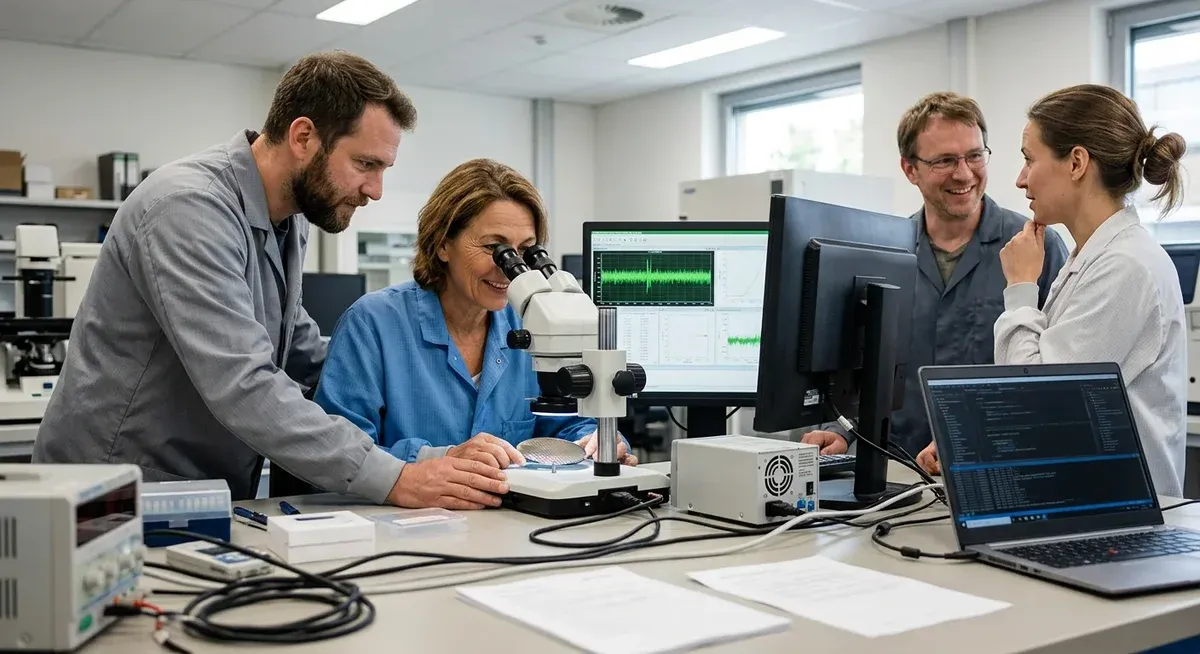
Editorial illustration for Researcher Counts Five to 10 New AI Chip Startups Every Year
AI Chip Startups Surge: 5-10 New Firms Yearly
Researcher Counts Five to 10 New AI Chip Startups Every Year
Albert Reuther has been tracking AI chips since 2018, and the count keeps climbing. Reuther, a staff member at MIT Lincoln Laboratory Supercomputing Center, leads the Lincoln AI Computing Survey, known as LAICS, now six papers deep into cataloging commercial AI accelerators and measuring their peak performance against peak power draw. The project started because government sponsors of the lab's work kept asking about a sudden surge of new chips designed to speed up neural networks and machine learning tasks.
These accelerators don't just run AI models. The same hardware can model molecular behavior or speed up fluid dynamics simulations, work that eats enormous computing resources regardless of whether it touches machine learning at all. The hardware itself splits into several categories: CPUs for general-purpose jobs, GPUs, application-specific integrated circuits built for narrow tasks, field-programmable gate arrays that can be reconfigured after manufacturing, and dataflow accelerators built around moving data efficiently rather than executing fixed instructions.
Each architecture trades off flexibility against speed differently, and that tradeoff shapes which chips end up in data centers, defense systems, or research labs. Reuther's survey exists to keep track of that shifting landscape, one that the Lincoln Laboratory team started documenting before most people outside the chip industry noticed it happening.
Since 2018, team from the Lincoln Laboratory Supercomputing Center (LLSC) has been conducting the Lincoln AI Computing Survey (LAICS, pronounced "lace"). Six papers later, LAICS continues to summarize current commercial AI accelerators and compare their peak performance and peak power.
Why this matters
For developers and founders picking hardware, the LAICS numbers are a warning against chasing every new chip announcement. Albert Reuther's team has tracked this market since 2018, and the pattern he describes, five to 10 fresh startups funded and shipping accelerators every year, means the landscape never actually settles long enough for a clear winner to emerge. That's a problem if you're trying to lock in a production stack: by the time you've benchmarked one generation of accelerators, another batch is already on the market claiming better throughput per watt.
For researchers, this is useful raw data rather than noise. A running survey of accelerator specs gives the field something rare, a historical record of how fast the hardware layer actually moves, instead of vendor marketing claims. Our read is that the real signal here isn't any single chip.
It's the funding velocity itself. Capital keeps flowing into niche accelerator designs even as compute giants dominate headlines, which tells us the market still thinks there's room for specialized silicon. Worth watching which of these startups survive past their second product cycle.
Related Reading
 Research & Benchmarks
 Microsoft AI Chief: "If It Isn't Safe We Shouldn't Build It
 Research & Benchmarks
 Google's FACTS benchmark shows 70% factuality ceiling across four tests
 Research & Benchmarks
 Nvidia's DLSS 4.5 beta adds 6x Multi Frame Generation for RTX 50 GPUs
 From Archives
 Researchers Build Universal AI That Spans Physics to Biology
 From Archives
 JEPA-Anything Applies Single Model Architecture to 7 Different Domains
Common Questions Answered
What is the Lincoln AI Computing Survey (LAICS) and who leads it?
LAICS is a research project led by Albert Reuther, a staff member at MIT Lincoln Laboratory Supercomputing Center, that has been tracking AI chips since 2018. The survey, now six papers deep, catalogs commercial AI accelerators and measures their peak performance against peak power draw to document the evolution of AI hardware.
How many new AI chip startups emerge annually according to the LAICS research?
According to Albert Reuther's team at the Lincoln Laboratory Supercomputing Center, between five to ten new AI chip startups are funded and shipping accelerators every year. This rapid pace of new entrants means the AI chip market landscape never settles long enough for a clear winner to emerge.
Why is the rapid emergence of new AI chip startups problematic for developers and founders?
The continuous influx of five to ten new AI chip startups annually creates instability in the market, making it difficult for developers and founders to lock in a production stack. By the time they benchmark one generation of accelerators, new competitors have already entered the market, preventing any clear hardware winner from establishing dominance.
What prompted the creation of the Lincoln AI Computing Survey in 2018?
The Lincoln AI Computing Survey was initiated because government sponsors of MIT Lincoln Laboratory's work kept asking about a sudden surge of new chips designed to speed up neural networks and machine learning. This inquiry led Albert Reuther's team to systematically track and catalog the growing commercial AI accelerator market.
Further Reading
- A Survey on AI Datacenter Hardware Architecture - arXiv
- 43 AI Chip Startups — $17.7B Raised vs Nvidia - ValueAdd VC
- AI Chip Startups Challenging NVIDIA in 2026 - Polaris Market Research
- The State of AI Accelerators in 2026: Trends and What You Need ... - Ellenox
