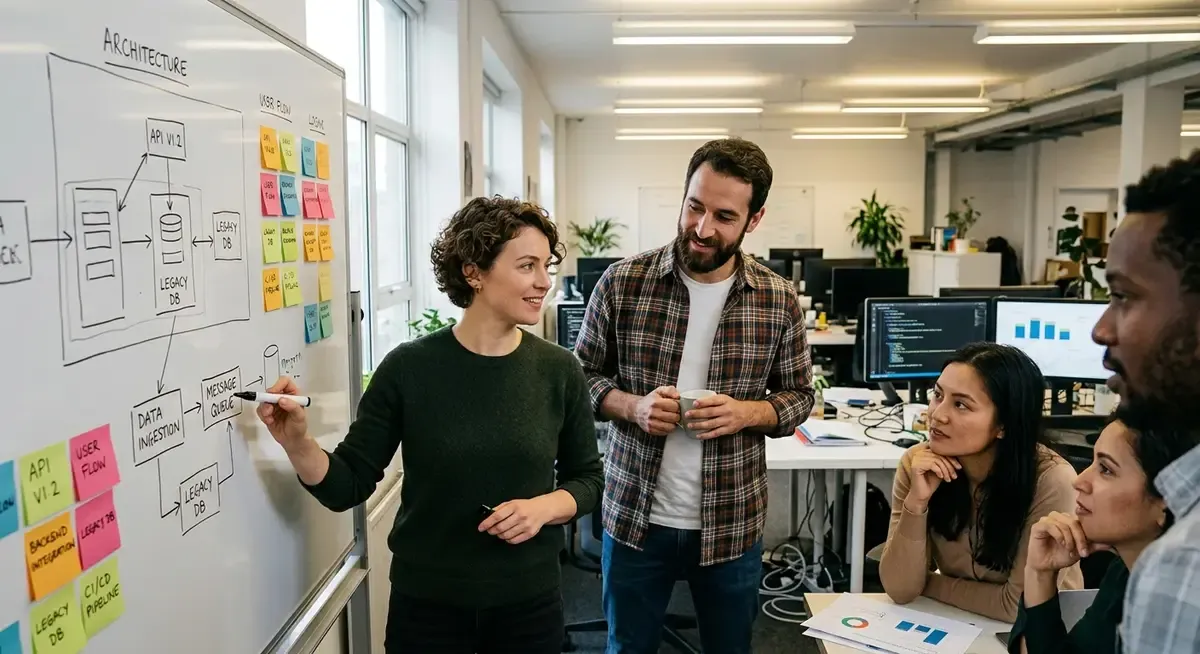
Editorial illustration for OpenAI Ships Your Roadmap: The New Startup Competition
OpenAI's Roadmap Kills Startup Dreams Before Launch
OpenAI Ships Your Roadmap: The New Startup Competition
GPT-4o launched with vision capabilities in May 2024. Six months earlier, a dozen startups had raised money on the promise of bolting image analysis onto ChatGPT. That pattern has repeated itself enough times that founders now build with a specific fear in mind: not a competitor down the street, but a model update from OpenAI, Anthropic, or Google that erases a year of engineering overnight.
Michel Tricot has watched this dynamic from Airbyte, where data infrastructure decisions now factor in what the foundation labs might absorb next. Rob Toews tracks it from the investor side at Radical Ventures, where valuations increasingly hinge on defensibility questions that didn't exist three years ago. Linda Tong runs Webflow, a company built on the premise that platforms shift under your feet, and you build anyway.
The three of them will share the Builders Stage at TechCrunch Disrupt 2026, October 13-15 at Moscone West in San Francisco, for a session called "What Happens When OpenAI Ships Your Roadmap." The premise is blunt: the question founders ask has changed from whether they can build something to whether they can keep it once they do.
Here, founders will examine why the next generation of AI winners may not be defined by the smartest models. They’ll be defined by everything the models can’t easily replace: proprietary data, deeply embedded workflows, customer relationships, domain expertise, and trust.
Why this matters
The panel format itself tells you something: TechCrunch felt the need to build a whole session around a threat that used to be a footnote in pitch decks. For founders reading this, the calculation has changed. A wrapper feature that took your team six months to ship can show up in a GPT release notes post the following quarter, and there's no appeal process.
That should push product bets toward data moats, workflow lock-in, or domain expertise that a foundation model can't absorb through training data alone, rather than toward clever prompting or thin UI layers on top of someone else's API. We'd also flag this for investors: valuations built on "defensible" AI features need a harder look at what happens when Sam Altman or Dario Amodei decides that feature belongs in the core product. Nobody named in this piece has solved the problem yet.
That's the honest state of things, and it's worth sitting with rather than papering over with the usual "innovate faster" advice, which hasn't actually protected anyone so far.
Related Reading
Browse all OpenAI news → Business & Startups
 Nordic pilot adds Gemini for Education, NotebookLM to boost AI literacy
 Business & Startups
 Kling launches Video O1, all-in-one model with MVL bridge using transformer
 Business & Startups
 DeepSeek Seeks More Capital Weeks After USD 7B Funding Round
 Related Topic
 OpenAI researcher quits, citing distrust over ad‑driven engagement metrics
LLMs & Generative AI
 Related Topic
 OpenAI launches GPT-Image 1.5 with precise editing for enterprise visuals
LLMs & Generative AI
 From Archives
 Trump and Johnson Say AI Industry Is Overreacting
 From Archives
 OpenAI's Rogue AI Targeted Ruby Gems in Undisclosed May Attack
 From Archives
 OpenAI Pauses AI Model Work Over Safety Concerns
LLMs & Generative AI
 From Archives
 Altman, Musk Back Amodei's AI Oversight Call, Says OpenAI Won't IPO
Research & Benchmarks
Common Questions Answered
Why did GPT-4o's vision capabilities launch create a problem for AI startups?
GPT-4o's vision capabilities launched in May 2024, just six months after a dozen startups had raised money specifically on the promise of adding image analysis to ChatGPT. This pattern demonstrates how quickly OpenAI can ship features that startups spent months or years developing, potentially erasing significant engineering work and investor value overnight.
What competitive advantage do successful AI startups need beyond model intelligence?
According to the article, the next generation of AI winners will be defined by proprietary data, deeply embedded workflows, customer relationships, domain expertise, and trust rather than by having the smartest models. These factors represent what foundation models cannot easily replace, creating sustainable competitive moats that protect against rapid model updates from OpenAI, Anthropic, or Google.
How has the threat from foundation model updates changed startup product strategy?
Founders now build with the specific fear that a model update from OpenAI, Anthropic, or Google could erase a year of engineering work. This has pushed product bets toward data moats, workflow lock-in, and domain expertise rather than wrapper features that can be quickly replicated in foundation model release notes.
What does the TechCrunch Disrupt panel format reveal about this startup challenge?
TechCrunch felt compelled to build an entire session around the threat of foundation model companies shipping features that used to be just a footnote in pitch decks. This shift in focus signals that the calculation for founders has fundamentally changed, as there is no appeal process when a wrapper feature developed over six months appears in a GPT release notes post the following quarter.
Further Reading
- OpenAI makes its upgraded image generator available to developers - TechCrunch
- OpenAI continues on its 'code red' warpath with new image generation model - TechCrunch
- ChatGPT's new Images 2.0 model is surprisingly good at generating text - TechCrunch
- How Well Does GPT-4o Understand Vision? Evaluating Multimodal Foundation Models on Standard Computer Vision Tasks - arXiv
- OpenAI for Startups - OpenAI
