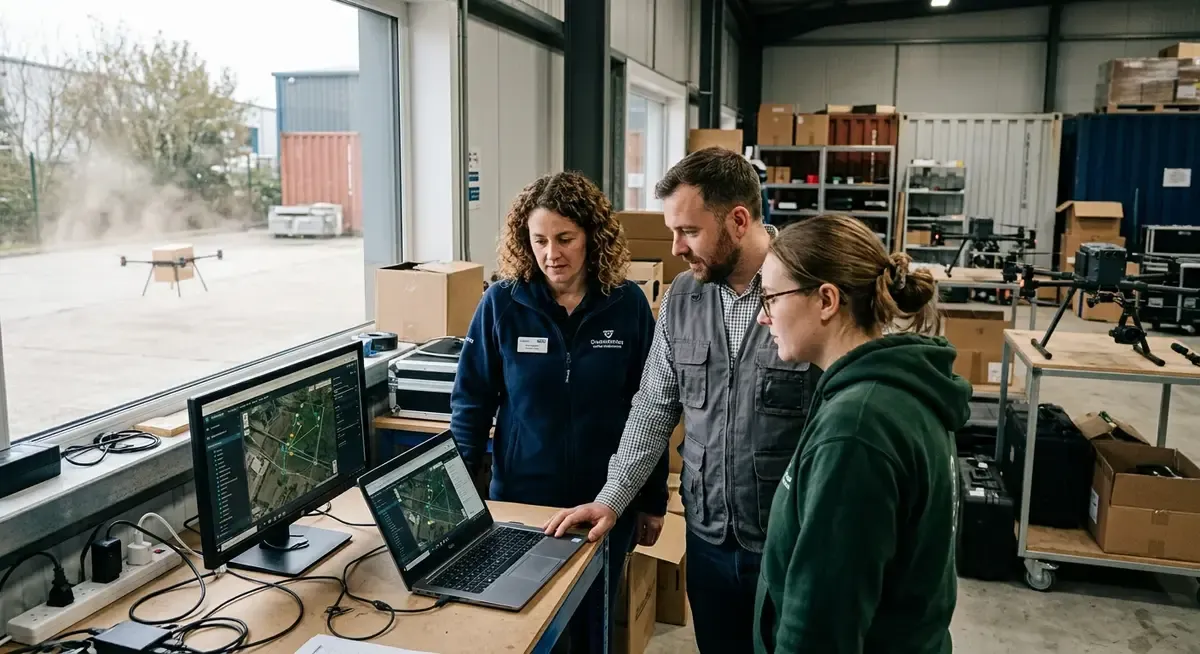
Editorial illustration for NGCĠUsesĠDigitalĠTwins,ĠAIĠAgentsĠtoĠValidateĠFactoryĠChanges
NGC Uses Digital Twins, AI to Validate Factory
An AI factory packs GPUs, CPUs, switches, DPUs, and SuperNICs into a single operating system that also has to juggle schedulers, orchestration, security policy, and software that changes by the week. Getting that infrastructure deployed is hard enough. Proving it actually works for the workloads a business plans to run on it is a separate problem, and operators can't afford to find out the answer after hardware lands on the loading dock.
NVIDIA's answer is to move validation earlier, using node-based digital twins paired with AI agents. A digital twin here isn't a physical mockup sitting in a lab. It's an executable, API-accessible model of the factory's hardware topology and software stack, one that platform teams can poke at, break, and fix before touching production. Wired into a CI/CD pipeline, it turns simulation into something that runs continuously, checking every proposed configuration or software change before it ever gets promoted.
Agents are what make that twin useful day to day rather than just during planning. They can query it, run checks against it, and kick off workflows based on what they find, which is the piece worth looking at closely.
A node-based digital twin simulation is a high-fidelity, executable representation of an AI factory’s infrastructure and operational interfaces. Unlike a physical replica, it gives platform teams a safe, API-accessible environment in which to model the hardware topology and software stack, exercise change, observe behavior, and validate outcomes before a production change is made.
Why this matters
For anyone building or buying AI infrastructure, this is a tacit admission that the hardest part of standing up an AI factory isn't racking GPUs, it's proving the whole stack actually behaves as intended before real workloads hit it. NVIDIA pairing digital twins with AI agents inside NGC's shared organizational context is a bet that validation can be automated rather than discovered the hard way in production, at 2 a.m., on someone's pager. For developers and founders, that matters because time-to-first-token is now a competitive metric, and nobody wants to burn it debugging scheduler or orchestration mismatches after deployment.
For researchers, it's worth watching how much trust gets placed in agents "executing valid" tests versus humans reviewing edge cases, since simulation environments are only as good as how faithfully they mirror the messy reality of switches, DPUs, and security policies interacting under load. We'd want to see independent benchmarks before assuming this closes the gap between lab and factory entirely.
Related Reading
 Industry Applications
 Westinghouse teams with Google Cloud to build AI platform for nuclear power
 Industry Applications
 NVIDIA NeMo powers telco reasoning model for autonomous network workflows
 Industry Applications
 Month-1 Agent Adds Holistic Observability with Trace IDs and Token Tracking
 From Archives
 Gemini 3.8 AI Models Promise Better Reasoning at Lower Cost
 From Archives
 NVIDIA DSX MaxLPS Handles Mixed AI Workloads on 140 GPUs
Common Questions Answered
What is a node-based digital twin simulation in NVIDIA's NGC platform?
A node-based digital twin simulation is a high-fidelity, executable representation of an AI factory's infrastructure and operational interfaces that provides a safe, API-accessible environment for platform teams. Unlike a physical replica, it allows teams to model the hardware topology and software stack, exercise changes, observe behavior, and validate outcomes before making production changes. This approach eliminates the need to discover problems after hardware is deployed to the loading dock.
How do AI agents and digital twins help validate AI factory infrastructure changes?
NVIDIA pairs digital twins with AI agents inside NGC's shared organizational context to automate the validation process rather than discovering issues the hard way in production environments. The AI agents can simulate workloads and test changes against the digital twin representation, allowing operators to verify that the entire stack behaves as intended before real deployments occur. This approach significantly reduces the risk of infrastructure failures and unexpected behavior when workloads are actually running.
What components must an AI factory's operating system manage according to the article?
An AI factory's operating system must manage multiple hardware components including GPUs, CPUs, switches, DPUs, and SuperNICs while simultaneously juggling schedulers, orchestration, security policy, and software that changes weekly. This complex infrastructure requires careful coordination to ensure all components work together seamlessly. Validating that this entire integrated system works for planned workloads is a critical challenge that cannot be discovered after hardware arrives.
Why is early validation of AI infrastructure changes important for operators?
Early validation using digital twins and AI agents allows operators to catch infrastructure problems before they impact production workloads, preventing costly failures and emergency fixes at inconvenient times. By moving validation earlier in the deployment process, platform teams can confidently prove the infrastructure works as intended without waiting to discover issues after hardware is deployed. This proactive approach reduces operational risk and eliminates the need for reactive problem-solving in production environments.
Further Reading
- Industrial Ecosystem Adopts Mega NVIDIA Omniverse Blueprint for Industrial Digital Twins - NVIDIA
- Industrial Facility Digital Twins—Use Case - NVIDIA
- AI in Manufacturing: From Design to Delivery - NVIDIA
- AI and the Digital Twin: Turbocharging the Digital Enterprise - Siemens
- Staying in Sync: NVIDIA Combines Digital Twins With Real-Time AI for Industrial Automation - NVIDIA
