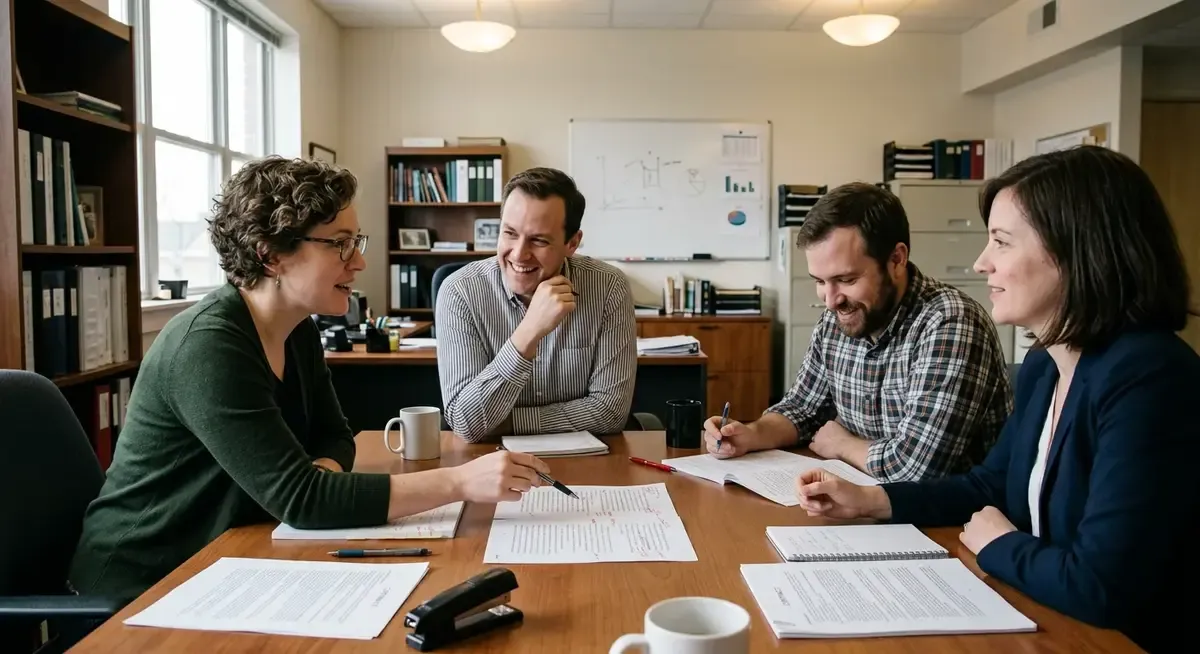
Editorial illustration for Harvey Launches AI for M&A Diligence, Contract Review Over 10,000 Docs
Harvey's AI Handles M&A Diligence Across 10K Docs
Harvey Launches AI for M&A Diligence, Contract Review Over 10,000 Docs
Harvey announced a research preview on August 20, 2026, called Harvey Tenet, its first post-trained model built for legal work that spans thousands of documents at once, the kind of contract review or M&A diligence job that used to eat a junior associate's week. The starting point is Moonshot AI's Kimi K3, an open-weight base model. Harvey and Fireworks ran it through asynchronous reinforcement learning on long-horizon legal tasks, training on a mix of synthetic data, public legal filings, and human expert examples. No customer data went into the mix, according to Harvey.
The training run used roughly 150 Nvidia B300 GPUs over two months, and the payoff shows up on Harvey's own Legal Agent Benchmark, where Tenet clears far more held-out tasks than the untouched K3 base. Those gains reportedly carried over to outside benchmarks the model never trained on, including Mercor's APEX Agents and Crosby's Redline Bench. Nothing here ships to customers yet.
There's no public model card, no weights, no API. What Harvey has put out is the method, aimed at law firms that want their own specialized models rather than a rented API call.
Against the base K3 model, Tenet completes almost twice as many held-out tasks on Harvey’s Legal Agent Benchmark (LAB) and 20% more on LAB: Contracts, lifting all-pass rate by 9 and 2 percentage points respectively.
Why this matters
Harvey is betting that post-training beats prompting for tasks that unfold over hours or days, not seconds. A 2x jump on held-out benchmark tasks is a real signal, but benchmarks built by the vendor running the study deserve scrutiny before anyone treats them as gospel. The bigger tell here is the stack: Kimi K3 as base, Fireworks for async reinforcement learning, and a training mix that deliberately excludes customer data.
That's a template other legal and enterprise AI shops will likely copy, since it sidesteps the privacy objections that come with fine-tuning on client documents. For founders building vertical agents, the lesson is that "long-horizon" work, chewing through 10,000 documents for diligence or redlining, needs training regimes built for multi-step reasoning, not just bigger context windows. For researchers, Tenet is a data point on whether open base models like K3 can be specialized into domain agents without a foundation lab's resources.
Whether Harvey's LAB numbers hold up against outside evaluation is the thing to watch next.
Related Reading
 Research & Benchmarks
 Microsoft AI Chief: "If It Isn't Safe We Shouldn't Build It
 Research & Benchmarks
 Google's FACTS benchmark shows 70% factuality ceiling across four tests
 Research & Benchmarks
 Nvidia's DLSS 4.5 beta adds 6x Multi Frame Generation for RTX 50 GPUs
 From Archives
 A.I. Agent Adoption Grows More Slowly Than AI Itself
 From Archives
 AI Labs Lack Plans to Contain Rogue Models, Documents Show
Common Questions Answered
What is Harvey Tenet and what legal tasks is it designed to handle?
Harvey Tenet is a post-trained model announced by Harvey on August 20, 2026, specifically built for legal work involving thousands of documents at once. It is designed to handle contract review and M&A diligence tasks that traditionally consumed significant time from junior associates, automating work that used to take weeks to complete.
How does Harvey Tenet's performance compare to the base Kimi K3 model?
Harvey Tenet completes almost twice as many held-out tasks on Harvey's Legal Agent Benchmark (LAB) compared to the base K3 model, and 20% more tasks on LAB: Contracts specifically. This performance improvement lifts the all-pass rate by 9 percentage points on the general benchmark and 2 percentage points on the contracts benchmark.
What training methodology and data sources were used to develop Harvey Tenet?
Harvey Tenet was developed by running Moonshot AI's Kimi K3 base model through asynchronous reinforcement learning on long-horizon legal tasks. The training mix included synthetic data, public legal filings, and deliberately excluded customer data to maintain privacy and independence in the model development process.
Why does Harvey believe post-training is more effective than prompting for legal work?
Harvey is betting that post-training beats prompting for tasks that unfold over hours or days rather than seconds, suggesting that legal work requiring extended reasoning and document analysis benefits more from specialized model training than from prompt engineering alone. This approach aligns with the complexity and duration of real-world M&A diligence and contract review projects.
What is the technology stack behind Harvey Tenet's development?
Harvey Tenet's stack consists of Kimi K3 as the base model, Fireworks for asynchronous reinforcement learning, and a training mix combining synthetic data and public legal filings while excluding customer data. This combination represents a template that other legal and enterprise AI shops may follow for developing specialized AI solutions.
Further Reading
- Harvey Introduces Tenet, Its First Post-Trained AI Model for Legal - Legaltech News
- Introducing Harvey II - Harvey
- Update on Harvey's Post-Training Effort - Harvey
- Harvey Announces Tenet, Its First in-House AI Model for Legal Work - Business Insider
- Harvey Tenet, Nashville, Legal Innovators + - Artificial Lawyer
