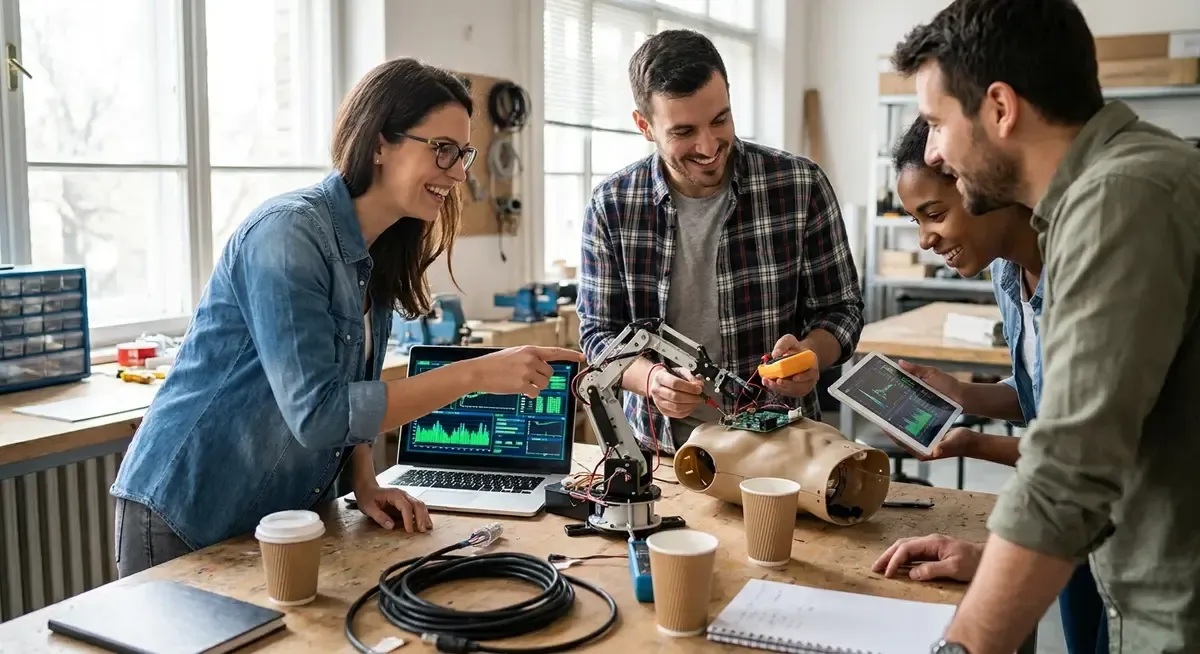
Editorial illustration for Google DeepMind's Gemini AI now controls entire humanoid robots
Gemini Robotics 2 Controls Full-Body Humanoid Robots
Google DeepMind's Gemini AI now controls entire humanoid robots
Google DeepMind's earlier robotics model could handle a humanoid's arms and hands. It stopped there. The company said Thursday that its new Gemini Robotics 2 model goes further, controlling a robot from its feet up through its fingertips, what DeepMind calls "whole-body motions."
In practice that means a robot can now walk, crouch, and stretch rather than just reach and grip while standing in place. Google shared footage of Apptronik's Apollo 2 robot bending down to grab a watering can and pulling specific items off a shelf, tasks that need coordination between legs, torso, and hands rather than isolated arm movement.
DeepMind is upfront that the robots still need to move faster to be useful outside a demo. But the company frames this as groundwork for real-world tasks that require full-body coordination rather than scripted single-limb actions. The update also brings finer control of five-fingered hands, letting robots manage fiddly jobs like sealing a Ziploc bag or unscrewing a lightbulb, alongside a parallel upgrade to Gemini Robotics ER, the model that handles a robot's reasoning about its environment and instructions.
Google DeepMind says the latest version of its Gemini Robotics AI model can “control entire humanoid robots.” While the previous model focused on controlling a humanoid robot’s upper body, Gemini Robotics 2 now supports “whole-body motions” ranging from its feet to fingertips, according to an announcement on Thursday.
Why this matters
The jump from upper-body control to full "feet to fingertips" motion is the part worth watching, not the branding. Locomotion and balance are where humanoid robotics projects usually stall, since a single model now has to reason about a foot placement and a fingertip grasp at the same time without the two tasks fighting each other. Google DeepMind hasn't published benchmarks alongside this announcement, so we don't yet know how it performs outside a demo, on uneven ground, or under payload.
For builders integrating Gemini Robotics into hardware, the practical question is whether "whole-body" control holds up across different robot chassis or whether it's tuned to whatever platform DeepMind used internally. For researchers, the interesting problem is how one model coordinates timescales as different as walking and manipulation without separate control stacks. We'd treat this as a capability claim to test, not a solved problem, and we'll be looking for independent hands-on evaluation before assuming this closes the gap between demo robots and ones that work in a warehouse or a home.
Related Reading
Browse all Google news → Research & Benchmarks
 Google's FACTS benchmark shows 70% factuality ceiling across four tests
 Research & Benchmarks
 Databricks finds multi-step agents beat single-turn RAG by 21% to 38% on STaRK
 Research & Benchmarks
 Nvidia's DLSS 4.5 beta adds 6x Multi Frame Generation for RTX 50 GPUs
 Related Topic
 NVIDIA and Google Cloud let developers scale AI from prototype to production
Market Trends
 Related Topic
 Google tests visual 'magazine-style' UI for Gemini 3 Pro users
LLMs & Generative AI
 From Archives
 Apple CEO Tim Cook Suggests Possible Paid iCloud Tier for AI Features
 From Archives
 Google DeepMind Demos AI Orchestrating Boston Dynamics Spot Robot
 From Archives
 Google Trains Gemini Robot AI With Human Teleoperation
LLMs & Generative AI
 From Archives
 Gemini Robotics ER 2 Advances Task Orchestration and Multi-Robot Control
Business & Startups
Common Questions Answered
What is the main difference between Gemini Robotics 2 and the previous version of Google DeepMind's robotics model?
The previous Gemini Robotics model could only control a humanoid robot's arms and hands, limiting it to reaching and gripping while standing in place. Gemini Robotics 2 now supports full "whole-body motions" from feet to fingertips, enabling robots to walk, crouch, stretch, and perform complex tasks like bending down to grab objects.
What specific capabilities does Gemini Robotics 2 demonstrate with the Apptronik Apollo 2 robot?
Google DeepMind shared footage showing the Apptronik Apollo 2 robot bending down to grab a watering can and pull it, demonstrating the robot's ability to coordinate lower-body locomotion with upper-body manipulation. This showcases the model's capacity to handle complex whole-body movements that require simultaneous control of multiple body regions.
Why is the transition from upper-body to whole-body control significant for humanoid robotics development?
Locomotion and balance have historically been major challenges where humanoid robotics projects typically stall, as a single model must now reason about foot placement and fingertip grasp simultaneously without these tasks conflicting with each other. This advancement represents a critical step in creating robots that can perform dynamic, multi-coordinated movements in real-world environments.
What information is missing from Google DeepMind's announcement about Gemini Robotics 2's performance?
Google DeepMind has not published benchmarks alongside the announcement, so the actual performance of Gemini Robotics 2 outside of controlled demos remains unknown. There is no data on how the model performs on uneven ground or in other challenging real-world conditions beyond the demonstration footage.
Further Reading
- Google DeepMind's new AI model can control a robot's entire body - The Verge
- Google Unveils Gemini AI for Robots Struggling With Dexterity - Bloomberg
- Gemini Robotics 2 brings whole body intelligence to robots - Google DeepMind
- Google DeepMind says its latest AI model can control whole humanoid robots - Wired
- Google's DeepMind says it will use AI models to power physical robots - CNBC
