
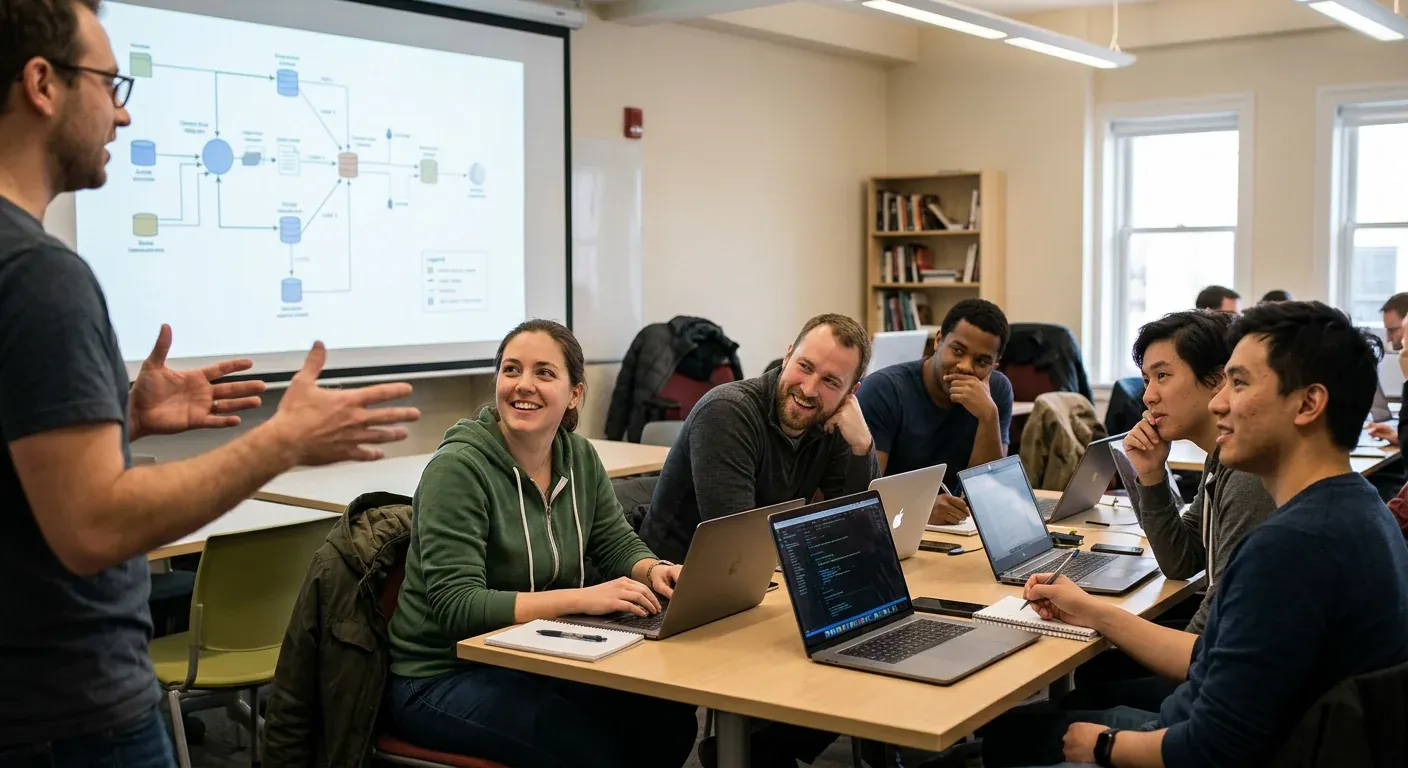
Editorial illustration for Focus on Python to Build Data Science Foundations in First Two Months
Python Mastery: Data Science Skills in First 2 Months
Focus on Python to Build Data Science Foundations in First Two Months
You already know Python. That’s your edge. The temptation is to scatter your attention across a dozen shiny tools, but the fastest path to data fluency is to double down on what you have.
The first two months aren’t about breadth, they’re about depth. Deepen your Python with Pandas and NumPy. Master SQL joins and aggregations until they feel like second nature.
Learn Git because version control isn’t optional. Build a foundation in descriptive statistics, then test everything on a real project: pull a month of public mobility data, clean it, summarise it, and answer a business question like which three stops cause the worst peak-hour delays. That single project will teach you more than a dozen tutorials.
Get this foundation solid, and the machine learning months that follow will make sense, not as magic, but as the next logical step.
You might have written a few loops, maybe even used a library like Pandas. But now you face a common problem. The field of data science is vast, and knowing where to start and, more importantly, what to ignore can feel exhausting.
Python is your lever. The next two months aren’t about mastering every library or memorizing algorithms, they’re about building the muscle memory to take raw, messy data and turn it into a clear answer. That city rides project isn’t a checkbox; it’s a rehearsal for the real world, where data never arrives clean and business questions never come with a schema.
Get comfortable with the discomfort of a broken join, a misaligned index, a missing value that reveals something deeper. Once you can walk through that process without hand-holding, you’ve earned the right to touch machine learning. Because models don’t save you from bad data.
They only amplify it. So double down on Python now, and let the algorithms wait their turn. The foundation you build in these eight weeks will determine how fast, and how far, you can go in the months that follow.
Related Reading
 Open Source
 D&B rebuilds 642 million‑business database after AI agents hit limits
 Open Source
 Box CEO Aaron Levie Says AI Will Drive "Biggest Cybersecurity Upgrade
 Open Source
 Study: 6.7% of Deepfake Requests on Hugging Face Targeted Children
 From Archives
 Team behind continuous batching urges operators to run inference on idle GPUs
 From Archives
 Nvidia's Nemotron 3 Super merges 3‑arch design, MTP to outpace GPT‑OSS, Qwen
Common Questions Answered
Why are the first two months of learning data science critical for newcomers?
The initial two months are crucial because they focus on building fundamental skills to handle real-world datasets independently. During this period, learners develop the ability to pull, clean, and merge data without constant guidance, which is more important than learning flashy new libraries.
What specific skills does the guide recommend mastering in the first two months of data science training?
The guide recommends deepening Python skills with Pandas and NumPy, mastering SQL joins and aggregations, learning Git for version control, and building a foundation in descriptive statistics. These skills are designed to help learners become self-sufficient in data manipulation and analysis.
What is the recommended project for practicing data science skills in the first two months?
The recommended project is a 'city rides analysis' where learners pull a month of public mobility data, clean it, summarize it, and answer a specific business question such as identifying the top three most significant mobility patterns. This project helps practitioners apply their newly learned skills to a real-world scenario.
Further Reading
- Back to Basics Week 1: Python Programming & Data Science Foundations — KDnuggets
- Python for Data Science, AI & Development — Coursera
- Getting Started with Python for Data Science — Codecademy
- Learn Python for Beginners, Python Basics Course — DataCamp
- Learn Python for Data Science – Full Course for Beginners — freeCodeCamp.org
