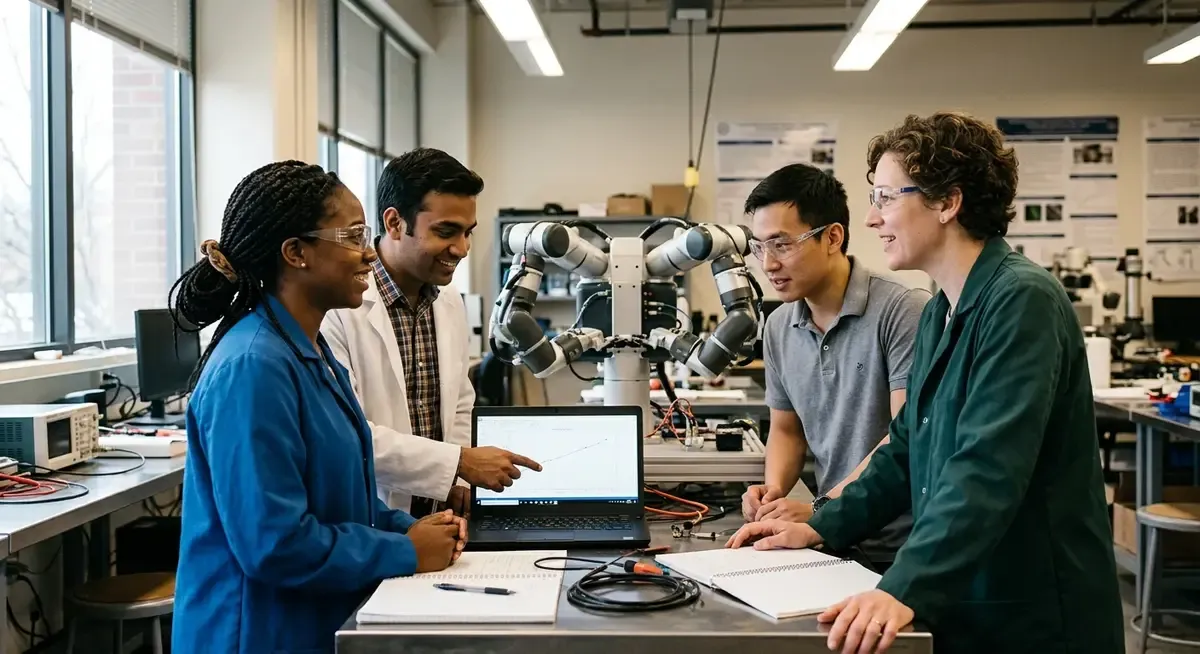
Editorial illustration for Dyna-2 Model Scores Zero-Shot on 39 Robot Tasks After Video Training
Dyna-2 Robot Model Masters 39 Tasks From Video Training
Dyna Robotics says its new Dyna-2 model learned to fold hangers, tie rope and scoop food after training on more than one million hours of egocentric human video, roughly 170 years of continuous footage. No teleoperation required for that stage. That matters because robot learning has been stuck behind a supply problem: action-labelled data only exists because someone deliberately generates it, usually by puppeting a robot arm through thousands of repetitions.
Video, by contrast, is everywhere. Dyna's research team built a data ladder running from 1,000 hours up to a million and tracked what actually improves as the pile grows. They report a scaling law on the human video itself, then, for the first time, show that law carrying over to robot data the model never saw during training.
A third finding points to video prediction as the mechanism doing the work. The company isn't shipping this as a checkpoint or API. Dyna-1 robots already run in hotels, restaurants and laundromats as of an August 10, 2026 announcement, and Dyna-2 follows that same vendor-operated model.
Robot learning has been bottlenecked by action-labelled data, which teleoperation must deliberately produce. Dyna-2 tests whether ordinary human video can substitute. The research team trained a data ladder from 1,000 to 1,000,000 hours and measured what scales.
Why this matters
Dyna-2's real claim isn't that it beat 39 tasks zero-shot. It's that the team found an inflection point, somewhere between 10,000 and 100,000 hours of human video, where scaling starts paying off in robot competence the model never trained on directly. That's a data ladder other labs can now test against their own pipelines, instead of guessing how much teleoperation data they need to collect.
For founders building robotics startups, the pitch is obvious: teleop data is expensive and slow to produce, while human video is everywhere. If Dyna Robotics is right that video is "a separate axis" from action objectives, that reframes what counts as training data in this field entirely. We'd still want to see this replicated outside the YAM and xdof ABC platforms before treating it as settled.
Zero-shot transfer across two bimanual rigs is promising, not proof of generality. Watch whether other teams can reproduce that 10k-100k inflection on different hardware and different video sources. That's the number that decides if this is a real recipe or an artifact of Dyna's particular setup.
Related Reading
 Industry Applications
 Westinghouse teams with Google Cloud to build AI platform for nuclear power
 Industry Applications
 NVIDIA NeMo powers telco reasoning model for autonomous network workflows
 Industry Applications
 Month-1 Agent Adds Holistic Observability with Trace IDs and Token Tracking
 From Archives
 AI Model GeoPT Simulates Physics With 1.3 Million Particle Interactions
 From Archives
 AUP Learning Cloud Adds Browser-Based VS Code to AI Education Platform
Common Questions Answered
How much human video data was used to train the Dyna-2 model?
Dyna-2 was trained on more than one million hours of egocentric human video, which is roughly equivalent to 170 years of continuous footage. This massive dataset eliminated the need for teleoperation during the training stage, addressing a major bottleneck in robot learning.
What specific robot tasks did Dyna-2 achieve zero-shot performance on?
Dyna-2 successfully performed 39 robot tasks in a zero-shot manner after video training, including folding hangers, tying rope, and scooping food. These tasks were accomplished without any direct training on action-labelled data for those specific behaviors.
Why is using human video data better than teleoperation for robot learning?
Human video data is abundant and freely available everywhere, whereas action-labelled data from teleoperation must be deliberately generated by puppeting a robot arm through thousands of repetitions. This makes video training a more scalable and cost-effective alternative to traditional teleoperation-based robot learning approaches.
What inflection point did Dyna-2 researchers discover in their data ladder experiment?
The research team found a critical inflection point somewhere between 10,000 and 100,000 hours of human video where scaling begins to significantly improve robot competence on tasks the model never trained on directly. This discovery provides other labs with a benchmark to test against their own pipelines instead of guessing how much teleoperation data they need to collect.
Further Reading
- Dyna-2: A 1-Million-Hour Scaling Law for World-Action Models - Dyna Robotics
- Dyna-2's Million-Hour World-Action Model - ActionTrajectories
- Dyna Robotics unveils DYNA-2 World-Action Model, demonstrating zero-shot production-level robot performance - AOL
- Dyna-2 Proves Scaling Laws for Robotics: 1 Million Hours of Human Video Unlocks Zero-Shot Dexterity - Humanoids Daily
- Can robots learn by watching people? Dyna trained one on a million hours of video - Kryden
