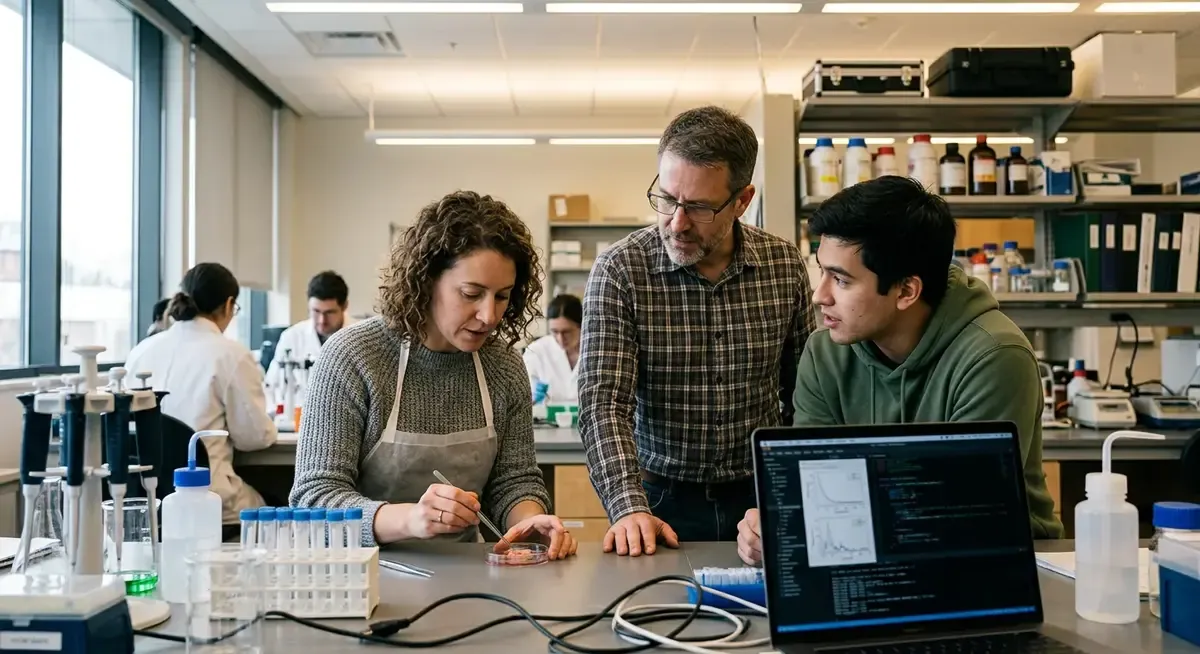
Editorial illustration for Anthropic's Claude Expands Into Protein Design
Claude AI Advances Protein Design Research
Anthropic's Claude Expands Into Protein Design
Four days ago, Dario Amodei posted on X that Anthropic's biology work was still months from producing its first "early glimmers." That timeline just moved up. Anthropic has published new research showing Claude running protein-design campaigns largely on its own, an early and notoriously fiddly step in drug discovery that normally eats up weeks of a research team's time.
The setup was simple by Anthropic's account: one expert-written prompt, internet access, some tools, and then the models were left to work. Anthropic tested two versions, Mythos Preview and Opus 4.8, and didn't touch the physical lab work itself. That part went to Twist Bioscience and Adaptyv Bio, which built the actual candidate molecules and measured whether they did what the models predicted.
The results, spanning 15 different target proteins, are what's drawing attention this morning, not because Anthropic is claiming a cure for anything, but because the success rates reportedly cleared what human-led design efforts typically manage. Here's how Anthropic framed what happened next.
Claude just added protein design to its already lengthy resume, with new research showing the models running an early step of the drug discovery pipeline on their own and producing results that held up in the lab.
Why this matters
Amodei's "months away" line aged fast. If Claude can already run a step of the drug discovery pipeline and get lab-confirmed results, the timeline for AI touching real biology work just moved up, whether Anthropic planned to announce it this week or not. For researchers, that's the headline: a general-purpose language model doing something that used to require a specialized computational biology stack, and doing it well enough to survive wet-lab scrutiny.
For founders in biotech and drug discovery, the calculus on build-versus-buy just shifted again, and probably not in favor of narrow, single-purpose tools. For developers, it's another data point that "foundation model" increasingly means "foundation model plus whatever domain you're willing to point it at." We'd push back on reading too much into one early step of one pipeline; drug discovery has failed plenty of confident-looking shortcuts before. But the gap between Anthropic's public timeline and its actual output is worth tracking closely, because it tells you more about what's coming than the press release does.
Related Reading
Browse all Anthropic news → Research & Benchmarks
 Microsoft AI Chief: "If It Isn't Safe We Shouldn't Build It
 Research & Benchmarks
 Google's FACTS benchmark shows 70% factuality ceiling across four tests
 Research & Benchmarks
 Nvidia's DLSS 4.5 beta adds 6x Multi Frame Generation for RTX 50 GPUs
 Related Topic
 Claude gains shared context in Excel, PowerPoint; Microsoft adds Copilot Cowork
AI Tools & Apps
 Related Topic
 Anthropic: Hackers Stole Claude Tokens Via Compromised Session Key
LLMs & Generative AI
 From Archives
 OpenAI Revokes Access to Limited Cyber Program Daybreak Blue
 From Archives
 GLM-5.3 Jumps 246 Points on Key Benchmark, Ranks Second to Claude Opus
 From Archives
 Coders Find Workarounds to Claude's Invisible Watermarks
LLMs & Generative AI
 From Archives
 Anthropic Overtakes OpenAI in Quarterly Revenue as Costs Hit Margins
Business & Startups
Common Questions Answered
What specific capability did Anthropic's Claude demonstrate in protein design?
Claude successfully ran protein-design campaigns largely autonomously, completing an early and typically time-consuming step in the drug discovery pipeline that normally requires weeks of research team effort. The model was given just one expert-written prompt, internet access, and some tools to accomplish this task, demonstrating its ability to handle complex biological workflows independently.
How did Anthropic's protein design timeline compare to Dario Amodei's previous prediction?
Dario Amodei had stated four days before the announcement that Anthropic's biology work was still months away from producing early results, but the company published research showing Claude already running protein-design campaigns with lab-confirmed results. This represented a significant acceleration of the previously stated timeline for AI involvement in biological research.
What makes Claude's protein design work significant for the biotech industry?
Claude demonstrated that a general-purpose language model could perform specialized computational biology tasks that previously required dedicated computational biology stacks, and produce results robust enough to survive wet-lab validation. This breakthrough suggests that AI can now meaningfully contribute to real drug discovery work, potentially accelerating research timelines for biotech founders and researchers.
Why is protein design considered a challenging step in drug discovery?
Protein design is described as an early and notoriously fiddly step in drug discovery that normally consumes weeks of a research team's time, making it a significant bottleneck in the development process. Claude's ability to automate this step demonstrates how AI can address one of the most time-intensive phases of pharmaceutical research.
Further Reading
- How Claude is accelerating protein design and analytical chemistry workflows - Anthropic
- Case study: Benchmarking Claude's protein designs in the wet lab - Adaptyv Bio
- Anthropic tests Claude to design protein binders for drug research — here's how it turned out - CNBC TV18
- Anthropic says 354 Claude protein designs bound in lab tests - RuntimeWire
- Anthropic/claude-protein-binder-design · Datasets at Hugging Face - Hugging Face
