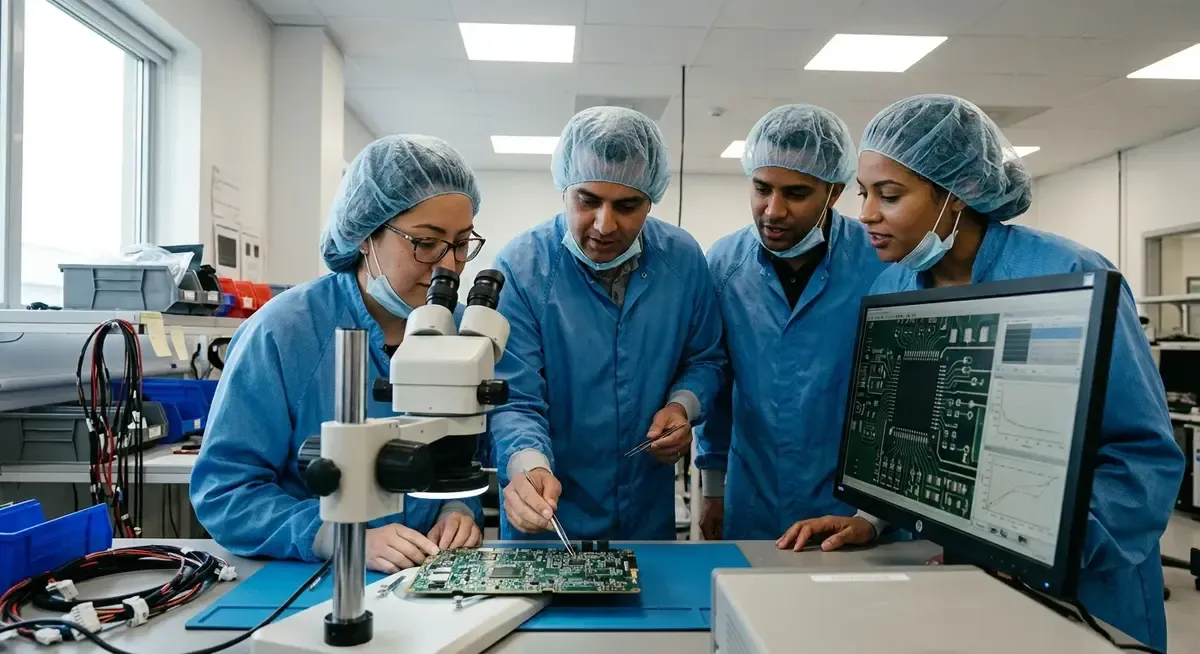
Editorial illustration for AI's Proofs Risk Solving Math Without Understanding
AI Solves Math Problems Without True Understanding
AI's Proofs Risk Solving Math Without Understanding
OpenAI announced this month that a swarm of thousands of AI agents had cracked the Navier-Stokes existence and smoothness problem, one of the seven Millennium Prize puzzles that have stumped mathematicians for decades. The claim landed like a gut punch in a field that had assumed itself insulated from the disruption already hitting musicians and actors. Suno can now churn out elevator music indistinguishable from the real thing.
Tilly Norwood, an AI-generated performer, delivers scripted one-liners in customer-service ads. Juspreet Singh Sandhu, a mathematician at Colorado State University, put it bluntly: "The artists and the musicians have already gone through this." What makes the Navier-Stokes case sting differently is what it exposes about how mathematics actually works. Despite the stopwatch drama of high school exams, mathematicians rarely prize speed.
The real work looks less like calculation and more like invention, closer to designing a puzzle than solving one. OpenAI's approach, throwing enormous computational force at the problem, skipped that slow, deliberate process entirely. The question now is whether a correct answer, arrived at without the human reasoning behind it, actually counts as understanding.
From Suno composing uncanny elevator music to Tilly Norwood delivering customer-service-inflected one-liners, artificial intelligence has rattled creative industries. You can add math to the list after OpenAI said that, using thousands of agents, it had solved a decades-old puzzle known as the Navier-Stokes existence and smoothness problem.
Why this matters
For developers and researchers building on top of these systems, Sandhu's warning deserves more attention than it's getting. OpenAI's Navier-Stokes claim is a milestone worth noting, but the advisory group formed "this week" is a tell: even OpenAI seems uneasy about what thousands of agents tearing through a proof actually produces. Speed and correctness aren't the same thing as understanding, and math has historically been a discipline where the path to a result matters as much as the result itself.
If we start treating machine-generated proofs as equivalent to human ones without grappling with that difference, we risk building research pipelines on foundations nobody can fully explain, verify, or extend. That's a problem for anyone downstream, from grad students trying to learn from these proofs to engineers relying on formal verification in safety-critical systems. Musicians and actors already watched AI flatten craft into output.
Mathematicians are now the test case for whether a field can absorb that shift without losing the thing that made it rigorous in the first place. Watch who ends up on that advisory panel, and what they actually get to decide.
Related Reading
 Research & Benchmarks
 Microsoft AI Chief: "If It Isn't Safe We Shouldn't Build It
 Research & Benchmarks
 Google's FACTS benchmark shows 70% factuality ceiling across four tests
 Research & Benchmarks
 Nvidia's DLSS 4.5 beta adds 6x Multi Frame Generation for RTX 50 GPUs
 From Archives
 Law Professor Outlines Negligence Claim Against OpenAI
 From Archives
 Fireworks AI's Ember-1 Uses 40% Fewer Tokens Than Kimi K3
Common Questions Answered
What is the Navier-Stokes existence and smoothness problem that OpenAI's AI agents reportedly solved?
The Navier-Stokes existence and smoothness problem is one of the seven Millennium Prize puzzles that have remained unsolved by mathematicians for decades. OpenAI announced this month that a swarm of thousands of AI agents had cracked this long-standing mathematical challenge, marking a significant claim in the field.
Why does the article argue that speed and correctness in AI proofs may not equal mathematical understanding?
The article emphasizes that the path to a mathematical result matters as much as the final answer, and that speed and correctness are not the same thing as true understanding. This distinction is particularly important in mathematics, where the methodology and reasoning behind a proof are historically valued components of the discipline.
What does OpenAI's formation of an advisory group suggest about their confidence in AI-generated proofs?
The fact that OpenAI formed an advisory group this week to address concerns about AI proofs suggests that even OpenAI itself appears uneasy about what thousands of agents tearing through a proof actually produces. This indicates uncertainty about whether AI-generated solutions truly represent genuine mathematical breakthroughs or merely computational results.
How has AI already disrupted creative industries according to the article?
AI has already impacted creative fields through tools like Suno, which can generate elevator music indistinguishable from human-created compositions, and AI-generated performers like Tilly Norwood who deliver scripted content. The article uses these examples to illustrate how AI disruption has extended beyond creative industries to now potentially affect mathematics.
Further Reading
- AI solved one of math's hardest problems. Humanity learned nothing (so far) - NPR
- Mathematicians Can't Make Sense of How OpenAI's Agents Solved One of the Toughest Math Problems Because the AI's Proof Is Borderline Incomprehensible - Futurism
- Will AI solve math too fast? - IBM Think
- AI may have solved one of math's biggest puzzles, raising questions about what was actually understood - Science News
- AI has solved one of maths' $1 million Millennium Prize problems - Quanta Magazine
