
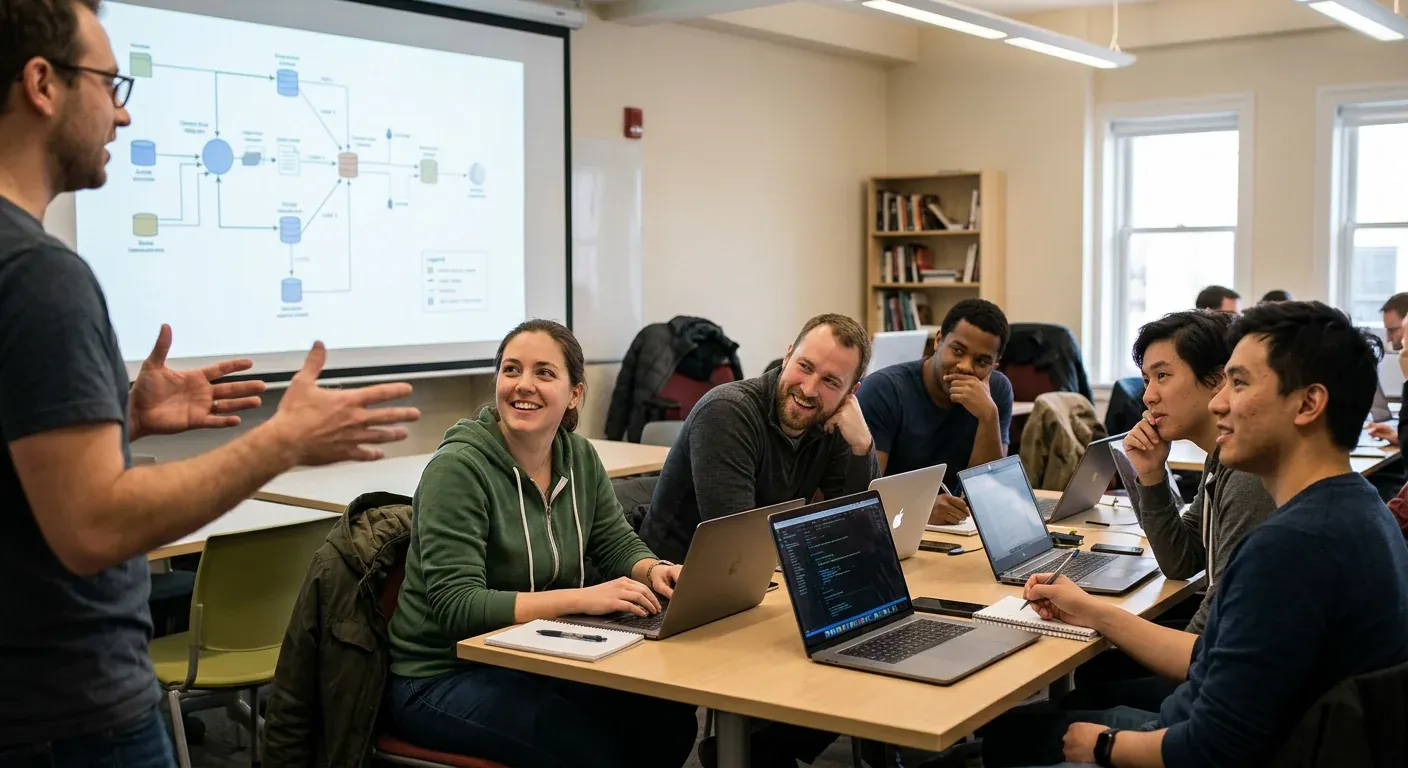
Editorial illustration for AI research increasingly relies on recursive loops, a staple of CS basics
AI research increasingly relies on recursive loops, a...
Every comp-sci freshman learns recursion: a function calls itself, cracks a problem, and stops. That's the textbook version. Step inside an AI lab today, and that neat, predictable structure has shattered.
The loops have gained a will of their own. Take the new AI agent developed by researchers at Stanford: it now decides when to halt its own process or launch a new copy. No programmer fully hard-coded that internal logic.
This shift from rigid rule to fluid judgment wasn't a design triumph. It simply emerged, as detailed in a recent TechCrunch report, the moment we started asking one AI to manage another.
Recursive loops -- functions that call themselves in order to repeat an action, along with a condition that stops the loop -- are a mainstay of intro computer science courses. These loops are following a non-deterministic logic -- that is, it's a sub-agent that chooses when to stop the loop instead of a clear condition -- but the same basic approach is at work. As soon as programmers started using AI to complete tasks, some version of the recursive loop, with AI overseeing AI, was bound to come up. Unlike classic computing, agentic loops can be maddeningly simple.
The practical outcome is visible in systems like Google’s recently unveiled Gemini "self-critique" module. The machine logic here mirrors organic thought more than silicon calculation. Real intelligence isn't a straight line.
It's messy. Iterative. A constant, loopy process of self-checking and revision.
By stumbling into these self-referential cycles, AI isn't revealing a bug. It's groping toward a better model of reasoning itself. So the pressing question isn't about the code's syntax anymore.
It's about what builds itself inside those endless loops. We're not just watching a program run. We're watching a process learn to think.
Related Reading
 Open Source
 D&B rebuilds 642 million‑business database after AI agents hit limits
 Open Source
 Box CEO Aaron Levie Says AI Will Drive "Biggest Cybersecurity Upgrade
 Open Source
 Study: 6.7% of Deepfake Requests on Hugging Face Targeted Children
 From Archives
 Amazon MGM shelves Luca Guadagnino’s Sam Altman film starring Andrew Garfield
 From Archives
 Anthropic shuts down Fable 5 and Mythos 5 models amid White House dispute
Common Questions Answered
How does the Stanford AI agent's approach to recursive loops differ from traditional computer science methods?
Unlike the textbook version where a function calls itself with predetermined stopping conditions, the Stanford AI agent decides autonomously when to halt its own process or launch a new copy without rigid programmer-defined logic. This represents a shift from rigid rule-based structures to fluid, self-directed judgment that wasn't fully hard-coded by developers.
What is Google's Gemini 'self-critique' module and how does it use recursive logic?
Google's Gemini self-critique module employs machine logic that mirrors organic thought processes rather than traditional silicon calculation. The system uses recursive, self-referential cycles for constant self-checking and revision, demonstrating how AI can iteratively improve its reasoning through repeated evaluation loops.
Why are AI researchers moving away from predictable recursive structures toward self-referential cycles?
AI researchers are discovering that real intelligence operates through messy, iterative processes rather than straight-line logic, making self-referential cycles more effective for reasoning. By embracing these loopy, self-checking processes, AI systems can better model how organic thought actually works, groping toward improved reasoning models rather than relying on predetermined algorithmic structures.
Does the emergence of autonomous recursive loops in AI systems represent a programming error or a breakthrough?
The development of self-directed recursive loops in AI is not a bug but rather a breakthrough in how machines approach reasoning and problem-solving. These autonomous cycles represent AI systems stumbling toward a better model of reasoning itself, moving closer to how biological intelligence actually operates through constant revision and self-critique.
Further Reading
- When AI builds itself — Anthropic
- Recursive Language Models: the paradigm of 2026 — Prime Intellect
- Model collapse when training on recursively generated data — Nature
- Will We See AI with Recursive Self Improvement in 2028? Likely Not. — Hash Collision
- Autoresearch: Sparks of Recursive Self Improvement — Latent Space
